
Potentially explosive hazardous environments demand intrinsically safe electronics.
Most designers are familiar with ruggedness mandates regarding temperature, vibration, heavy use or abuse, and dirt/dust in the context of military, aerospace, automotive, and even some consumer products. However, there’s another special design mandate with which most are less familiar but is also very important: intrinsically safe designs.
These designs are required whenever and wherever there is a chance of explosion and subsequent fire due to the conditions in the ambient atmosphere. While some of the concerns are obvious — such as fumes from hydrocarbons (gasoline, methane, hydrogen, among others) — there is also a very real danger of explosion from fine particles in the air (metal and metal alloys, charcoal, carbon black, flour, plastics, grains, and wood).
Strict standards were established many years ago by insurance companies to allow safe interaction with electronic circuitry. Subsequently, these standards evolved and were adopted as safety requirements and mandates with full legal impact.
This FAQ will look briefly at aspects of what are termed intrinsically safe (IS) designs. The subject is simple in concept but extremely complicated in its implementation. Designers who are not experienced with its many strictures and subtleties almost always rely on an expert on staff or call in a specialized consultant to ensure they are doing the planning, analysis, and execution properly before they apply for formal approvals. This FAQ will focus on electronic aspects of intrinsically safe designs, as thermally induced risk from system-level overheating into a danger zone is low. Still, there are exceptions for extremely sensitive scenarios and materials.
Q: What does intrinsically safe actually mean?
A: In simple terms, it means that the piece of equipment itself can’t cause an explosion due to excessive electrical or thermal energy (temperature). Intrinsically safe devices will generally have simplified circuitry, controlled internal temperatures, and high dust resistance, making it impossible for the device to initiate a fire or spark an explosion.
These devices are built so they physically can’t trigger combustion when used in a hazardous environment. To do this, an electrical “barrier” separates IS from non-IS circuitry (Figure 1).
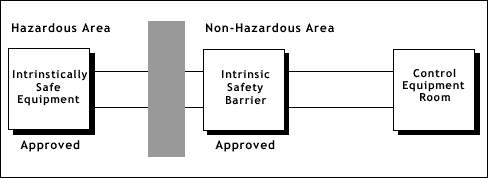
Even an innocent-looking PC board can be a problem if a component failure allows a higher voltage or energy spark to jump across the fault.
Q: Is intrinsically safe the same as explosion-proof?
A: No. Explosion-proof means that if an explosion did happen, the device would be protected by an explosion-proof enclosure that helps contain the explosion and prevents it from spreading. Think of it this way: intrinsically safe refers to explosion prevention, whereas explosion-proof refers to containment.
Explosion-proof devices don’t have to be innately incapable of igniting in a hazardous environment (but they may be). Instead, explosion-proof devices are housed in an enclosure that effectively contains the explosion. If the device inside the enclosure does explode, the flames and gases cannot escape and spread to other areas of the facility.
Q: Which is preferred: explosion-proof or intrinsically safe?
A: Explosion-proof devices are usually heavier, bulkier, and more time-consuming to install, making them better suited to permanent installations rather than limited space or mobile ones. Intrinsically safe devices are often lighter and less bulky than explosion-proof devices.
They can also be more easily maintained without shutting down production. Explosion-proof equipment is best suited for permanent installations that demand high voltage and power. Intrinsically safe devices can be used for permanent installations and nearly all portable instrumentation. However, the final answer is determined by the specifics of the installation and regulations.
Q: Exactly what are intrinsic safety and intrinsically safe?
A: Intrinsic safety is a low-energy signal and power-transfer technique that prevents explosions by ensuring that the energy transferred to a hazardous area is well below the energy required to initiate combustion and a possible explosion. These low energy levels are small but usable and more than adequate for most instrumentation systems.
Q: How is it formally defined?
A: Formally, the definition of intrinsic safety used in the relevant IEC Apparatus Standard IEC 60079-11 is a “type of protection based on the restriction of electrical energy within apparatus and of interconnecting wiring exposed to the potentially explosive atmosphere to a level below that which can cause ignition by either sparking or heating effects.” (There are many other related and applicable standards, of course.)
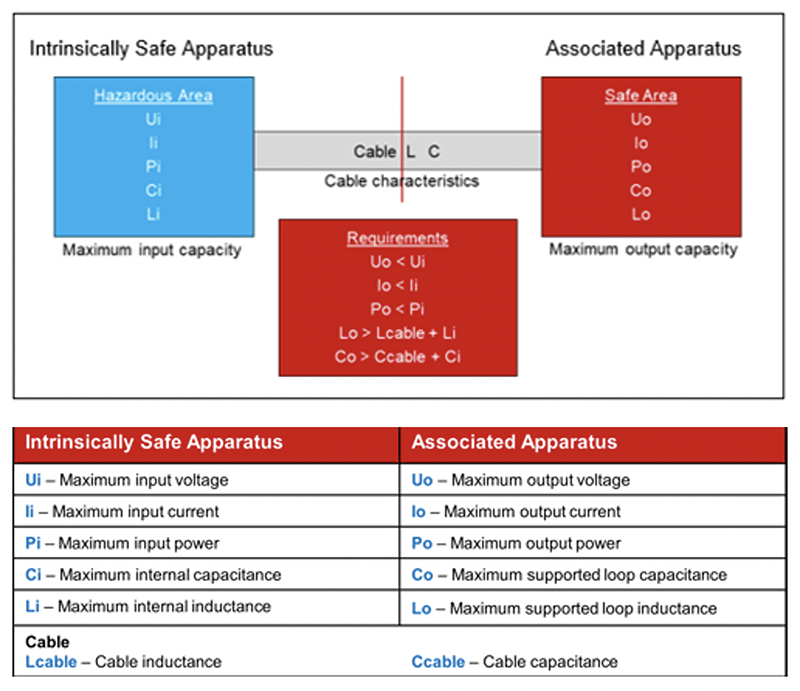
Note that as the pieces of intrinsically safe apparatus are interconnected, the safety of the overall system must still be established. A typical intrinsically safe circuit or IS loop consists of three main components that must be considered (Figure 2):
- Intrinsically safe apparatus: certified field devices installed in the hazardous area.
- Associated apparatus: devices installed in the safe area that interface with devices in the hazardous area, such as the IS barrier.
- Field wiring: compatible interconnecting cable.
Q: Is there a single level of intrinsic safety?
A: No, the classification begins but does not end with the three primary levels: “ia” (most stringent), “ib,” and “ic” (least stringent). Determining which level applies is often a challenge. There are also different sub-classifications that look at risk level and different sections of the path from risk area to control electronics, temperature, use, and more. It all gets very complicated (Figure 3).


Q: Is that all there is with respect to groupings?
A: Of course not. There are also sub-groups for the specific possible hazards of gas and temperature and other factors (Figure 4). There’s no doubt that it gets very complicated.
Q: Once those assessments and determination are made, what are some of the other steps?
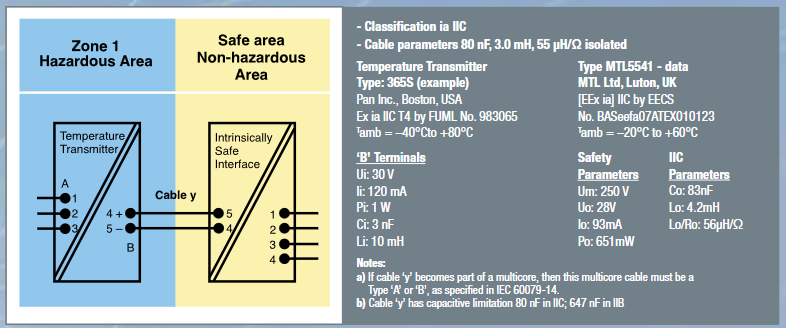
A: The specific proposed scenario must be analyzed in detail regarding voltage, current, resistance, capacitance, and many other energy-related factors (Figure 5).
Q: What sort of voltage, current, and power numbers are we looking at?
A: Defining the maximum level of available power is complex, but generally, it means voltages less than 29 V and under 300 mA. A simpler view is to say that power must be less than 1.3 W. Note that much instrumentation requires 24 V and can often be designed to draw and operate from less than 500 mA.
That moderate power level is sufficiently low to meet IS certification in many situations. However, it is not a “firm” boundary, and there are many exceptions and complicating factors.
Q: Which regulatory bodies set the standards?
A: Within the European Union, equipment must be what is called, “ATEX certified” where ATEX is an abbreviation for the ATEX Directive and is short for “Atmospheres Explosibles”. While such ATEX certification is required in Europe, there is also an IECEx certification, which is recognized internationally across various countries. Although IECEx is widely accepted, some country-specific certifications may be required. In the US, it is UL (Underwriters’ Laboratory) in conjunction with ANSI and organizations such as Factory Mutual Corp (FMC).
The next part looks at some specifics related to the electronics of intrinsically safe designs.
Related EE World content
Intrinsically safe meters simplify mechanical, electrical bond testing
Intrinsically-safe LVDTs for hazardous and explosive environments
Fast-acting fuses protect barrier circuits in intrinsic safety applications
Magnetic target switch designed for ready-to-install position sensing
Varistors give intrinsically safe overvoltage protection
Humidity/temperature transmitters handle hazardous environments
Avoiding electrical hazards in the lab and repair shop
20 mA current loops, Part 2: Advanced features
Gas-discharge tubes protect circuit from transients to 600 V
External references
Omega Engineering, “What does intrinsically mean?”
Wikipedia, “Intrinsic Safety”
RealPars B.V., “What is Intrinsically Safe?”
EICS Technology, “Marking”
Matric Group, “What Is Intrinsically Safe Equipment?”
Matric Group, “ ‘Intrinsically Safe’ Design Guidelines for Electrical Devices”
Vaisala, “Q&A about intrinsically safe measurement devices”
Eaton/MTL, “AN9003 – A Users Guide to Intrinsic Safety” (lengthy but very informative)
Pruftechnik, “Intrinsically Safe vs. Explosion Proof: What’s the Difference?”
Industrial-Scientific, “What is Intrinsic Safety?”
PR Electronics, “Understanding intrinsic safety”
PR Electronics, “Isolated barriers vs. Zener barriers”
PR Electronics, “Difference between a Zener barrier and an intrinsically safe isolator”
Fluke Corp., “Intrinsically safe test tools for hazardous areas”
Fluke Corp, “Fluke 28 II Ex Intrinsically Safe True RMS Digital Multimeter”
Intrinsically Safe Store, “Intrinsically Safe Phone Cases”