
AI battery thermal management now relies more on models that are primarily data-driven. Physics-based thermal models are accurate under controlled conditions but cannot adapt in real time to the variable loads, charge rates, and degradation states EV batteries encounter in service.
This technical FAQ discusses how AI thermal models compare to physics-based approaches and which deep learning architectures engineers are deploying in BMS.
How do AI thermal models compare to physics-based approaches for cell temperature estimation?
Physics-based thermal models rely on fixed nodal structures to compute temperature distribution within the cell. A Thermal Equivalent Circuit Model (TECM) uses a predefined set of nodes representing the cell geometry to solve heat equations at each timestep. This approach is accurate under predefined conditions but carries a computational cost that scales with model resolution.
Adapting a TECM to new cell geometries or operating conditions requires recalibration, making it poorly suited to the dynamic demands of real-time BMS operation.
Data-driven models take a different approach. An Artificial Neural Network (ANN) learns thermal behavior directly from operational data and bypasses the need to solve physics equations at each timestep. Figure 1 compares both architectures within the same real-time framework.
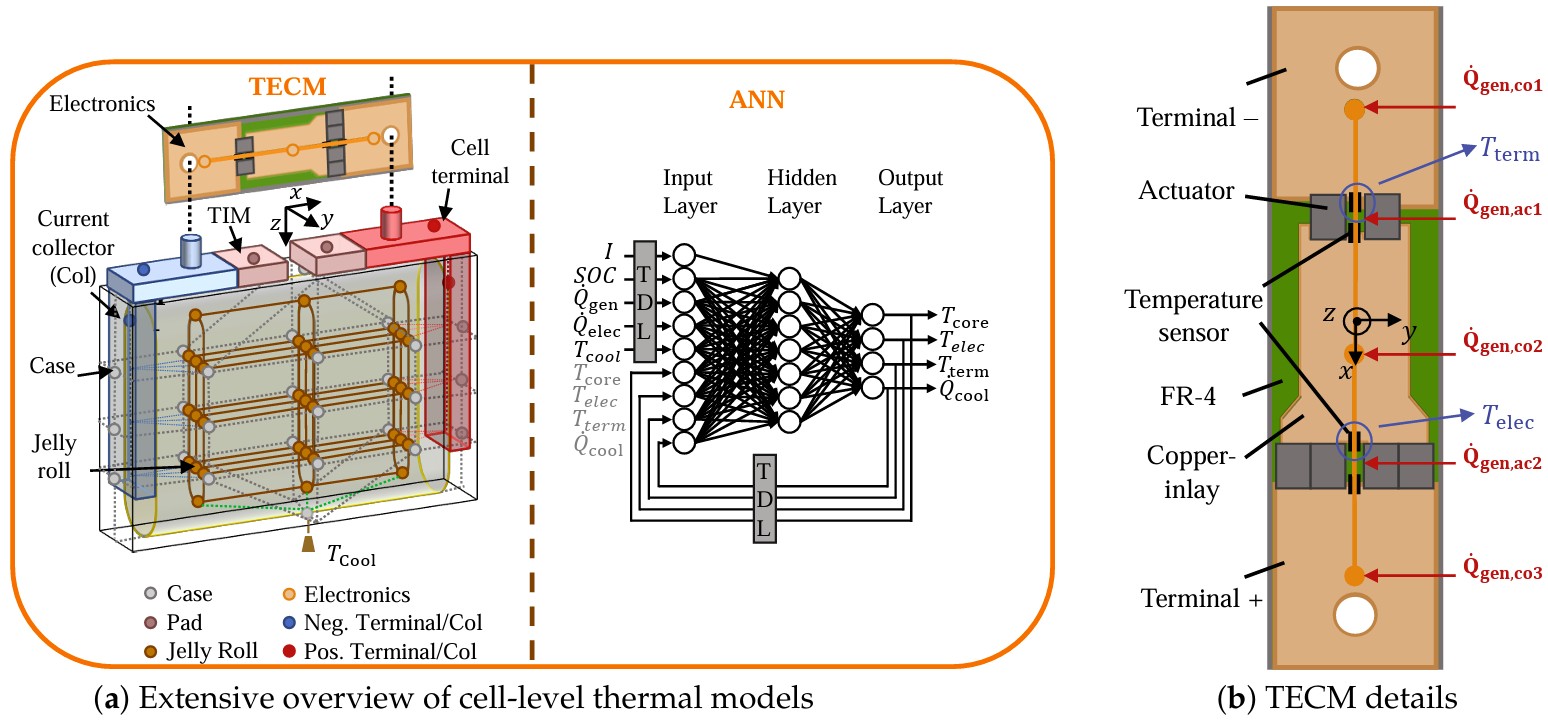
The TECM uses 33 internal nodes confined to the jelly roll interior, arranged as a 3×3×3 cuboid core of 27 nodes, with three above and three below to capture the curved geometry. Casing, current collector, and terminal nodes are additional and separate.
The ANN trains on six standard driving cycles, ECE, EUDC, US06, RTS95, FTP72, and Artemis Motorway, covering static, dynamic, fast charging, and cooling load profiles. The ANN runs at 10 ms per timestep, half the TECM’s 20 ms. Root Mean Square Error (RMSE) measures 0.08 K against the TECM’s 0.23 K, nearly three times more accurate.
Which deep learning architectures are engineers deploying in advanced battery management systems?
Selecting the right deep learning architecture for a BMS application depends on the estimation task, the available training data, and the computational budget of the target hardware. SOC estimation sits at the center of thermal management.
Accurate charge state tracking allows the BMS to anticipate heat generation under different load conditions and adjust cooling or charge rates before temperatures drift outside the safe operating window.
No single architecture dominates across all BMS tasks. Each has a defined performance envelope, and engineers need benchmark data across relevant operating conditions to make informed selections. Table 1 shows four architectures in active use, with measured accuracy across SOC estimation tasks.
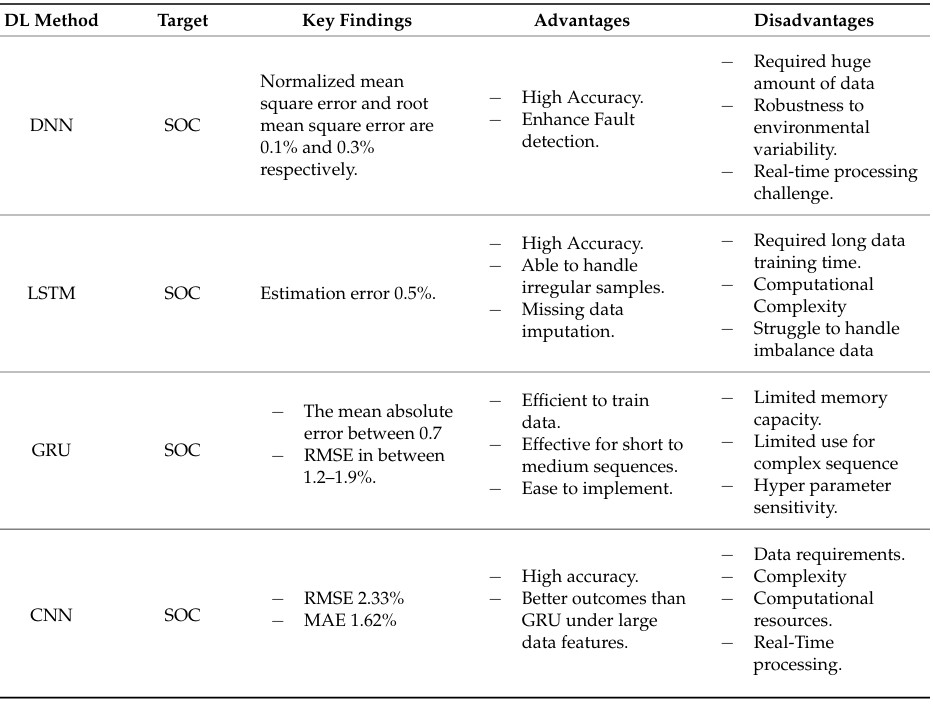
Deep Neural Networks (DNNs) deliver the highest SOC estimation accuracy, with a normalized mean square error (NMSE) of 0.1% and an RMSE of 0.3%. Long Short-Term Memory (LSTM) networks handle irregular samples and missing data imputation, a practical requirement when sensor gaps occur during real-world driving.
Gated Recurrent Units (GRUs) trade some accuracy for lower computational overhead, a practical tradeoff for cycle-level thermal forecasting over short to medium prediction sequences. Convolutional Neural Networks (CNNs) return an RMSE of 2.33% and a mean absolute error (MAE) of 1.62%, outperforming GRUs when feature datasets are large.
All four architectures require large training datasets and impose high computational costs at deployment. Engineers evaluating these architectures for embedded BMS hardware need to balance estimation accuracy against the memory and processing constraints of the target ECU.
Connecting an AI diagnostic system’s thermal data to battery degradation and health monitoring
Sustained operation above the optimal temperature window accelerates electrolyte decomposition, increases internal resistance, and triggers lithium plating during fast charging.
An AI diagnostic system that integrates thermal data with other electrochemical signals detects these signatures earlier than threshold-based monitoring alone. Figure 2 illustrates the full diagnostic pipeline, from on-board sensor data to health output.
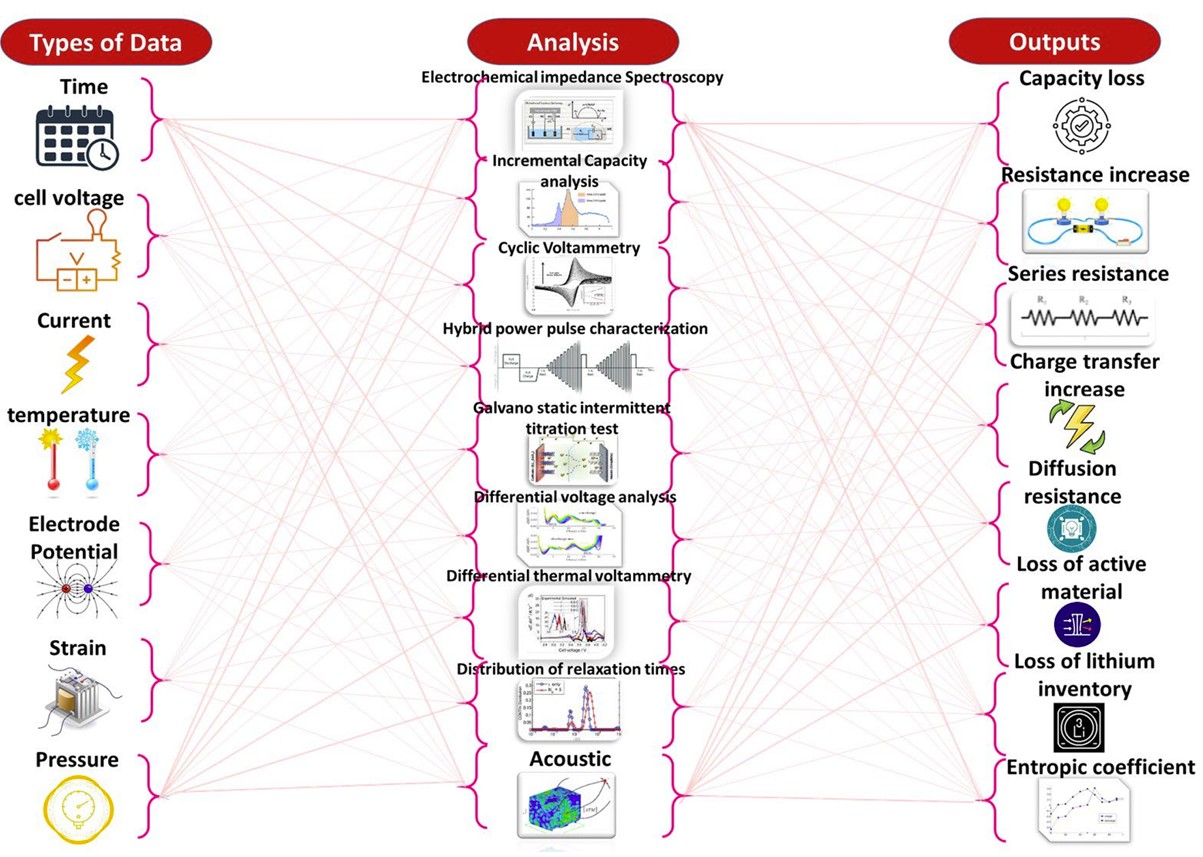
The system processes seven data inputs, specifically time, cell voltage, current, temperature, electrode potential, strain, and pressure. Thermal data is one of seven interconnected signals, consistent with how integrated production BMS architectures must be structured.
From this multi-channel input, the AI layer identifies three specific failure signatures. Those are capacity degradation, resistance increase, and material failure, the exact degradation modes that uncontrolled temperature directly accelerates. The output is actionable health state data that enables early fault detection before conditions escalate toward thermal runaway.
Summary
Physics-based thermal models established the foundation for BMS design. AI-assisted models are now changing how the BMS predicts and responds to thermal state in real time, with measurable gains in estimation accuracy, processing speed, and diagnostic depth.
The three sections of this article trace that progression. They cover a cell-level model comparison, a catalog of deep learning architectures in production BMS, and an AI diagnostic pipeline linking thermal data to battery health. Deploying these models at the edge, inside BMS hardware, where latency and compute constraints apply, is the next engineering challenge.
References
Artificial Intelligence and Digital Twin Technologies for Intelligent Lithium-Ion Battery Management Systems: A Comprehensive Review of State Estimation, Lifecycle Optimization, and Cloud-Edge Integration, Batteries, MDPI
Artificial Intelligence Approaches for Advanced Battery Management System in Electric Vehicle Applications: A Statistical Analysis towards Future Research Opportunities, Vehicles, MDPI
Advanced Monitoring and Prediction of the Thermal State of Intelligent Battery Cells in Electric Vehicles by Physics-Based and Data-Driven Modeling, Batteries, MDPI
EEWorld Online related content
Hot topic: Electric vehicle components get more sophisticated thermal models
EV battery thermal management challenges
Battery Management Systems: effective ways to measure state-of-charge and state-of-health
How can simulation improve EV battery thermal design? – EV Engineering & Infrastructure
Q&A: What is the role of AI in EV battery management systems?
What is an EV battery state of charge (SOC)?