
Considered too expensive to deploy at scale in mobile networks, mmWave technologies are appearing in other use cases.
When 3GPP added mmWave to cellular standards starting with Release 15, the first for 5G, the telecom industry hyped mmWave (24 GHz, 28 GHz, 39 GHz, and 52 GHz) as the future of mobile wireless. Wireless operators began advertising blazingly fast downloads, expecting consumers to pay for it. Something, however, went wrong.
While mmWave channel bandwidths can reach 1 GHz, a vast improvement over LTE and even 5G sub-6 GHz, physics and deployment costs intruded. The short distances, say 100 m, and signal attenuation from trees, buildings, glass, and so on required carriers to install huge quantities of small cells. While several companies jumped into mmWave by offering various kinds of repeaters, ultimately the carriers couldn’t justify the massive cost. Some deployment did occur, mostly in cities with a high density of users. The telecom pundits declared mmWave dead.
If your only perspective comes from mobile handsets, then I agree that mmWave is dead. Indeed, I’ve heard no talk of mmWave in the 6G conversations other than perhaps for Integrated Sensing and Communication (ISAC). That said, mmWave lives in commercial applications, and not just in radar and satellites.
If there’s one mobile application where mmWave has taken hold in the mobile business, it’s at stadiums and arenas where thousands of users want to connect all at once, though they are not very mobile. Figure 1 demonstrates how multiple mmWave beams connect users in a hockey arena. That’s where mmWave signals make sense for mobile use. Not only can 5G mmWave connect thousands of users, but it delivers those connections with lower latency than is possible with lower-frequency 5G signals.
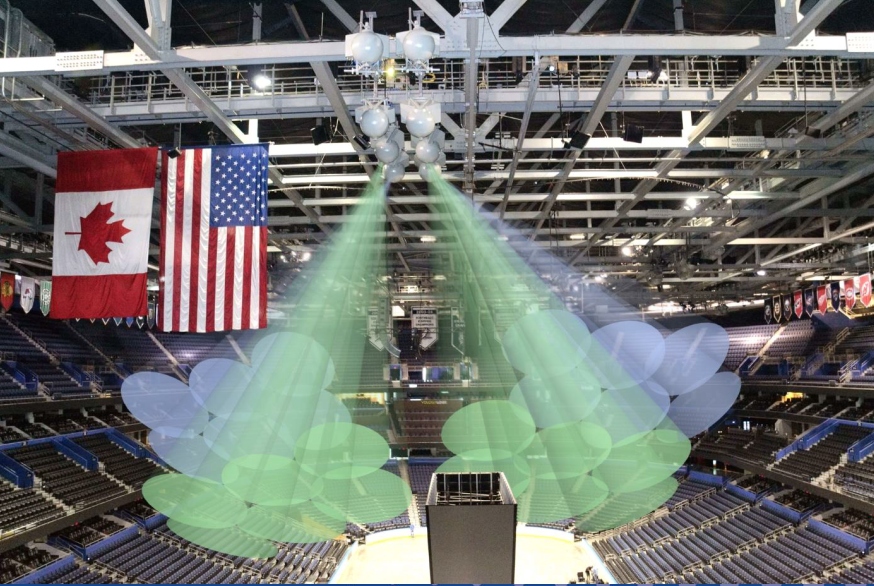
No mobility
Fixed-wireless access (FWA) internet access shows promise for mmWave signals. Carriers in many countries use mmWave for FWA. In the U.S., Verizon, AT&T, and T-Mobile, as well as Canadian carriers Rogers, Telus, and Bell, all deliver FWA over mmWave. Not all deployments use mmWave, as many also use sub-6 GHz connections.
Initially, FWA wireless connections from a tower to a home or business used 5G radios. That’s changing. Furthermore, FWA is also gaining ground in developing countries where the cost of equipment is the major barrier.
“People are building different solutions to address FWA,” said Movandi’s Maryam Rofugaran. “Many of them use millimeter wave front ends with Wi-Fi instead of 5G. Rofugaran noted that in India, FWA modems are using 60 GHz carrier frequencies.
“There’s worldwide interest in mmWave FWA,” added Qorvo’s Pete Moosbrugger, “particularly in developing countries, because you don’t have to bury a lot of cable.”
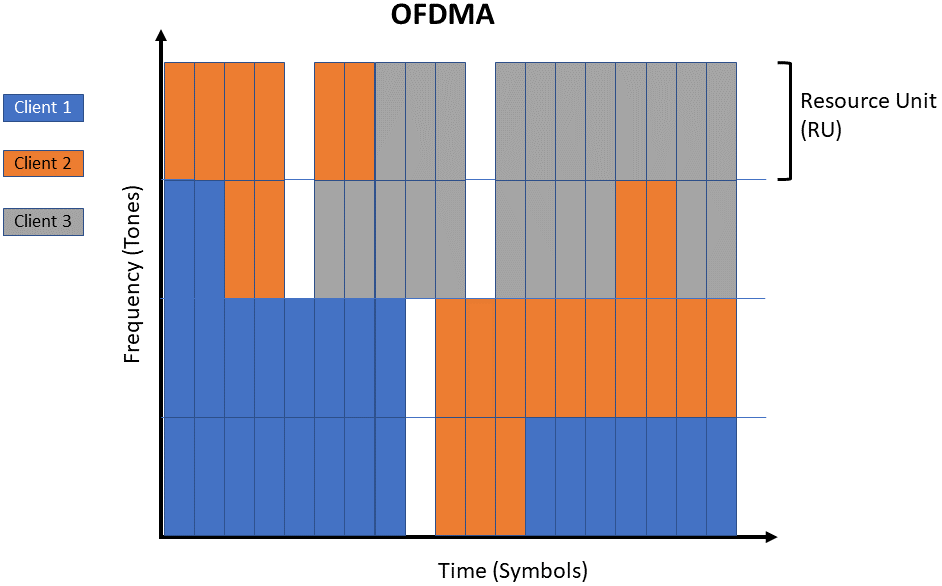
To reduce costs for both base stations and user equipment, FWA radios are starting to use Orthogonal Frequency Division Multiple Access (OFDMA) modulation used in Wi-Fi 6 and later versions. Figure 2 shows the structure of OFDM with its symbols and subcarriers.
In addition to using OFDMA, FWA radios also rely on beamforming to serve multiple users. Beamforming uses phased-array antennas to direct beams between a base station and a client. Beamforming is especially useful in mmWave communications due to the short distances and signal attenuation. Focusing the signal leads to stronger signals where they are needed.
“A phased array can provide a very focused beam with a 10° beam width,” noted Moosbrugger. “You can really focus the energy with a phased array. At mmWave frequencies, the wavelength of a phased array’s individual antenna elements is also very small. For example, they fit on a 3 in. by 3 in. circuit board.”
As late as 2025, EEWorld reported that one manufacturer of FWA equipment found difficultly on procuring components due to few suppliers. That’s changing, according to Moosbrugger. Companies including Qorvo and Movandi are supplying beamformers, amplifiers, up/down converters, front-end modules, and other active components.
Beyond communications
Many of the commercial use cases for mmWave focus on communication, but there are many others. One example is using mmWaves at airports for passenger screening. With mmWaves, a screening system from Rohde & Schwarz can detect both metallic and non-metallic objects that people might be carrying.
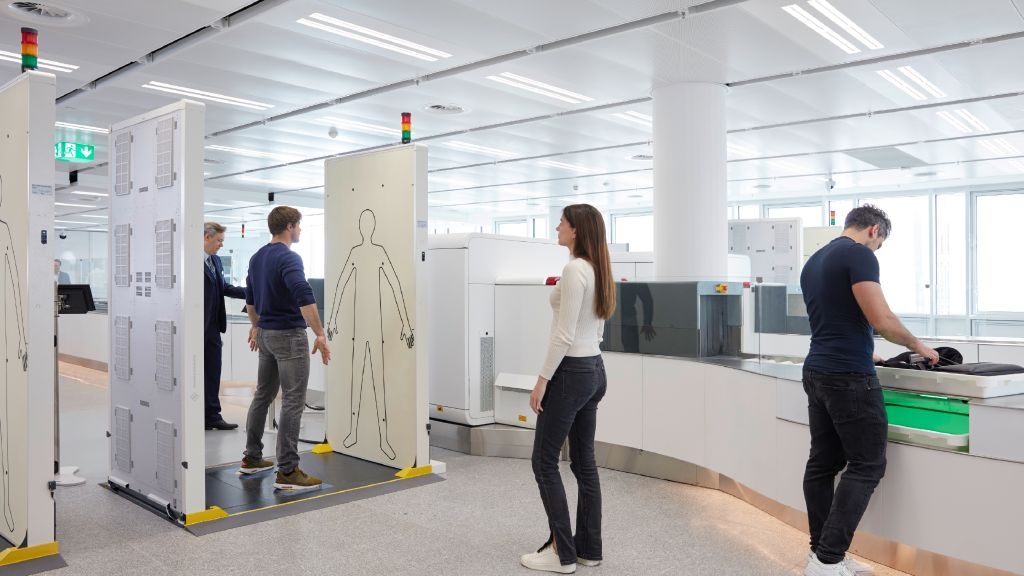
Darren McCarthy described how the mmWave scanner uses non-ionizing multi-static radar, where signals bounce off the skin rather than penetrating it. According to McCarthy, the mmWave scanner is safer than systems that use X-ray technology.
The scanner consists of 32 clusters with 94 transceivers on each side panel. That totals 3,008 transceivers that operate across 160 frequencies ranging from 71 GHz to 81 GHz. McCarthy added that the technology meets federal safety limits and uses no moving parts. In this application, beamforming isn’t needed. The signals and subjects are stationary.
As in many phased-array beamforming applications, the scanner can operate without all transceivers being fully functional.
These mmWave applications fall outside of the traditional radar, military, and satellite use cases. Others include wireless backhaul, surveillance and video, and private networks.
Related EEWorld content
Lens antennas focus multiple wireless beams
OFDMA improves spectrum use in Wi-Fi 6
6G could add sensing to cellular networks
FWA equipment manufacturer contends with few mmWave suppliers