
Quantum computing (QC) may seem far in the future, but early versions of room-temperature quantum computing (RTQC) are already being deployed in commercial environments, and tools for integrating QC into systems are available. Designers need to keep abreast of what’s new and what’s next. RTQC is both new and next.
This Judgement lays out the case that designers must act decisively and begin understanding, embracing, and integrating RTQC. The future is only months away, and it’s unstoppable.
RTQC is obviously a new technology, but why now? There are several reasons, including the fact that the European Union’s Cyber Resilience Act (CRA) takes effect in 2027 and will force hardware and software designers to build crypto-agility and long-term lifecycle security into digital products to defend against future quantum decryption threats.
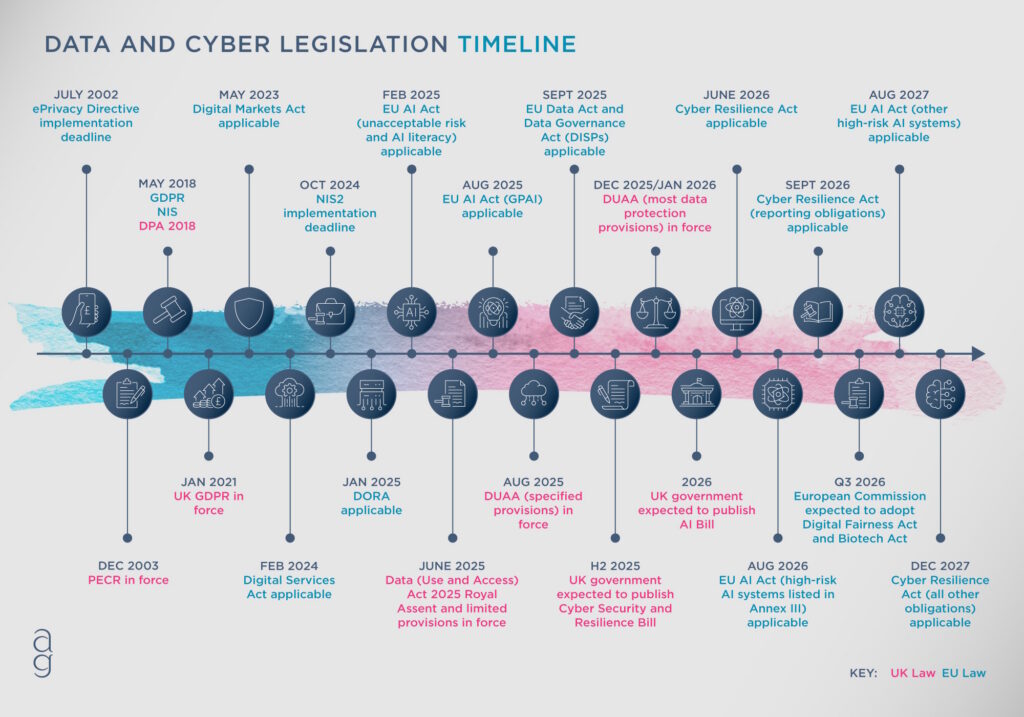
Major hardware and software suppliers like NVIDIA, Microsoft, Google, and others have introduced QC development environments and tools for a variety of applications like automotive, defense, pharmaceuticals, chemicals, and more. So, even if being second or third to the market is tolerable, having a product excluded from consideration is usually a showstopper. RTQC is new, next, and nearly now (Figure 1).
Photonic RTQC breakthrough
The photonic RTQC breakthrough refers to accelerating market introductions, not technology development. While traditional QCs operate near 0K, photonic RTQC operates at a relatively sizzling 300K (25 °C). Early adopters are already testing RTQC, with deployment expected to accelerate through 2030 and beyond.
RTQC is not without its drawbacks. For example, while it uses simpler fiber optic interconnects (compared with cryogenic microwave cabling), it typically has lower deterministic two-qubit gate fidelities and requires complex path multiplexing on chips.
Overall thermal management is much simpler, but there are still thermal challenges like local hot spots on photonic ICs (PICs) that can change the index of refraction of interconnects and cause lasers and other light sources to drift from specified wavelengths, reducing performance.
Room-temperature operation does not eliminate concerns related to fault tolerance and scalability. There are a variety of qubit technologies being used in RTQC to address those and other challenges.
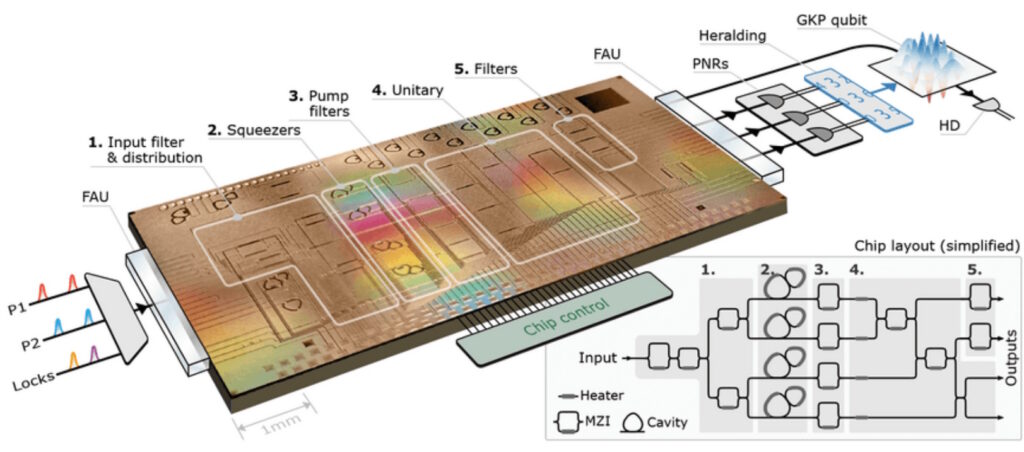
Gottesman–Kitaev–Preskill (GKP) qubits encode digital quantum information into continuous-variable oscillator states (squeezed light) on PICs. GKP encoding is robust for small optical losses and low thermal noise. GKP-based PICs can include built-in error correction against small noise shifts, improving hardware efficiency (Figure 2).
Fitting into data centers
In addition to GKP and other squeezed light techniques that use continuous laser fields to encode and process information across complete wave patterns, single-photon systems are available that use discrete “yes/no” qubits. In all cases, RTQC simplifies the software stack by reducing calibration layers and simplifying integration into existing datacenter fiber infrastructure.
Minimizing disruption of existing datacenter operations is a key consideration. To that end, the Open Compute Project (OPC) has established an effort to define mechanical, electrical, thermal, and control interface specifications for RTQC in datacenters. A key goal is enabling hybrid quantum-classical integration and management.
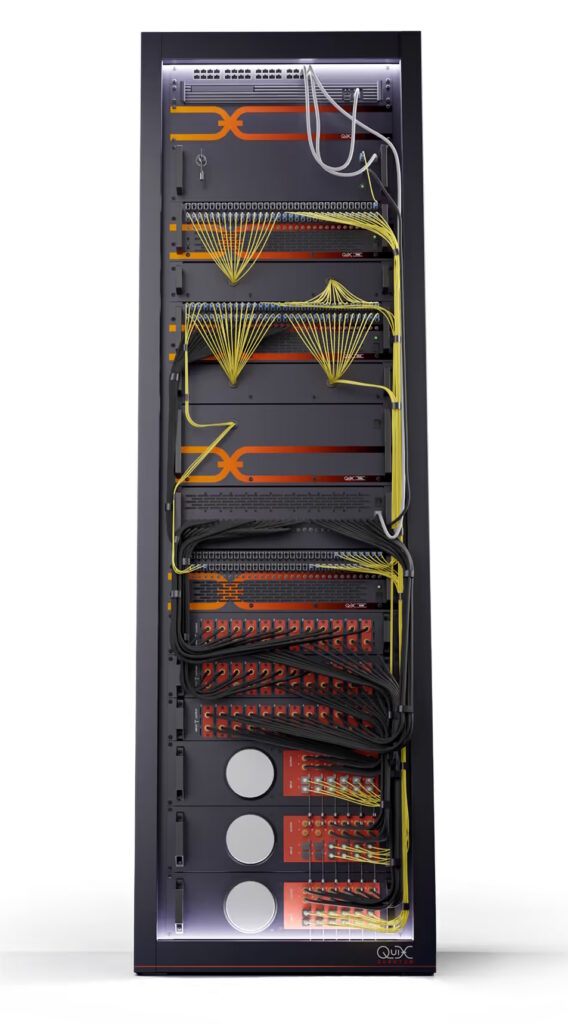
Several vendors offer RTQC systems in standard 19-inch datacenter-compatible rack footprints (Figure 3). Some fit into a single rack while others are spread across multiple racks. Power and cooling requirements can vary from standard datacenter infrastructure and can be a significant consideration.
Standard support
OPC is a leader in the push to develop tools that support RTQC integration into data centers, but they are not alone. On October 1, 2026, JESD264, Silicon Photonics Qualification and Reliability Requirements, was published by JEDEC and establishes qualification and testing baselines for silicon photonics devices needed to support RTQC use in data centers, telecommunications, and AI networks.
The IEEE Standards Association has several efforts underway to support deployment of RTQC, including IEEE P3185 for standardizing hybrid quantum-classical computing architectures, and IEEE P3329 for specifying energy efficiency standards for quantum platforms.
The ISO/IEC Joint Technical Committee 1 (JTC 1) has a work group focused on standardizing terminology, benchmarking software-defined quantum metrics, and formatting interoperability standards so RTQC systems from different vendors can share unified data pipelines.
Finally, the Telecommunication Standardization Sector of the International Telecommunication Union is heavily involved with quantum networking fabric, distributed quantum orchestration, and secure communication overlays.
Summary
RTQC checks all the boxes needed to qualify it as the new and next challenge for designers. Designers need support to address key requirements related to crypto-agility and the Cyber Resilience Act, check. Datacenter compatible RTQC hardware is needed, check. Software integration tools are needed, check. Standardization to support interoperability and smooth deployments is needed, check.
References
A Benchmarking Framework for Hybrid Quantum–Classical Edge-Cloud Computing Systems, MDPI applied sciences
Built for All: Introducing Our New Software Stack, Qualcomm
Data Center Integration of Quantum Information Infrastructure, Open Compute Project
Integrating Quantum Computing into Your HPC Infrastructure, QuEra
Google Quantum AI Software, Google
NVIDIA Launches Ising, the World’s First Open AI Models to Accelerate the Path to Useful Quantum Computers, NVIDIA
Powerful new developer tools increase the versatility of the Microsoft Quantum platform, Microsoft
Quantum Computing Systems and Architecture, Emerging Information & Technology Conference
Room-temperature photonic quantum computing in integrated silicon photonics with germanium–silicon single-photon avalanche diodes, APL Quantum
The Architecture Blueprint for Hybrid Quantum-Classical Supercomputers, Quantum Machines
The photonic qubit of the future, Xanadu
Top 10 Applications of Quantum Computing, Veritis
Top 35 Open Source Quantum Computing Tools, Quantum Insider
Top Quantum Computing Software Tools & 2025 Trends, SpinQ
Related EEWorld Online content
What’s a quantum sensor?
Post-quantum crypto standardization — background
How does a quantum radar sensor work?
What’s the relationship between Ohm’s Law and quantum mechanics?
What is the mathematical foundation of post quantum cryptography?