
That’s a trick question. Temperature-compensated oscillators (TCXO) and oven-controlled oscillators (OCXO) are solution architectures using crystals, while silicon micro-electro-mechanical systems (MEMS) are device fabrication technology. Both temperature-compensated and oven-controlled timing solutions can be made using MEMS technology as well as crystals.
There are additional nuances in terminology. TCXO and OCXO apply specifically to crystal-based temperature-corrected timing solutions, respectively. TMXO and OMXO (also called evacuated miniature oscillator, EMXO) are often used to differentiate the corresponding MEMS-based designs.
It can get more challenging since the terms are not standardized. In addition to referring to MEMS-based solutions, TMXO can refer to a tactical miniature crystal oscillator designed for military use.
SWaP starts
As with many choices in defense electronics, size, weight, and power (SWaP) tradeoffs are important when selecting timing devices. Once the SWaP requirements are defined, it can quickly whittle down the available options.
Oven-controlled oscillators (OCXOs) use a combination of insulation and a heating element to create a hot temperature-controlled environment, minimizing concerns with frequency stability, phase noise, and aging rate by keeping the internal quartz crystal at a constant, elevated temperature. Many designs include active thermal regulation to deliver peak timing precision. (Figure 1).
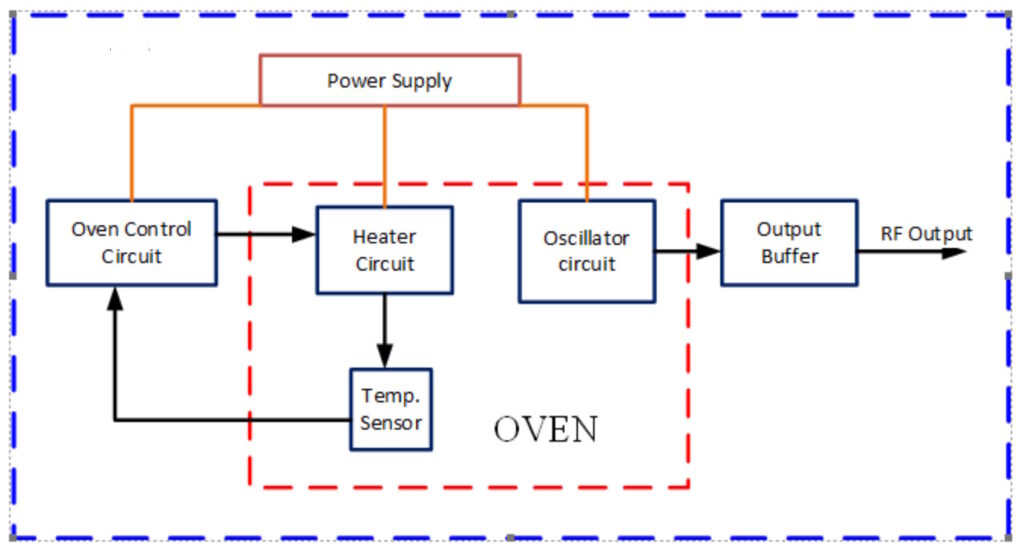
OCXOs tend to be the largest and heaviest option, measuring tens of mm on a side and weighing over 10 g. Power consumption is high, often consuming several watts during startup (depending on how quickly the system needs to reach operating temperature) and about 1 W for steady-state operation.
OCXOs can deliver frequency stability in low parts-per-billion (ppb) and good phase noise performance. They are generally unsuited for power-constrained environments like portable battery-powered devices. OCXOs are often found in ground radars, communications base stations, GNSS / GPS systems, and test equipment.
OMXO/EMXO solutions are up to 75% smaller and require less power, sometimes less than a tenth of a W. Their stability and phase noise performances are nearly as good as OCXOs, and they deliver start-up times under a minute. Plus, the MEMS technology is more shock and vibration-resistant compared with OCXOs. The combination of lightweight, low power, and good shock and vibration resistance makes OMXO/EMXO designs highly suitable for advanced mobile hardware, 5G small cells, and similar applications.
Going smaller and reducing power
TCXOs deliver small solutions with lower power consumption compared to either OCXOs or OMXOs. Common TCXO packages are 2.0 x 1.6 mm and 2.5 x 2.0 mm surface-mount configurations with weights measured in milligrams, sometimes under 0.03 g.
TCXOs are available with either analog or digital control for temperature compensation. Analog control delivers lower power consumption and smooth frequency corrections. Digital control typically provides better accuracy and higher adaptability but uses more energy and introduces stepwise frequency micro-jumps that can be problematic in some applications.
Some TCXOs support startup and stabilization times <100 ms. Typical power consumption is 50 mW, or lower. Several of these devices consume <5 mA and use standard supply voltages ranging from 1.8 to 3.3 Vdc. Rapid stabilization, low weight, low power, and low voltage operation can make TCXOs suitable for battery-powered portable systems.
Finally, TCXOs offer parts-per-million (ppm) stability but don’t support ultra-high ppb stability required for critical telecom or defense synchronization. A well-designed TCXO can deliver a frequency stability up to ± 0.5 ppm between -40 and 85 °C. (Figure 2).
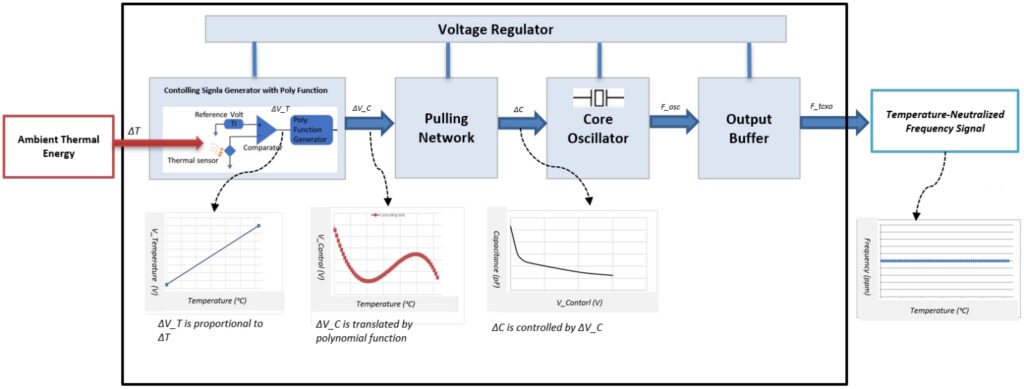
When the smallest and lightest solution is paramount, designers often turn to TMXOs. Based on overall solution size, they can be 50% smaller and 70% lighter than TCXOs. When SWaP is not a primary factor, TCXOs deliver lower phase noise, better radiation tolerance, and higher baseline precision in high-frequency radio or telecom applications.
A general benefit of using silicon MEMS, like in TMXOs, is their lower quality (Q) factor compared with crystal devices. While high Q means higher efficiency, it can also mean the output signal has higher phase noise and greater period jitter close to the carrier frequency.
TMXOs are inherently more environmentally and mechanically rugged than crystal-based options. For example, the much smaller mass of MEMS devices means they can withstand heavy shocks (50,000+ g) and severe vibrations without phase noise spikes. And, because the silicon MEMS device and internal temperature sensor can be tightly co-located with virtually zero thermal impedance between them, TMXOs are more resistant to fast temperature spikes.
Summary
SWaP analysis points out the significant tradeoffs when choosing the right timing device for defense applications. OCXO and OMXO devices provide the highest performance but are also relatively heavy and large. TCMO and TMXO devices can be quite tiny but also deliver smaller performance capabilities. MEMS-based devices generally deliver higher levels of shock and vibration resistance compared with their crystal counterparts.
References
A Method to Increase the Frequency Stability of a TCXO by Compensating Thermal Hysteresis, MDPI sensors
Comparative analysis of oscillators: MEMS vs TCXO vs OCXO vs RUBIDIUM, Bodet Time
Disadvantage of OCXO (Oven control oscillator), Dynamic Engineers
Get to Know the Evacuated Miniature Crystal Oscillator, Microchip
How Oven Control Works Inside an OCXO and Why It Stabilizes Frequency, Sapphire OSC
Oven-Controlled Crystal Oscillators (OCXOs), HardwareBee
TCXOs vs OCXOs: Which One Is Right for Your Next Design?, SiTIme
Unlocking Precision Exploring the Advancements in TCXO Technology, ESC Inc. International
Working principle of temperature compensated crystal oscillator, YXC
Related EEWorld Online content
What is a negative temperature coefficient?
How many ways are there to measure temperature?
Measuring clock and oscillator frequency
Measuring oscillator jitter
Need a really long-life battery or heat? Try a radioisotope thermal source – problem solved!