
Industry 5.0 is an emerging paradigm, and it marks a shift from purely technological automation (Industry 4.0) to a human-centric approach meant to improve sustainability and resilience. It focuses on collaboration between human creativity and robotic efficiency. Key differences include prioritizing worker well-being, customized production, and sustainability over speed and cost reduction.
Background
When first introduced in Europe, Industry 5.0, based on Japan’s Society 5.0 initiative, was mostly aspirational and faced significant adoption hurdles. That is changing. This article reviews the pillars of Industry 5.0 and briefly considers the technology challenges and roadblocks to widespread adoption, and closes with a brief look at early efforts to define Industry 6.0.
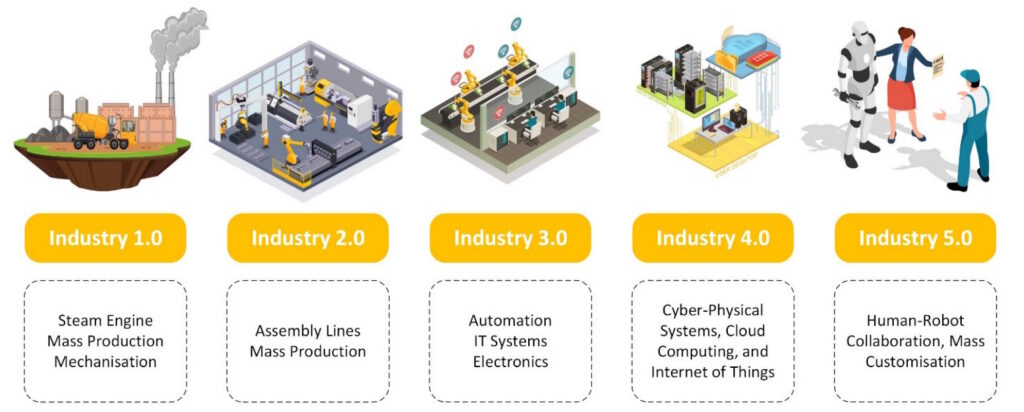
Advancements in industrial technology are accelerating. It took about 100 years from the initial use of steam and water power that characterized Industry 1.0 to the introduction of assembly line technology and Industry 2.0.
The pace picked up, and Industry 3.0 emerged 75 years later with primitive automation systems based on numerical controls using punch cards or magnetic tape. In another 50 years, Industry 4.0 was launched, and islands of automation began to be connected. Industry 4.0 is not yet fully developed, yet Industry 5.0 is already emerging (Figure 1).
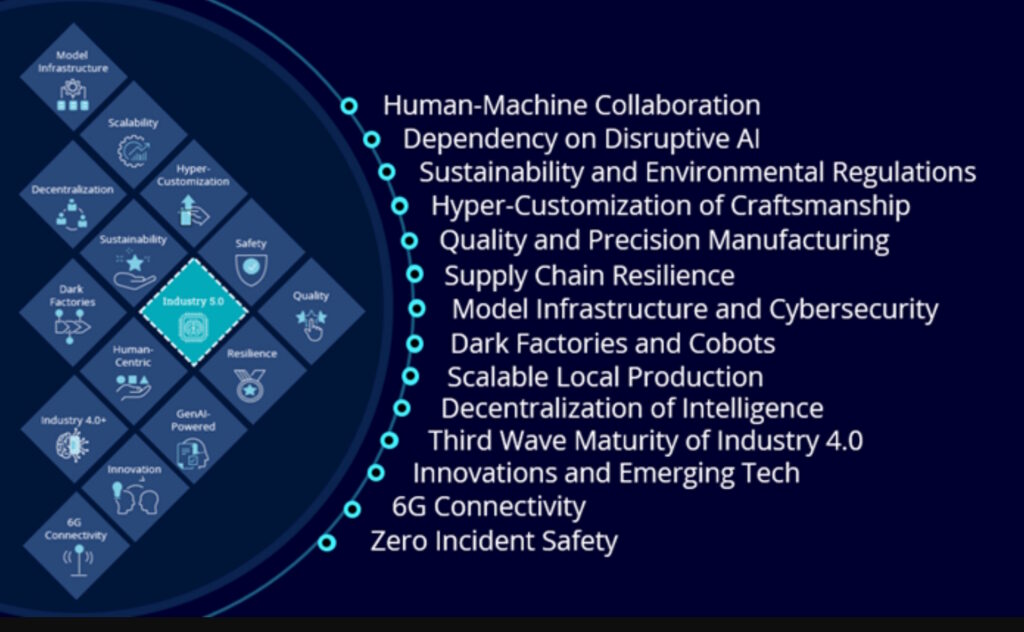
When formally announced in 2021 by the European Commission, Industry 5.0 was envisioned as an evolutionary advancement of Industry 4.0, not a wholesale replacement. The EC sought to correct what were seen as limitations in Industry 4.0, including favoring machine efficiency over worker well-being and environmental protection. It was expected to require significant changes, or at least adjustments, in many aspects of Industry 4.0 to arrive at Industry 5.0 (Figure 2).
Three pillars
While it’s expected to require numerous technological developments and adjustments, Industry 5.0 is guided by three pillars (Figure 3).
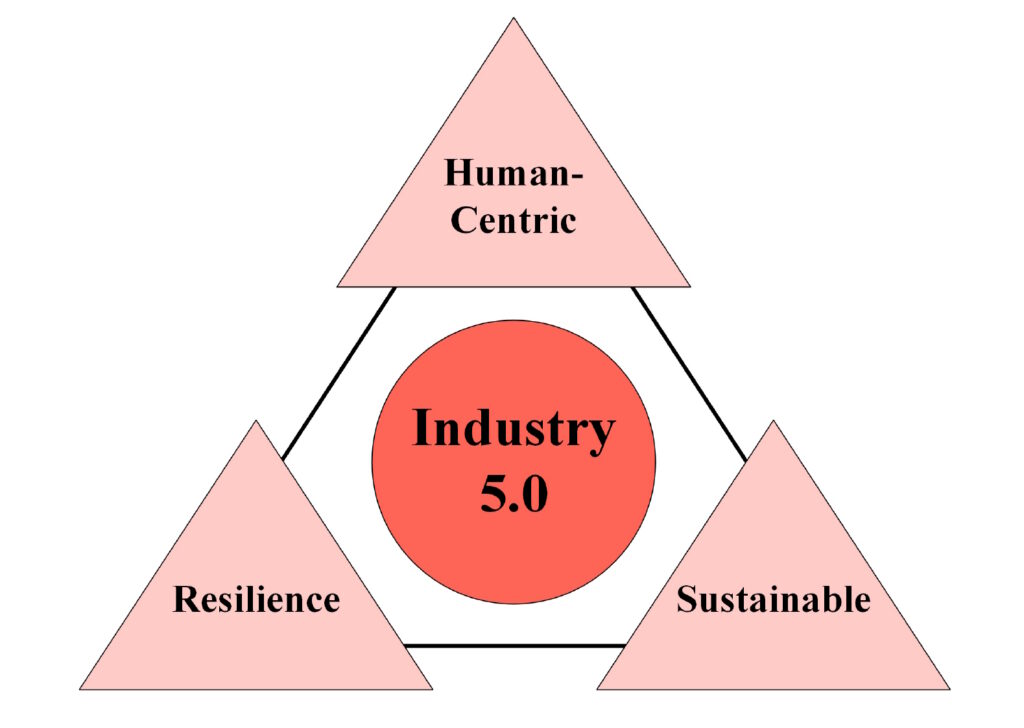
- Human-centric, sometimes called human-focused, is the key differentiator. Human contributions are not minimized, as they tend to be in Industry 4.0. In Industry 5.0, automation is not expected to replace humans, but to augment unique human contributions for tasks that require creativity and judgment. Collaborative robots (cobots), often in the form of humanoids, are given repetitive, heavy, or hazardous tasks to improve human well-being.
- Sustainability is another big goal. Industry 5.0 is expected to move from the “less negative” sustainability paradigm of Industry 4.0 to being a net-positive contributor to sustainability. Some of the concepts being developed in Industry 5.0 include circular production models, eco-friendly, regenerative production processes, and resource efficiency optimization.
- Resilient Industry 5.0 systems are expected to be robust and agile in the face of unexpected challenges ranging from the COVID-19 pandemic to tariffs. Industry 4.0 focused on maximizing operational flexibility, not necessarily developing robust processes.
What will it take?
Artificial intelligence (AI), which was not a factor in the early development of Industry 4.0 cyber-physical systems, will take center stage in Industry 5.0. The Industrial Internet of Things (IIoT), with its massive number of sensors, is a defining feature of Industry 4.0.
The IIoT has been successful, but it produced more data than humans can possibly analyze, much less use. AI is changing that. The merger of AI and the IIoT has resulted in a new term, the artificial intelligence of things, or the AIoT.
The AIoT can turn connected devices into proactive systems that analyze data, improve using machine learning (ML), and make autonomous decisions. It can also produce insightful analysis from masses of heterogeneous data, producing the actionable information needed to support all three central pillars of Industry 5.0 deployments.
HOOTL in Industry 6.0?
Industry 6.0 can be considered as either an extension of Industry 5.0 or as the logical conclusion of Industry 4.0. It will rely on hyper-connected ecosystems based on 6G telephony, machine independence using quantum computing for ultra-fast, secure, and highly-capable AI analyses, and robot swarms that eliminate the need for humans. The result is expected to be so-called “human-out-of-the-loop” (HOOTL) operations.
HOOTL will result in dark factories, or “lights-out manufacturing,” and further advance the three pillars of Industry 5.0. A key feature will be the elimination of human-centric infrastructure systems like environmental controls, lighting, and so on. That will contribute to lower energy costs, improving sustainability and resilience.
Summary
The acceleration of industrial technology advancements continues. Before Industry 4.0 matured, Industry 5.0 was being rolled out, and Industry 6.0 was in the early stages of being defined. Where Industry 4.0 sought to automate industrial operations without human intervention, Industry 5.0 added humans back into the picture in a central way. Industry 6.0 hopes to eliminate the need for humans.
References
A New Era: Towards Industry 5.0 and 6G, Siemens
Beyond Reality: A Study of Integrating Digital Twins, Journal of Physics
How Do We Define Industry 5.0?, ISG
Industry 4.0 Versus 5.0: What’s the Difference?, Rutgers School of Engineering
Industry 5.0, European Union Industrial Research and Innovation
Industry 5.0 and human-centered design approach, Leaf Design
Industry 5.0 paradigm transformation adoption in developing countries: an analytical game theoretic model, Scientific Reports
Industry 5.0 vs Industry 4.0, WorkfloPlus
Industry 5.0: A Comprehensive Introduction, Hexagon
Industry 5.0: What’s Next for Manufacturing?, Epicor
What is Industry 4.0 vs. Industry 5.0?, infor
What Is Industry 5.0 And How It Will Radically Change Your Business Strategy?, Forbes
What Is Industry 5.0?, Intelycx
What is Industry 5.0? (Top 5 Things You Need To Know), The Welding Institute
Related EEWorld Online content
What is the IEEE 1801-2024 Unified Power Format 4.0 standard?
What’s the difference between live zero and dead zero?
How do ML and AI work in power conversion? part 1
What is multimodal sensing in physical AI?
The difference between physical AI and machine learning in power electronics