
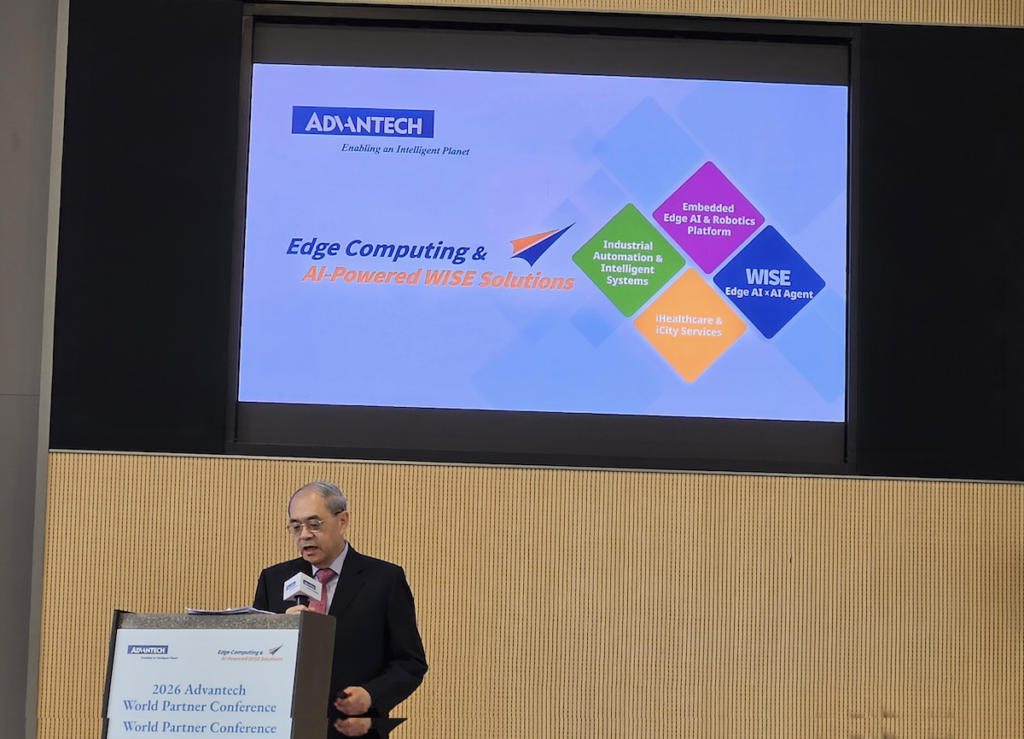
Advantech’s Miller Chang used his opening keynote at Advantech’s Edge AI Conference to reframe the progression from cloud to edge to Physical AI, and explain why the third stage is where industrial transformation happens
If you’ve been following the edge AI conversation for a few years, the argument that intelligence belongs closer to the data source is familiar ground. What Advantech President of Embedded Sector Miller Chang pushed on in his opening keynote was the layer above that: what changes when the AI doesn’t just process data at the edge, but uses it to perceive, reason, and act in the physical world in real time.
His framework organized the evolution into three stages. Cloud AI is the foundation most of the industry spent the last three years absorbing: large language models, generative AI, centralized inference. Edge AI is the second layer: intelligence deployed to the field, with the latency, data security, and real-time response advantages that come from keeping computation local. Physical AI is the third, and in Chang’s framing it’s where industrial competitive differentiation will be decided. The distinction matters because edge AI can still be passive, processing and reporting. Physical AI acts. It handles perception, decision-making under time constraints, and control of physical systems, whether that’s a collaborative robot arm, an AMR navigating a warehouse floor, or an autonomous inspection system in a semiconductor fab.
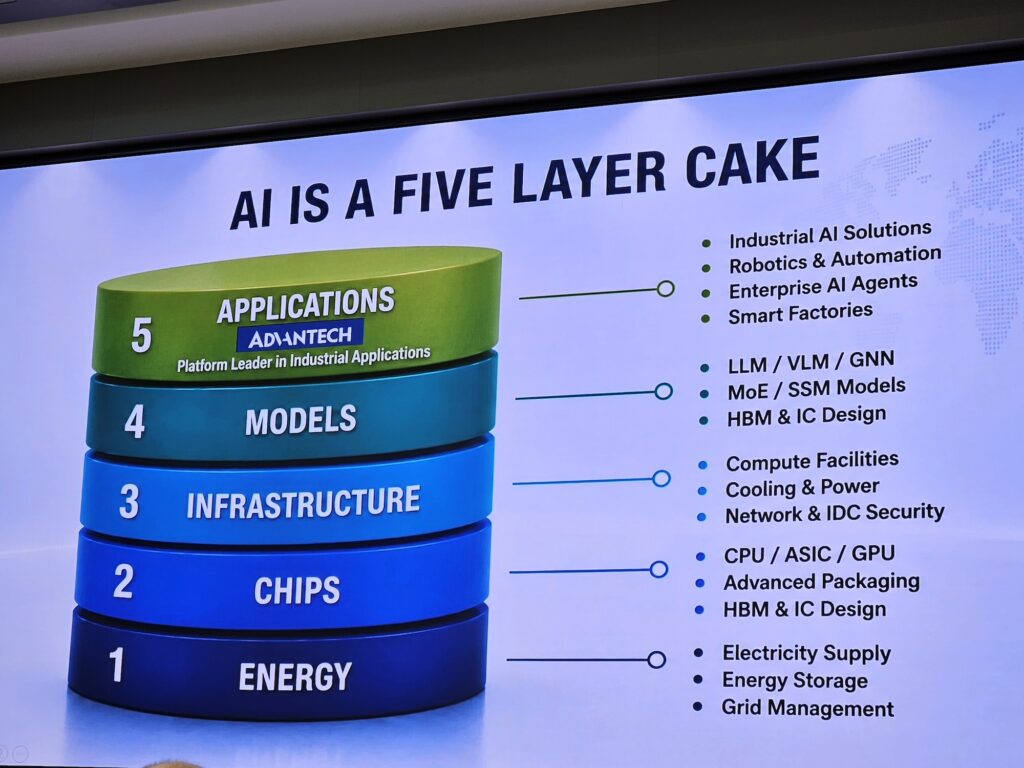
To make the full stack concrete, Chang presented what he called the five-layer cake of AI, a framework worth keeping handy. At the base is energy: electricity supply, energy storage, and grid management, the infrastructure that makes everything above it possible and increasingly a constraint in its own right as AI compute demands grow. Layer two is chips: CPUs, ASICs, and GPUs, advanced packaging, and HBM and IC design. Layer three is infrastructure: compute facilities, cooling and power systems, and network and data center security. Layer four is models: LLMs, vision language models, graph neural networks, mixture-of-experts and state space models, along with the HBM and IC design that supports them. The top layer is applications: industrial AI solutions, robotics and automation, enterprise AI agents, and smart factories. That’s where Advantech positions itself, as a platform leader operating at the application layer, integrating what’s happening in the four layers beneath it into deployable industrial solutions.
The market context Chang cited reflects that trajectory. The edge AI hardware and software market is projected to reach $196.6 billion by 2034 with a 23.8% CAGR, driven primarily by demand for AI accelerators alongside growing software and integration services opportunities. He flagged that large-scale deployment cost and data security management remain the two biggest friction points for industrial customers moving from pilot to production, consistent with what surfaced in the panel discussion later in the day.
On the hardware architecture side, Advantech’s edge AI stack runs three tiers. At the base are edge AI compute modules that embed into existing devices to add inference capability without a full system redesign. The middle tier covers vertical-specific edge AI inference appliances targeting retail, medical, transportation, and similar markets. At the top sits the edge AI server layer, handling enterprise-scale data aggregation and analysis across deployments.
Tying it together is WISE, the Wireless IoT Sensing Embedded developer architecture, a container-based software platform designed to abstract the cross-platform complexity that comes with supporting multiple silicon partners simultaneously. For physical AI robotics specifically, WISE provides building blocks spanning the AI reasoning and decision-making layer, sensor and module integration including cameras, IMUs, LiDAR, and motion control, and a robotic software suite that consolidates partner SDKs into a unified development environment. The intent is to reduce the integration overhead that typically burns development cycles before a single line of application logic gets written.
The industries Chang highlighted as active deployment targets reflect how broadly the physical AI opportunity extends: smart factory and manufacturing, medical robotics, semiconductor equipment, energy, and retail, with AMR and humanoid robotics applications growing across all of them. More than 50 global partner projects are currently in progress under that framework.
The five-layer cake framing is useful precisely because it makes clear that physical AI isn’t a single technology problem. It’s a stack problem, and progress at any one layer, whether that’s a new chip architecture, a more efficient cooling approach, or a better foundation model, has downstream effects on what’s possible at the application layer. Chang’s point, and Advantech’s bet, is that the companies who understand all five layers and can integrate across them are the ones who will define what physical AI looks like in practice.