
by Steffen Thewes, Product Manager-Surge Protection, Weidmüller Group
Protection in electrical systems is often misunderstood, especially when it comes to the roles of circuit breakers and surge protective devices (SPDs). In many installations, both are seen as similar or even interchangeable. In reality, they address two fundamentally different types of electrical threats: overcurrent and overvoltage.
Overcurrent occurs during overloads or short circuits, when the current exceeds safe limits. Overvoltage, in contrast, is typically caused by transient events such as lightning strikes or switching operations. These surges are extremely fast, often lasting only microseconds, but can reach several kilovolts and damage sensitive electronics instantly.
Different functions: interrupting current vs. limiting voltage
Because these disturbances behave differently, they require different protection mechanisms. This distinction is essential for designing reliable electrical systems.
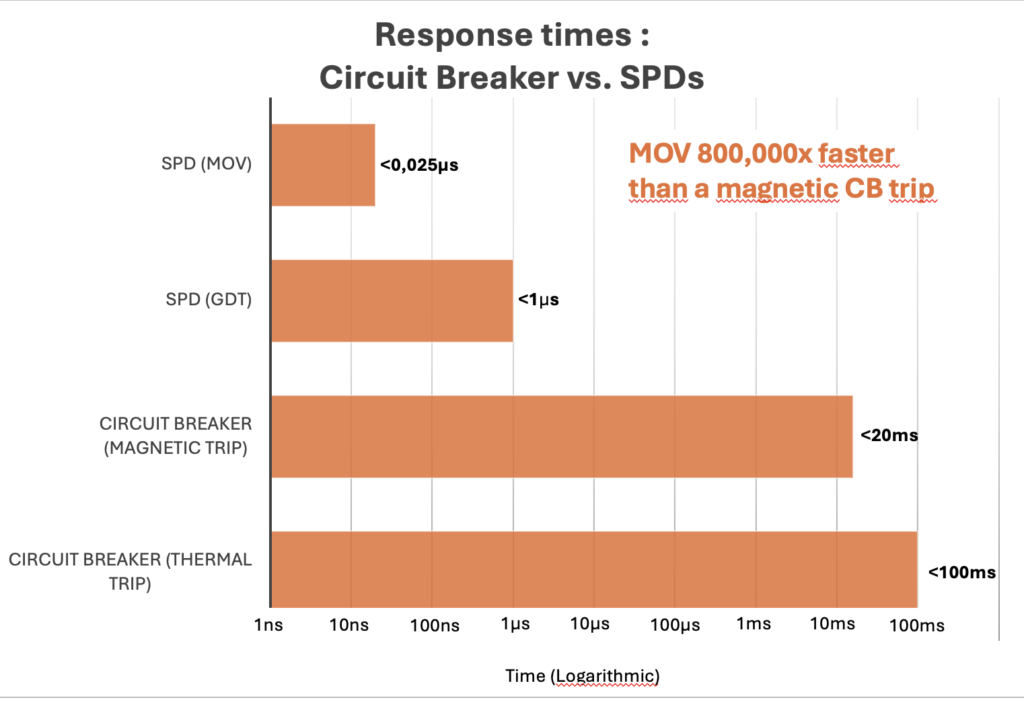
Circuit breakers are designed to protect against overcurrent conditions. When the current becomes too high, they interrupt the circuit to prevent overheating, cable damage, and fire hazards. Their strength lies in handling sustained faults, typically reacting within milliseconds, which makes them well suited for overloads and short circuits.
Surge protective devices (SPDs), on the other hand, protect against transient overvoltage. Instead of disconnecting the system, they react extremely fast and limit voltage peaks to a safe level while diverting excess energy to ground. This happens in microseconds, much faster than any circuit breaker could respond, as illustrated in Figure 1.
In simple terms, circuit breakers deal with too much current, while SPDs deal with too much voltage. Circuit breakers ensure safety by stopping dangerous current flow, whereas SPDs ensure system reliability by keeping harmful voltage spikes away from sensitive components such as PLCs, drives, communication systems, and power supplies.
An SPD performs its function without interrupting operation. It can respond to multiple surge events over time without requiring manual reset, which makes it particularly valuable in applications where continuous operation is important.
Why both for complete protection
A common misconception is that circuit breakers alone provide sufficient protection. However, this leaves a critical gap.
In the case of a transient surge, the event is often too fast and too short to trigger a breaker. From the breaker’s perspective, nothing is wrong. At the same time, the voltage spike can damage electronic equipment instantly or contribute to long-term degradation.
This is why circuit breakers and SPDs are not alternatives, but complementary devices. Circuit breakers provide protection against excessive current and associated risks such as overheating, while SPDs address transient overvoltage that would otherwise stress insulation and electronic components.
This distinction becomes increasingly important in modern electrical systems with a high density of electronic components.
A typical example can be found in data center environments. These systems work with a large number of interconnected devices such as servers, storage systems, network infrastructure, UPS systems, and power conversion equipment. At the same time, these devices are highly sensitive to even small voltage disturbances. The electrical infrastructure is designed for maximum availability, but this also means that a single transient event can affect many critical components at once.
Circuit breakers and SPDs both contribute to overall system safety, but they address different types of risks. Circuit breakers protect against overcurrent conditions, while SPDs are specifically designed to handle fast transient overvoltages that can propagate through the system.
Even a very short voltage spike can affect multiple components at the same time. It may lead to immediate failure, data corruption, unexpected resets, or subtle damage that reduces equipment lifetime. This is especially critical because the root cause is not always visible afterwards. In many cases, no breaker trips, but system reliability is still impacted.
SPDs address this type of risk directly. By limiting voltage peaks before they reach sensitive equipment, they help maintain stable operation without interrupting the system. This is especially important in environments where availability is critical, and even short disturbances can result in significant costs, service interruptions, or troubleshooting efforts across several subsystems.
While data centers represent a particularly sensitive application, the same principle applies to many industrial and commercial systems. Wherever electronics are used, protection against transient overvoltage becomes an essential part of the overall protection concept.
True protection in electrical systems therefore requires both. Circuit breakers provide safety by interrupting dangerous current, while SPDs ensure reliable operation by controlling voltage transients. Only the combination of both creates a complete and robust protection strategy.