
Implementing robust sensor security is essential in connected systems. Compromised sensors can feed corrupt, inaccurate data directly into operational systems, leading to devastating real-world failures, catastrophic physical damage, safety concerns, and compromised decision-making.
The increasing number of sensors in modern systems and the diversity of sensor types across applications like machine learning (ML) and automation present an expanding attack surface that can be invaded by bad actors.
Sensors are used in a variety of critical systems, from the electric grid to autonomous vehicles and pacemakers. Corrupted data can create life-threatening conditions. Corrupted data can also result in an AI application that makes incorrect predictions, resulting in unsafe actions. Adding to the challenges, sensors are often resource-constrained devices, making it difficult to integrate significant levels of security directly into the sensor.
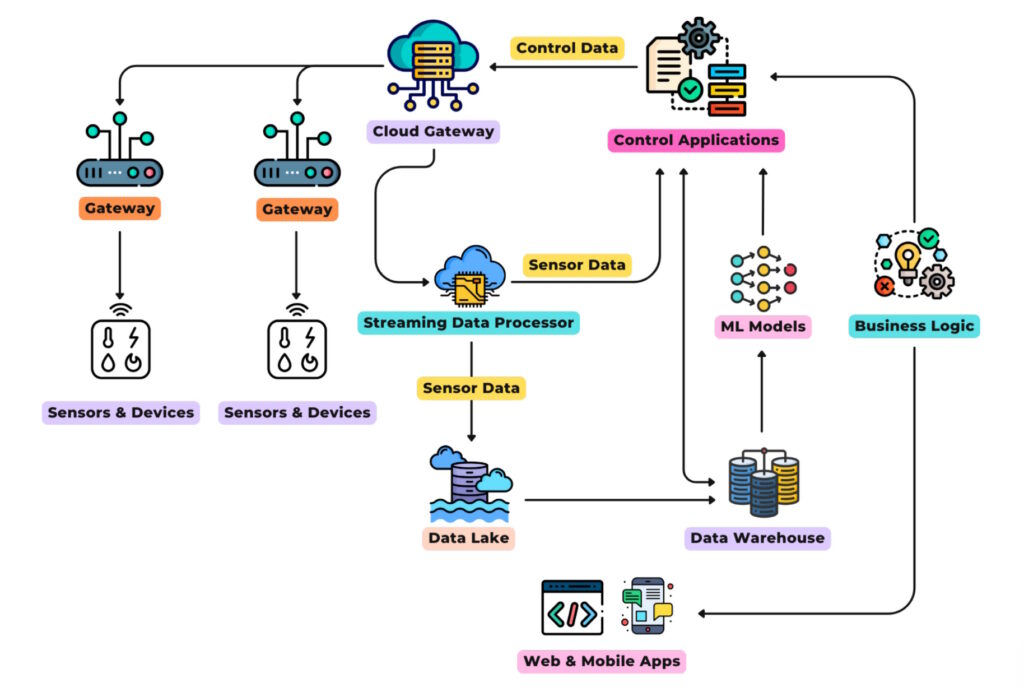
The growing complexity of sensor networks further expands the attack surface, making implementing sensor security complex as well as critical. That necessitates implementing a defense-in-depth approach that embraces hardware, network, and software layers (Figure 1).
Strategies for sensor security
Hardware considerations for sensor security include tamper detection using physical switches, accelerometers, or other tools to monitor for unauthorized physical access. Unused ports should be physically sealed and secure boot implemented.
Network isolation can be important, including the use of virtual LANs to limit outbound sensor communication and block all unauthorized inbound connections. Use of a zero-trust architecture to verify all communication provides an additional level of security.
A well-regulated and controlled patch management process for the delivery of encrypted firmware updates is essential. ML tools can be used to identify anomalous sensor data that may indicate a sensor that’s been physically compromised or subjected to environmental manipulation.
Holistic approach
Strategies for sensor security must extend beyond the edges of traditional networking. Modern systems no longer include a so-called ‘air gap’ without wired or wireless connections that isolates individual systems from the rest of the operation. Today, most systems are designed to allow various types of external connectivity, adding dimensions of concern to the attack surface (Figure 2).
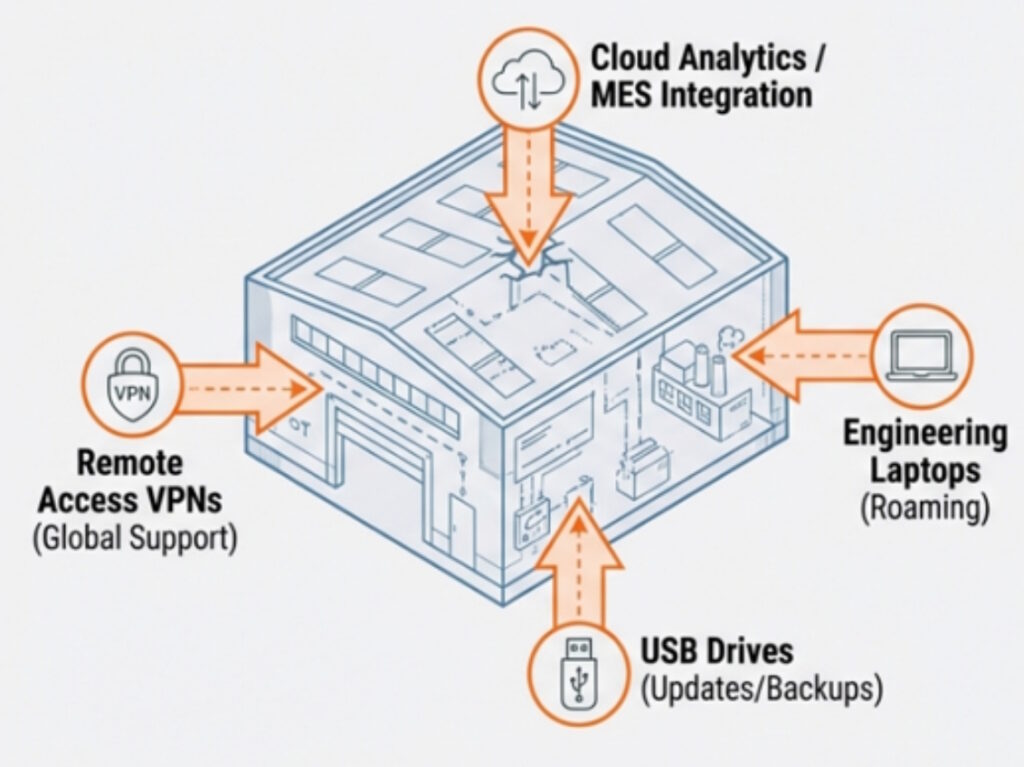
- Remote virtual private networks (VPNs) used for remote and global connectivity can be hacked.
- Manufacturing execution systems (MES) link high-level business planning systems (like enterprise resource planning, ERP) and the physical production floor.
- Engineering laptops and USB drives are often used to update systems and backup configuration data.
Wired vs. wireless
There are fundamental differences in attack surfaces and attack vectors between wired and wireless sensor implementations. Wireless connections cannot be disabled by simply cutting a wire. Wireless sensors can be targets for signal interception or manipulation.
Wired sensor networks are less flexible than wireless implementations and are vulnerable to communication or power cables being severed. Insertion of a resistor at the sensor end of a connection can allow the control panel to detect if a wire has been cut, or if a sensor has been tampered with. Wired connections can’t be easily intercepted and are relatively immune to hacking, jamming, and electromagnetic interference.
OT vs IT
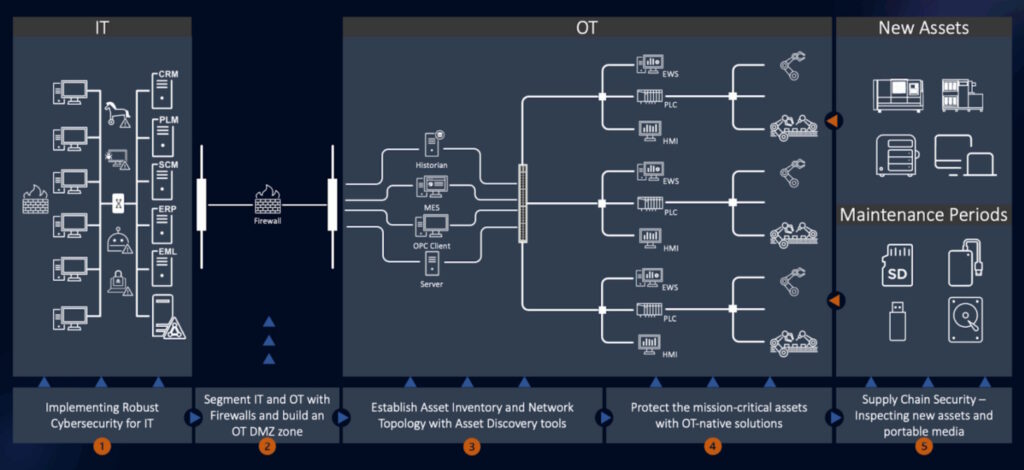
Finally, there’s a tension between the security demands of operational technology (OT) on the factory floor and information technology (IT) in businesses. For example, OT systems prize stability and infrequent changes while IT systems require more frequent updates to ensure maximum performance.
The intersection between IT and OT systems must be tightly managed. A strictly IT-related event is not generally life-threatening. An OT-related event can compromise safety. OT concerns extend to supply chain issues and ensuring that new sensors or other assets and maintenance or calibration tools don’t introduce security risks (Figure 3).
Summary
Implementation of sensor security in connected systems is as complex as it is important. There are multiple types of sensors, heterogeneous IoT architectures including wired and wireless devices, and application requirements to consider, plus the intersection of IT and OT systems to manage. External vulnerabilities from new equipment and calibration services can exacerbate the internal networking challenges.
References
A step-by-step guide to achieving fast, secure IoT connectivity and device lifecycle management, Crypto Quantique
Combining Edge Computing-Assisted Internet of Things Security with Artificial Intelligence: Applications, Challenges, and Opportunities, MDPI applied sciences
Enhancing Cyber Security Through Machine Learning-Based Anomaly Detection, International Journal of Engineering Research & Technology
IoT Security: Essential Strategies to Protect Connected Devices, Paessler
OT Cybersecurity: The Guide to Securing Industrial Systems, TXOne Networks
Secure OTA Boot Chains and Firmware Verification: Building Trust in Connected Devices, Promwad
Securing All Your Shiny New Connected Devices, NJCCIC
Securing Connected Devices: Enhancing IoT Security in Manufacturing, Orlan Tech
Security Considerations for Field Equipment in Industrial Systems, Industrial Cyber
Security for Industrial Control Systems (ICS), Splunk
Sensors Cybersecurity, MDPI sensors
What Is ICS Security?, Palo Alto Networks
Related EEWorld Online content
How does the Machinery Regulation (EU) 2023/1230 affect designs?
What is an AI governor and how does it relate to physical AI?
How will the Cyber Resilience Act impact embedded developers?
How does the Zenoh protocol enhance edge device operation?
OpenClaw is open-source edge AI for (almost) every application