
It seems lately many of my clients are having conducted emission challenges largely due to switching power supplies. These can be OEM modules in their products or other EV or backup power conversion systems. While many have in-house test benches for conducted emissions, the challenge is always “what next?” in order to mitigate failures. The ability to observe the differential mode (DM) and common mode (CM) components of the total conducted EMI would go a long way towards designing the best filter topology.
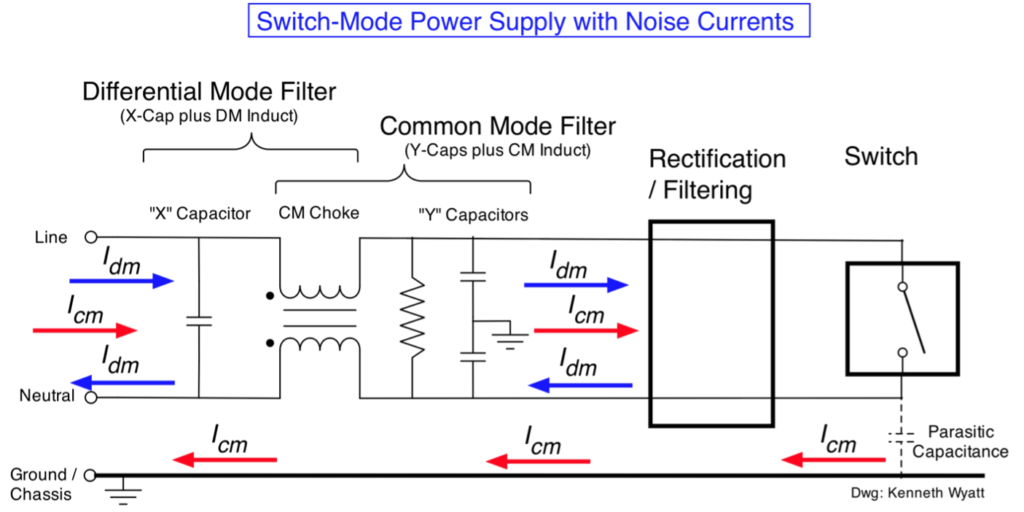
Most power input filters include both CM and DM filter components (Figure 1). For example, observing that the DM component in the overall conducted emission is dominant, you can focus on improving the “X”-capacitor or DM-component of the CM choke (or perhaps adding a second stage of DM filtering). Likewise, if the CM component is dominant, focus can be made on the CM choke or “Y”-capacitors.
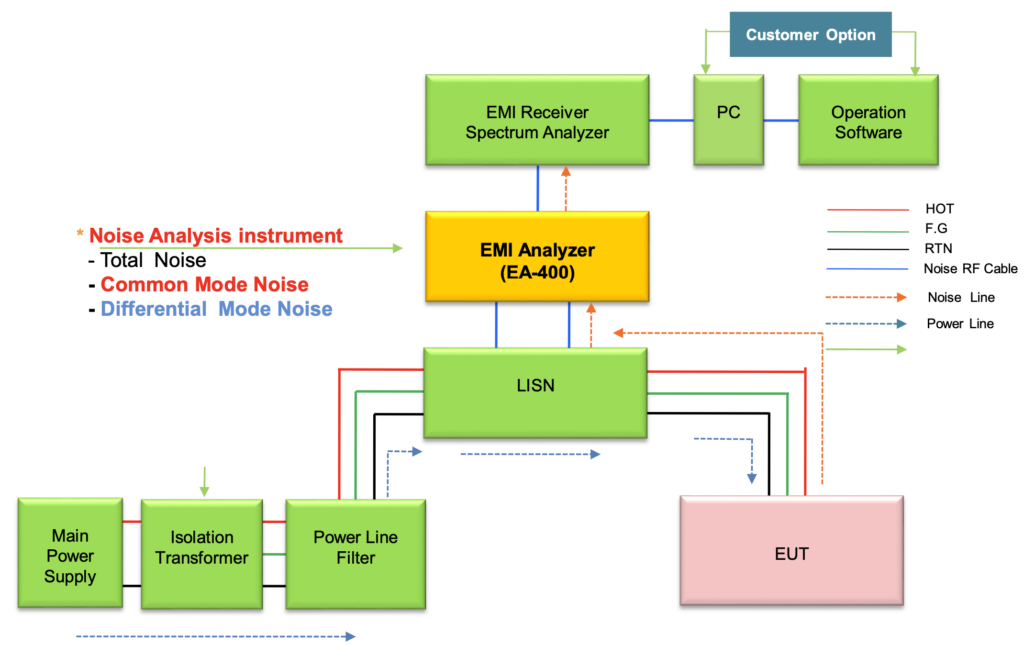
EMCIS Co., Ltd [1], a manufacturer of EMC equipment based in Korea, recently announced the EA-400 EMI analyzer [2] shown in Figure 2. This instrument is designed to connect between a LISN and a spectrum analyzer and will show, at the push of a button, the conducted emissions (Line 1 and 2), as well as the CM and DM components on the power input path. This instrument may be configured for DC, single-phase, or 3-phase circuits. See Figure 3 for the connection block diagram.
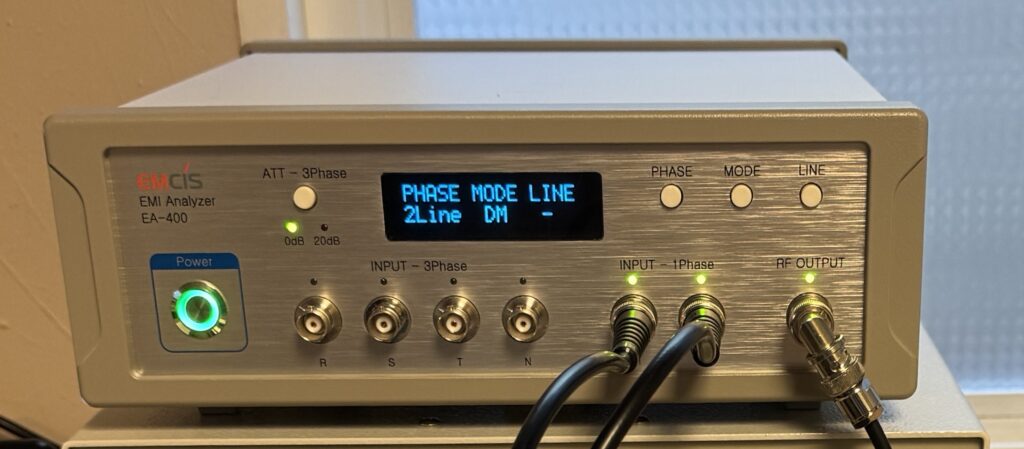
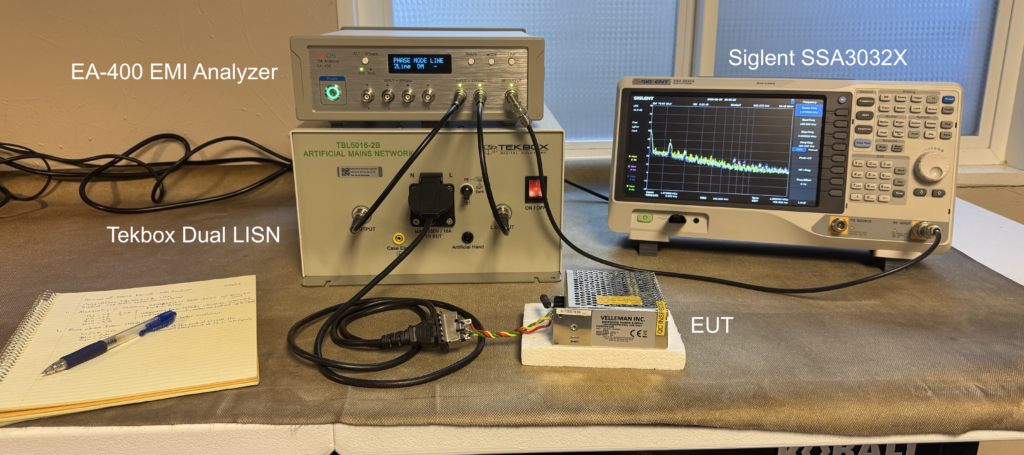
Connecting and operating the EA-400 is a breeze. I’m using the Tekbox TBL5016-2B dual LISN, which has two separate outputs, ideal for connecting directly to the analyzer’s single-phase inputs with short BNC cables. Figure 4 shows the overall test setup with the Siglent SSA3032X spectrum analyzer and EUT.
Using the EMI Analyzer
AC power supply: The first EUT tested was a Vellman 12V power supply, shown in Figure 4. It turned out to be rather uninteresting because it already had an excellent power line filter, so I turned my attention to an older GE UFL 20W light bulb.
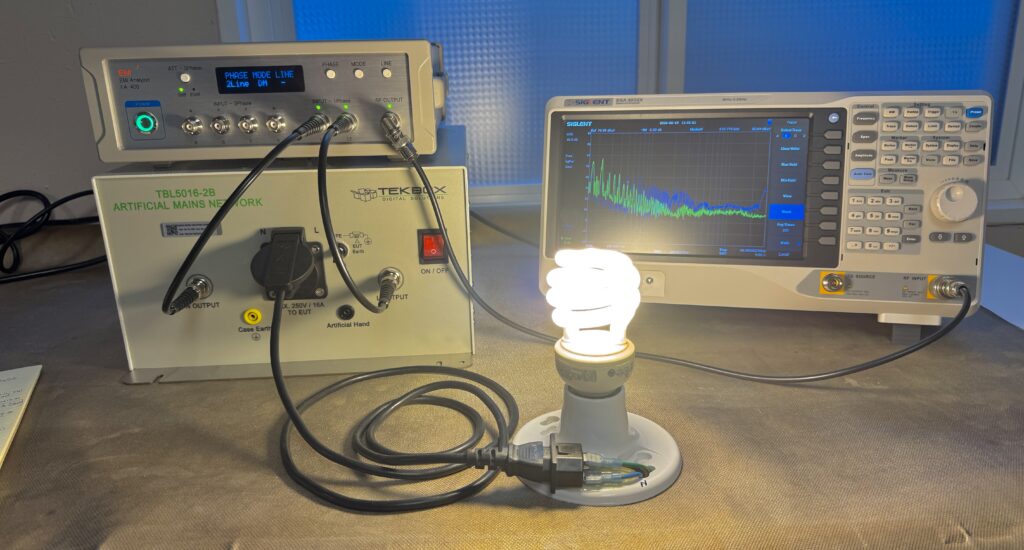
Fluorescent lamp: I keep this bulb in my collection because it is a noisy technology from days gone by. Figure 5 shows the test setup, and Figure 6 shows the differential and common mode components. The ability to separate the two makes it easy to see what type of filtering is required.
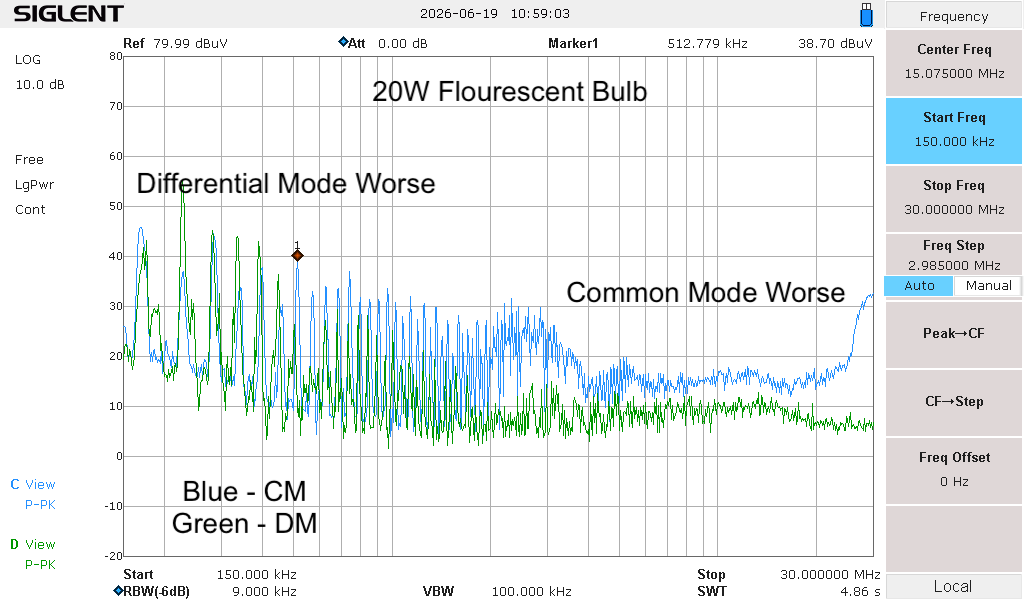
For example, both the DM and CM are dominant below 500 kHz, and the DM gradually decreases by 2 MHz, while the CM stays dominant above 2 MHz. An appropriate filter would include a CM choke with “Y” capacitors and a DM “X” capacitor.
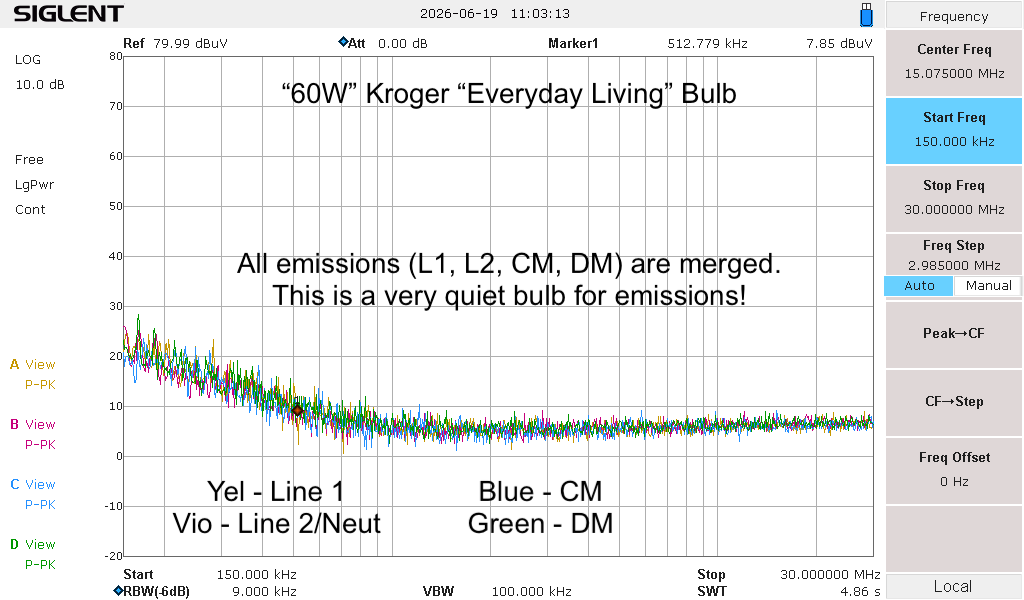
Modern LED bulb: Most modern LED bulbs today do have some reduced level of emissions as compared to 2010-era bulbs I’ve measured. However, the Kroger “Everyday Living” 60W (equivalent) bulbs are the quietest I’ve measured (Figure 7).
1 MHz DC-DC GaN converter: The EPC 9101 demo board is now obsolete, but it provides a nice source of CM and DM emissions due to its lack of power input filtering. We’ll measure it with and without an external filter board.
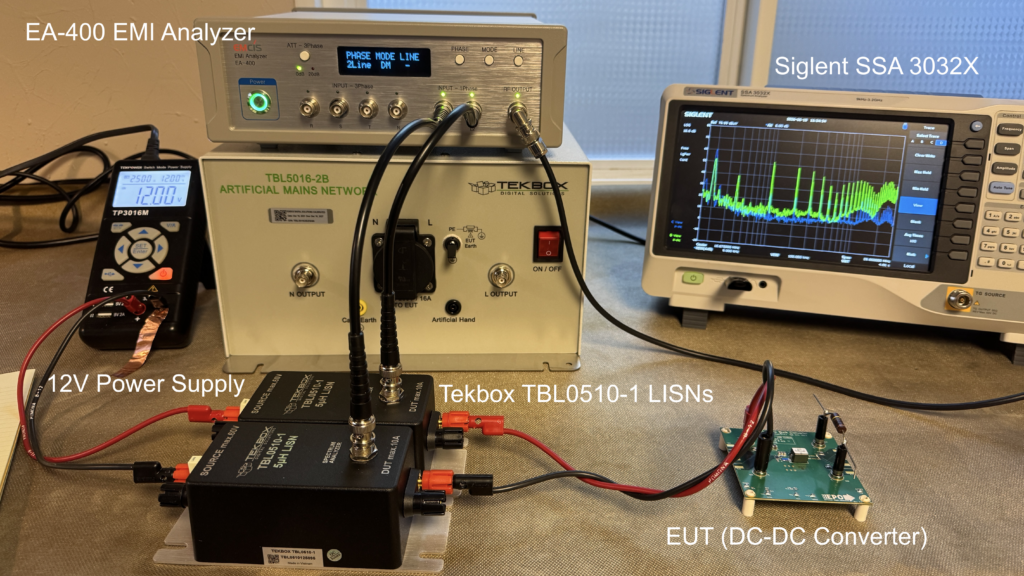
I’m using a pair of Tekbox TBL0510-1 DC 5 µH LISNs, with each connected to the single-phase inputs of the EMI analyzer. The converter is powered by a 12V DC supply. As shown in Figure 8, the dominant emission is DM, which is not unusual for DC-DC converters in my experience.
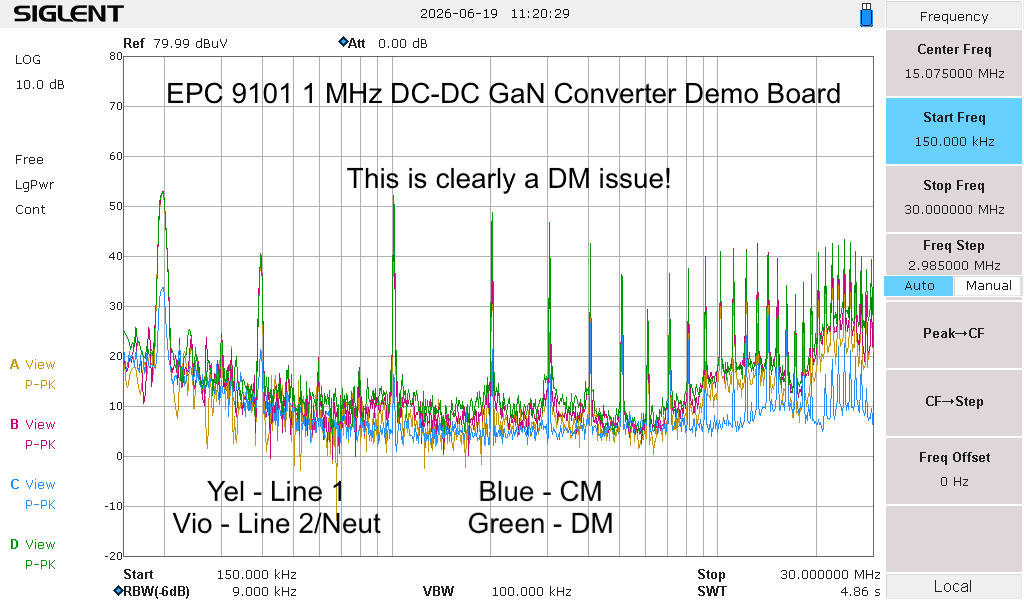
DC-DC converter with series inductor: Let’s try some filtering techniques. Because the dominant issue is DM, I’ll simply add a series 100 µH inductor to the +12V power input path. From experience, this has worked well at reducing DM in DC-powered products.
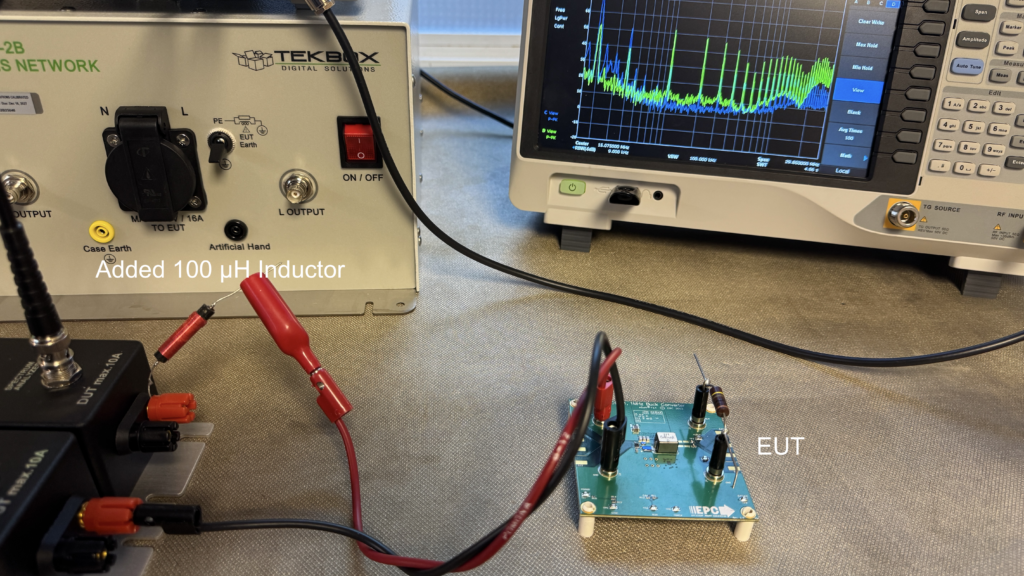
Figure 10 above shows the added series inductor. Yes, it should more properly be added directly to the PC board, and probably explains the higher resonance at 197 kHz due to the long power wires in Figure 11 below.
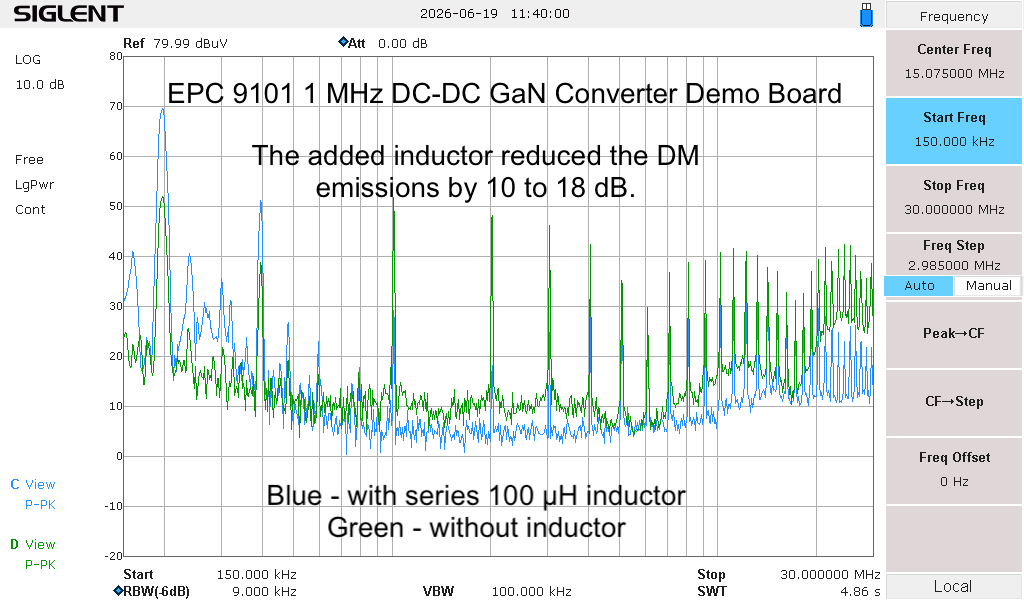
That series inductor forms a two-pole low-pass filter when combined with the EUT’s input shunt capacitor. You can see that it lowered the DM emission by 10 to 18 dB across the frequency range.
External filter board: Würth Elektronik sells a nice filter kit, model 744998, reviewed by my friend, Arturo Mediano [3]. I’ll use a pre-made filter I’ve used in the past to improve the DC-DC converter emissions. Figure 12 shows the test setup with the filter board inserted between the LISNs and EUT.
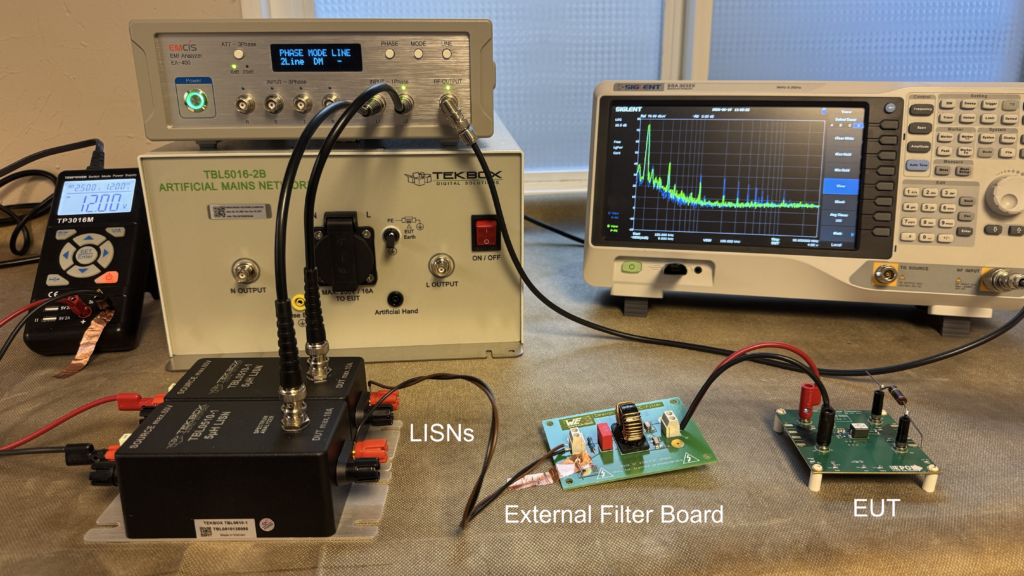
As I mentioned previously, I suspect that with the additional wiring, I may have increased the 197 kHz harmonic artificially, and I noticed neither DM nor CM filtering affects that amplitude.
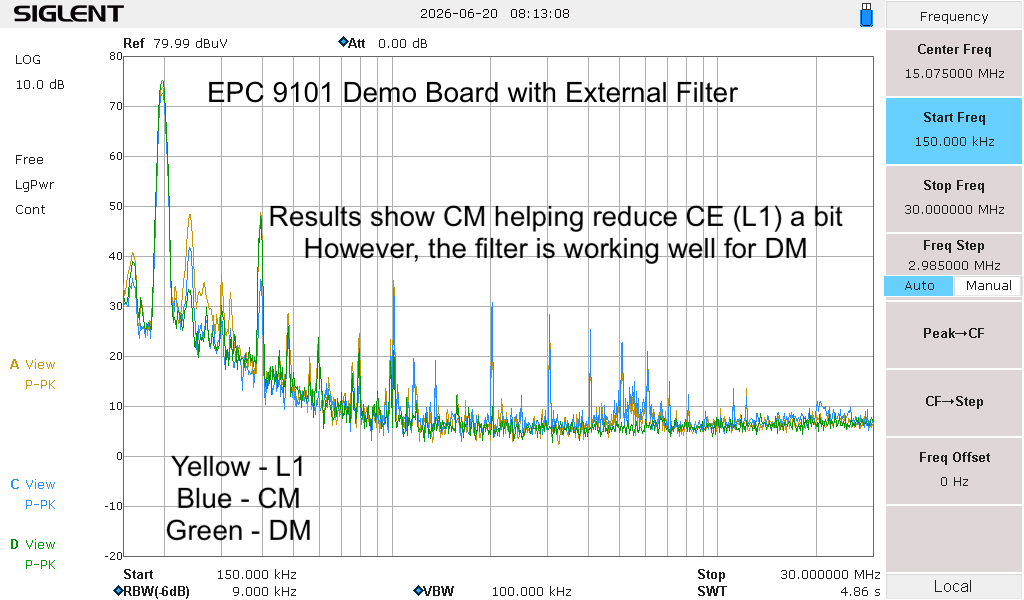
The filter board is a conventional topology with the usual CM and DM components installed. Results of the added filter in Figure 13 show a 2 to 10 dB improvement for CM (blue) and almost a complete reduction for DM (green). I’m showing the conducted emission for Line 1 (yellow) for reference.
This shows that the CM filtering needs to be improved, while the DM portion of the filter is good as-is.
Using the LISN Mate
The LISN Mate from Tekbox is an alternative to the more versatile EA-400 analyzer, in that it can separate out the CM from DM emissions. However, it is only designed for single-phase or simple DC power inputs. It requires two LISNs, which connect to ports on the LISN Mate. You must manually connect to either the CM or DM port to the spectrum analyzer. I’ve written a review of the LISN Mate here [4].
Let’s compare using the more manual LISN Mate with the EA-400 using just the EPC 9101 demo board. For each instrument, we recorded the CM and DM emissions and compared just the CM and DM between the two.
The results are shown in Figures 14 and 15, and as expected, both CM and DM measured very close to one another.
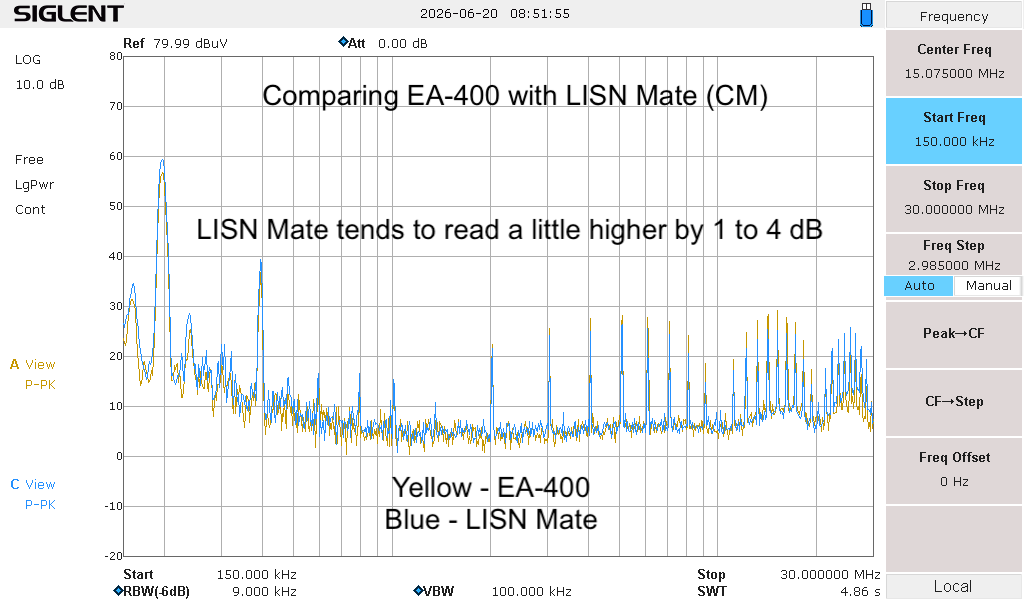
Figure 14. Comparing the EA-400 with the LISN Mate for CM. (Image: Kenneth Wyatt)
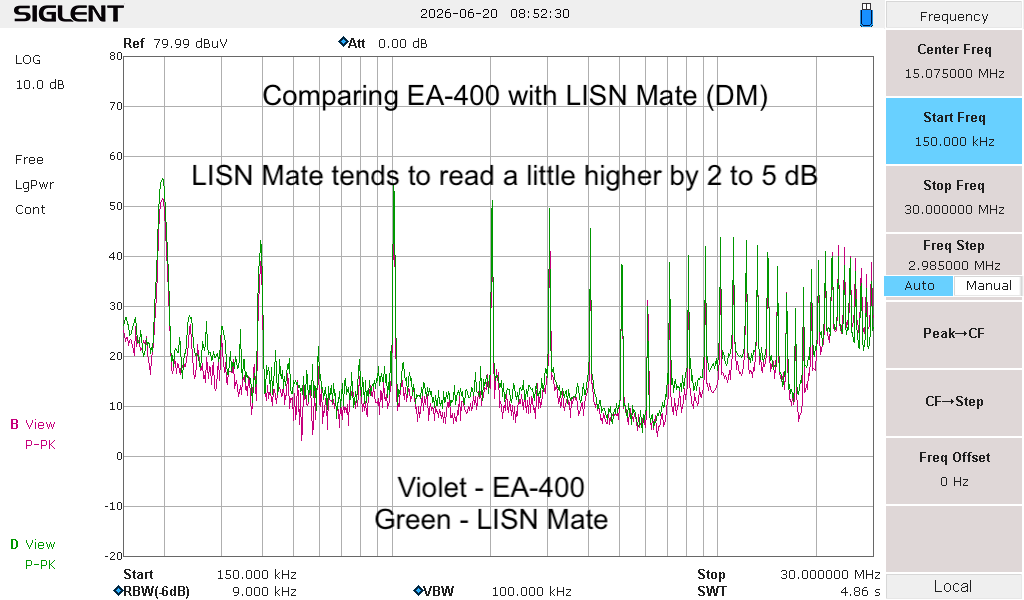
For the most part, the two instruments measured nearly the same levels, but the LISN Mate tended to read a bit higher by a few dB, depending on frequency. There seemed to be more divergence in frequencies between 20 and 30 MHz.
Because both instruments measured slightly differently, it’s hard to tell which is more accurate. However, the important point is that it’s possible to generally tell whether CM or DM is dominant, and in which frequency bands, then take definitive action to redesign the filter. This certainly beats guessing at filter topologies or “shot-gunning” component values. Refer to [4] for how I determine component values based on test results and component data sheet impedance curves.
Choosing the EA-400 or LISN Mate?
Both the EA-400 and Tekbox’s LISN Mate can split out the separate DM and CM components of the overall conducted emissions response. So, when would you choose one over the other?
Use the LISN Mate when performing limited troubleshooting tests or “one-off” confirmation tests. The LISN Mate is best suited for DC or single-phase AC power inputs. It also manually requires switching cables around, so is a little slower in use. However, the price is much less at $314 through the US distributor, Saelig Electronics [5].
Use the EA-400 EMI Analyzer for longer, more repetitive jobs, production testing multiple products, or running extended experiments, where simple push-button captures of conducted emission (line 1 and line 2), CM or DM may be quickly recorded. Besides DC and single-phase AC measurements, the EA-400 will also perform fast captures for three-phase power inputs, for which the LISN Mate is not well suited. Three-phase measurements and analysis would be extremely valuable for those working on electrification projects like EVs or systems using traction motors or other three-phase power conversion. Approximate price is $6,500 to $7,000.
Summary
I found the EA-400 a delight to use, with a simple hookup between the LISN and the spectrum analyzer. It allows fast switching between normal conducted emission (Line 1/2 or Line/Neutral) and the CM or DM components comprising the total conducted emission. With four button presses, I capture all the information I need in order to focus on improving the power input filter without a lot of “shotgunning” of filter components and manual cable-switching. The EA-400 EMI analyzer may be purchased from the U.S. distributor, Reliant EMC [6].
References
[1] EMCIS Co., Ltd.
[2] EMCIS EA-400 EMI Analyzer
[3] Mediano, Würth Elektronik filter kit review (Interference technology)
[4] Wyatt, LISN Mate review (EDN)
[5] Saelig Electronics
[6] Reliant EMC