
Physical artificial intelligence (PAI) development kits for humanoid robotics range from high-end, industrial-grade platforms to prosumer and educational, modular do-it-yourself (DIY) kits, Raspberry Pi-based options, and more.
Some kits are suited for specific functions like walking and navigation, using AI to understand natural language, sensor fusion, power conversion, and motion control, and handling objects in unstructured environments.
This article provides a brief overview of some available dev kits to help jump-start research, exploration, and development efforts.
Complete platforms
Complete humanoid robot platforms are available, designed for various levels of technical expertise. They can support experimentation and research into autonomous robotics, computer vision, AI, PAI, and other areas. Examples include:
- Human-sized humanoids designed for research in motion control, computer vision, and human-robot interactions.
- Advanced exploration kit for robotics with an Arduino-compatible microcontroller, 16 servos, and support for C++ and open-source development.
- Semi‑humanoid on a wheeled base built to use imitation learning and reinforcement learning to replicate human demonstrations and perform complex PAI-based industrial tasks.
- Open-source humanoid based on the Raspberry Pi board that supports Python programming, machine learning, motion control, and the ROS operating system.
Categorizing less than complete kits
One way to categorize PAI and humanoid dev kits is robot-specific technologies versus more general-purpose AI technologies. Humanoid walking relies on gait planning, navigation, and control of servo actuators, stability sensing, flexibility, balance, and other considerations. Computer vision and voice recognition are common technologies for a variety of applications, including human-robot interactions (Figure 1).
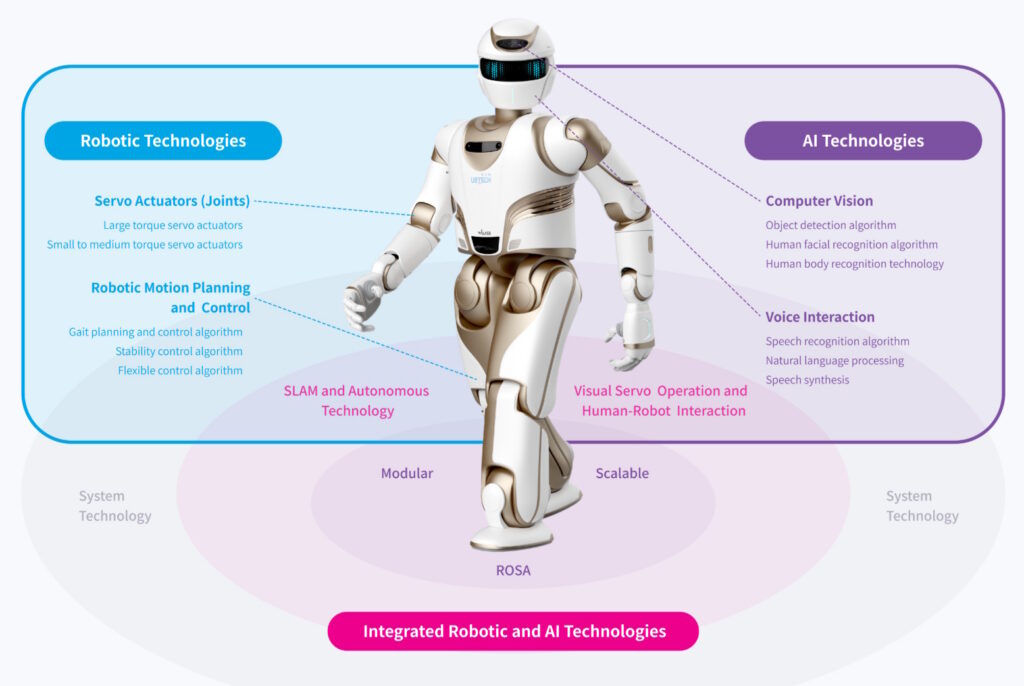
Not surprisingly, NVIDIA offers PAI and humanoid dev platforms, including the Isaac GR00T, for developing general-purpose models and data pipelines to accelerate humanoid research and development.
Jetson Thor platforms for physical AI and robotics deliver up to 2070 FP4 TFLOPS of AI compute and 128 GB of memory with power configurable between 40 and 130 W.
Hardware needs software
Exemplary software platforms include the Robot Operating System (ROS), an open-source software environment for robotics applications. Plus, variations like the robot operating system application framework (ROSA 2.0), a tailored, industrial-grade enhancement or wrapper around standard ROS/ROS 2, and the NVIDIA Isaac Sim for training in synthetic environments.
An AI SDK is available for running AI models locally on autonomous machines and robots and interfacing with humans.
A three-tier family of dev platforms, including: A semi-humanoid robot designed for advanced, real-world industrial tasks, such as logistics, assembly, and inspection; a middle-level 6-DOF manipulator designed for versatile research and automation, combining AI with high-torque performance; and a compact 5-DOF manipulator designed for simpler research projects into PAI and robotics.
Sensor streaming
The software used for sensor fusion needs to receive data with low latency from a variety of often incompatible sensor data streams. That’s where a technology like the NVIDIA Holoscan Sensor Bridge (HSB) is a handy development tool. HSB supports sensor-over-Ethernet connectivity that enables real-time data streaming.
HSB is particularly useful in applications like robotics. It’s based on a standard API and open-source software that supports flexible and scalable deployments (Figure 2).
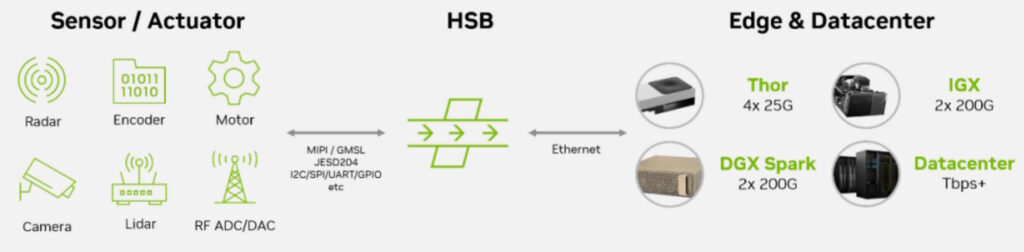
The NVIDIA HSB is being utilized differently by a variety of semiconductor makers. NXP Semiconductors focuses on using HSB to integrate high-speed sensor data into application processors and Ethernet switches for industrial and humanoid robotics edge-to-brain communication.
STMicroelectronics focuses on speeding the development of physical AI using NVIDIA’s HSB and Isaac Sim ecosystem for robotics by integrating its imaging and IoT sensors, like IMUs and ToF devices, into the NVIDIA platforms to optimize the “sim-to-real” training process.
Humanoids and forklifts
The power and voltage levels found in humanoid PAI applications are similar to those found in a variety of industrial applications, including forklifts. The primary difference is that space constraints tend to be more demanding for humanoids than forklifts.
For example, the Infineon Mobile Robot (IMR) development platform focuses on motion control as a core feature. The platform is designed for advanced motion and motor control capabilities, particularly for autonomous mobile robots (AMRs) and service robots, including wheeled humanoids.
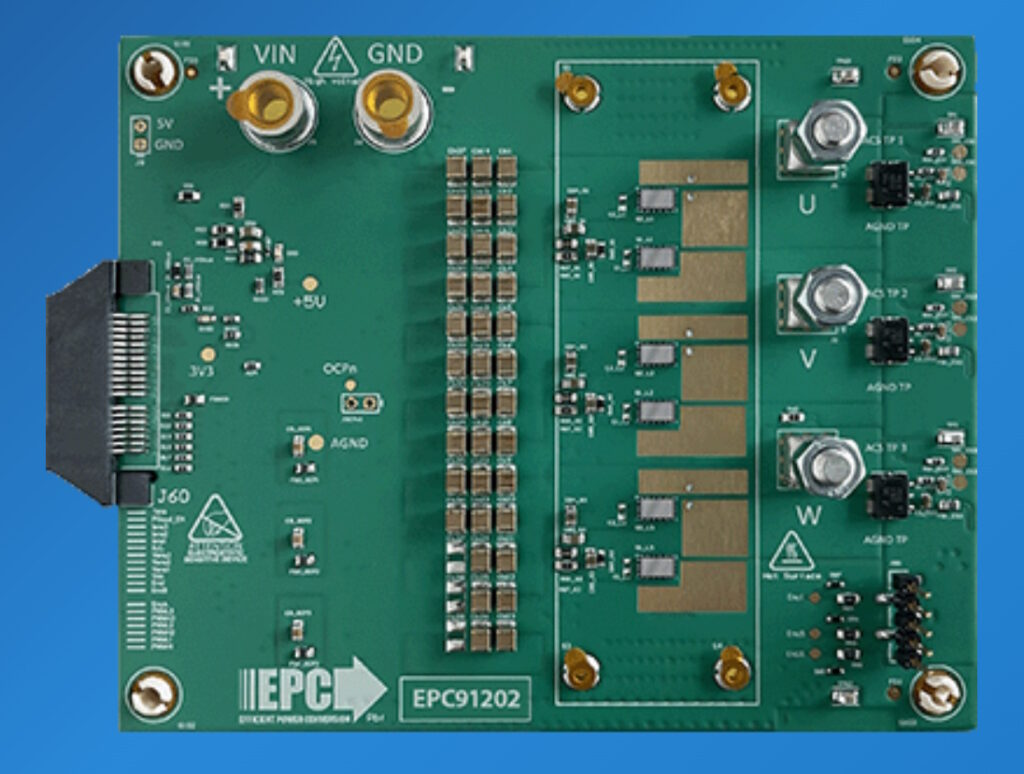
If the development team wants to explore the use of GaN-based motion control, the EPC91202 eval board is a complete three-phase BLDC motor drive inverter designed to accelerate development of high-efficiency motor drive applications in robotics, e-mobility, drones, industrial automation, and other battery-powered systems. It includes 100 V eGaN FETs and can deliver up to 70 A peak using PWM frequencies up to 150 kHz (Figure 3).
Summary
A wide range of dev kits is available for humanoid and semi-humanoid robots. They range from complete robot platforms to software environments, sensor fusion tools, and circuit boards for implementing motion control.
References
A Novel Implementation of a Social Robot for Sustainable Human Engagement in Homecare Services for Ageing Populations, MDPI sensors
EPC Introduces EPC91202 Evaluation Board: High-Performance 50 ARMS Three-Phase BLDC Inverter Powered by eGaN®, Efficient Power Conversion
EZ-Robot Developer Kit, EZ-Robot
Humanoid Robots for Research, AI and Education, Génération Robots
Humanoid Robotics and Physical AI, NXP
Infineon accelerates deployment of robots with improved safety and security features using digital twins in collaboration with NVIDIA, Infineon
JD – Humanoid Robotics Kit, Robots.Education
NEURA Robotics and Qualcomm Enter Strategic Collaboration to Advance Physical AI and Cognitive Robotics, NEURA Robotics
NVIDIA Jetson Thor Unlocks Real-Time Reasoning for General Robotics and Physical AI, NVIDIA
Qualcomm Introduces a Full Suite of Robotics Technologies, Powering Physical AI from Household Robots up to Full-Size Humanoids, Qualcomm
STMicroelectronics accelerates global adoption and market growth of Physical AI with NVIDIA, STMicroelectronics
Tether Launches QVAC SDK as the AI Universal Building Block that Runs, Trains, and Evolves Intelligence Across any Device and Platform, QVAC
Related EEWorld Online content
Designing for functional safety in robotics: key considerations for engineers
Are there any benefits from generative AI hallucinations?
Cloud connectivity for edge AI: bridging the demo-to-deployment gap
How is power limiting the adoption of physical artificial intelligence in humanoid robotics?
What is physical artificial intelligence and why is it important?