
Solid-state transformers (SSTs) have great potential benefits, but they are also expensive. In a hybrid solid-state transformer (HSST), sometimes called simply a hybrid transformer (HT), a smaller SST stage operates in tandem with a traditional line-frequency or low-frequency transformer (LFT). HSSTs can deliver lower costs compared with a 100% SST-based solution, but there are some tradeoffs.
In an HSST, the SST stage handles only the portion (typically 10-20%) of the total power needed for power quality-related functions like injecting reactive power, while the LFT processes the bulk load. The LFT section makes HSSTs larger than full SSTs.
An HSST is cheaper and more efficient than an SST, but more costly than just an LFT. A typical LFT is 99% efficient while an SST is 97-98% efficient. An HSST is in between with about 98.6% efficiency.
HSSTs are better suited for near-term use in microgrids and AC/AC environments. They can’t dynamically control voltage or completely filter electrical noise. SSTs, on the other hand, will enable direct medium-voltage to high-voltage DC conversion, supporting emerging 800V and ±400V data center power architectures. In AC-powered systems, grid voltage can vary ±10% and still meet the requirements of EN 50160. An HSST can do that.
More choices
It’s not simply a matter of using an HSST or an SST. There are different types of SSTs that provide different performance options. And two different HSST system architectures.
A single-state SST performs a direct AC-to-AC or AC-to-DC conversion using a single high-frequency transformer, completely avoiding intermediate DC energy storage. While simpler than a three-stage conversion, a single-stage SST provides limited control. The lack of a DC bus means it can’t provide advanced grid functions like power factor correction, reactive power compensation, or DC energy storage integration.
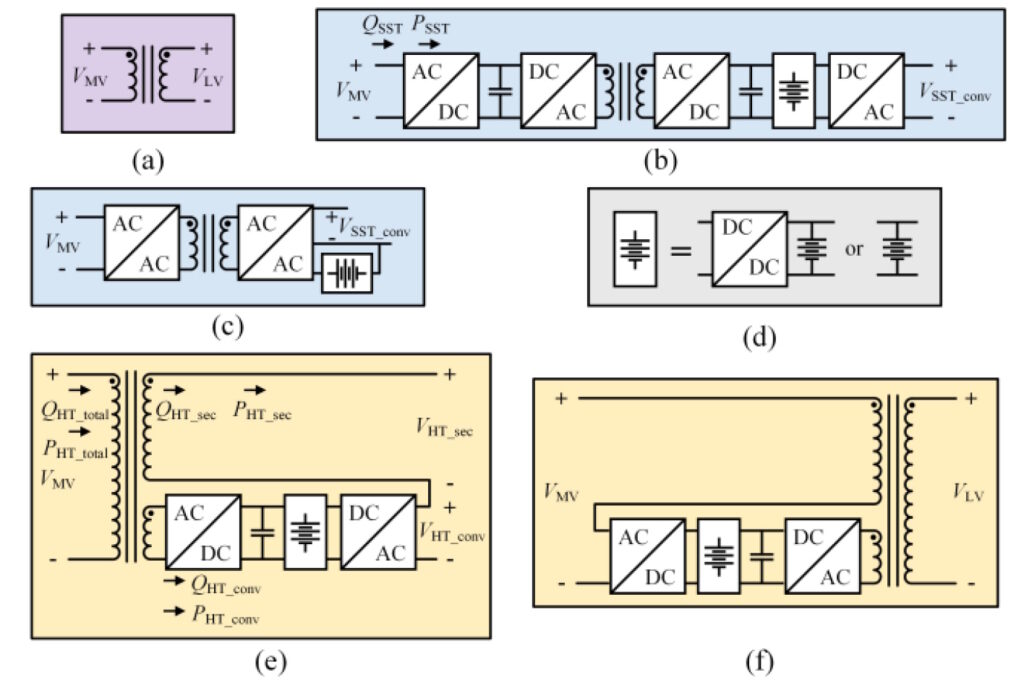
An HSST avoids the higher energy losses of a fully three-stage SST while providing enough active control to stabilize the grid and clean up power. Figure 1a shows a basic MV/LV LFT. Figures 1b and 1c illustrate a three-stage SST and a single-stage SST, respectively. Both can include an energy storage element detailed in 1d. In an HSST, the SST element can be located on either the LV side of the LFT (1e) or the MV side of the LFT (1f).
Protection considerations
Protection from overvoltage and overcurrent events on the grid during short circuits, lightning strikes, and other anomalies is important for all systems. The semiconductors in HSSTs and SSTs are much less robust compared with passive magnetic cores and demand more complex protection schemes.
That makes protection for HSSTs more complex. The protection circuitry must be fast and able to distinguish between minor grid disturbances, which the HSST can dynamically correct, and severe faults that can result in damage and demand immediate isolation.
Failure of the semiconductor devices in an SST can result in a complete loss of functionality. HSST architecture is more resilient. If the SST portion of an HSST goes offline, the basic LFT function can continue uninterrupted. The only loss is the additional power-quality-related functionality contributed by the SST section.
Validating HSST operation
HSST operation has been validated by several organizations. In one instance, a European power electronics laboratory designed and built a 100 kVA prototype HSST where the SST section is a 10 kVA converter using GaN power switches (Figure 2). The prototype was able to regulate voltage, active, and reactive power up to ±10% of the nominal values. It can also balance three-phase loads and actively filter harmonics.
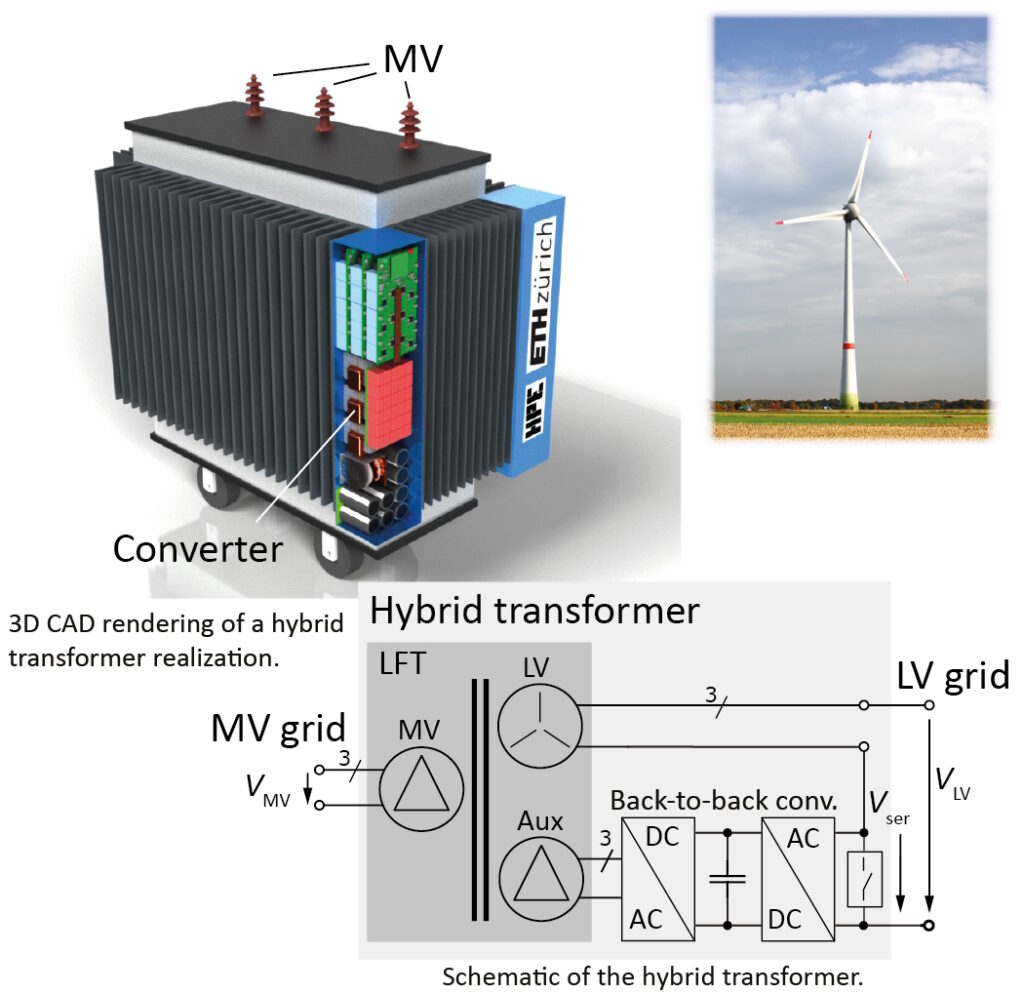
The prototype testing confirmed that a fractionally rated SST combined with a conventional LFT can control voltage, actively filter grid harmonics, and mitigate inrush currents. The thermal performance, switching losses, and control speed of the SST module were validated. Overall efficiency was over 98%.
In addition to demonstrating basic HSST operation, this design monitored grid and transformer operation and transmitted the data to a central control unit, like the operation of Industry 4.0 facilities. Centralized monitoring can be useful in distributed installations like wind or solar energy farms.
Summary
An HSST combines an LFT that handles almost all power and a much smaller SST section. It delivers many of the benefits of a full SST solution at a much lower cost. There are several circuit and system architectural options for implementing HSSTs based on application requirements. HSSTs are more robust and able to withstand voltage and current surges compared with SSTs. HSST functionality has been validated, and development efforts are underway.
References
A Modular Multi‐Port Hybrid Solid‐State Transformer for Large‐Scale Renewable Power Applications, IET Electric Power Applications
Active Hybrid Solid State Transformer Based on Multi-Level Converter Using SiC MOSFET, MDPI energies
Comparative Evaluation of MVAC-LVDC SST and Hybrid Transformer Concepts for Future Datacenters, ETH Zurich
Multifunctional Control Strategy for a Hybrid Solid-State Transformer Applied to Modern Distribution Electric Grids, MDPI electronics
MVAC-LVDC Hybrid and Solid-State Transformer Concepts for Future Data Centers, European Center for Power Electronics
Protection of Hybrid Transformers in the Distribution Grid, ETH Zurich
Solid-State Transformer and Hybrid Transformer with Integrated Energy Storage in Active Distribution Grids: Technical and Economic Comparison, Dispatch, and Control, IEEE Journal of Emerging and Selected Topics in Power Electronics
Solid-State Transformers and 800 VDC: What AI Data Centers Are Really Preparing For, Moonshot
Solid-State Transformer (SST) for AI Data Centers, Microchip
Related EEWorld Online content
What is the antiresonance effect in power supply capacitors?
How does the IEEE MagNet Challenge use AI for power magnetics modeling?
How do ML and AI work in power conversion? part 1
The difference between physical AI and machine learning in power electronics
How is physical artificial intelligence used to optimize data center efficiency?