
A grid-interactive microgrid now operating at Delta Electronics Americas’ Detroit-area facility is putting three power electronics technologies through their paces under live utility conditions: a solid-state transformer (SST), a 3MW Power Conditioning System (PCS), and a software-defined Energy Management System (EMS).
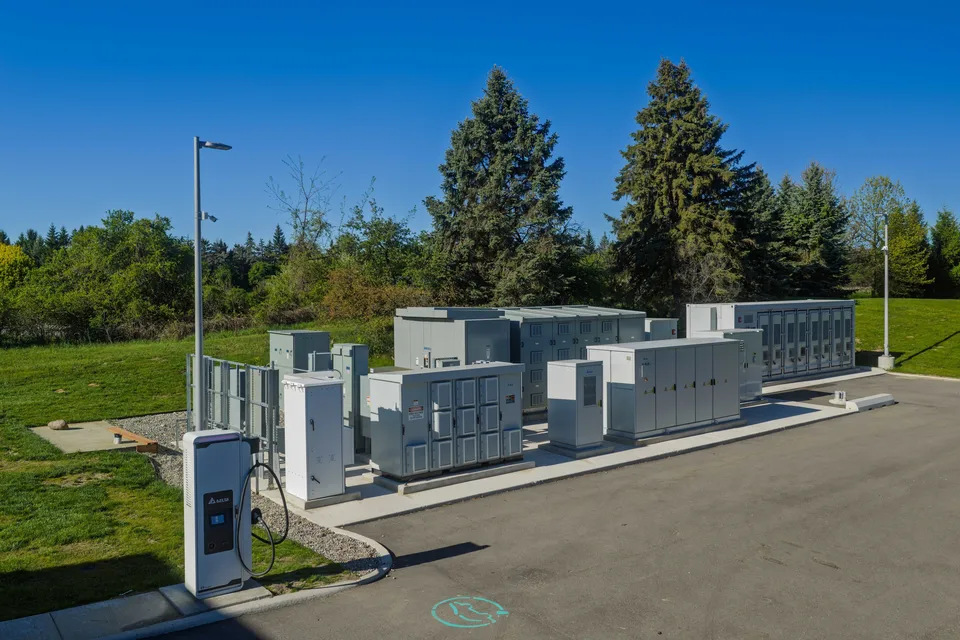
The SST, developed with DOE grant support, replaces passive voltage conversion with digitally controlled power electronics stages that actively regulate voltage in real time. In a microgrid where solar generation, battery storage, and EV chargers are operating simultaneously, that active control matters. Rather than simply absorbing load fluctuations, the SST compensates for them, enabling tighter coordination across the system. The installation connects to DTE Energy’s distribution network through a 13.2 kV medium-voltage interconnection, operating under conditions that closely resemble real commercial deployments.
The 3MW PCS manages bidirectional power flow across a 2.8 MWh BESS, 425 kW of rooftop solar, eight Level 2 EV chargers, and a 400 kW DC fast charger developed through a DOE-funded program. Each asset has a different electrical profile and demand characteristic. The PCS keeps them balanced without letting the dynamics of any one asset propagate back onto the grid. Planned additions include two back-to-back 5 MWh storage units for black-start and off-grid switching tests, plus a 300 kW gas turbine to study interactions between solar, storage, and dispatchable generation.
Orchestrating all of it is Delta’s EMS, monitored through its VTScada SCADA platform. The system continuously balances facility load demand, battery state of charge, solar forecasts, utility pricing signals, and grid stability requirements, shifting between operational modes as conditions change. During summer months the facility achieves net-zero operation. Over a full year, grid dependence has dropped by approximately 50 percent.
The Detroit site is open for customer engagement, giving commercial and data center operators the opportunity to evaluate SST performance, PCS architecture, and EMS control strategies under real operating conditions before committing to their own deployments.