
Humanoids and physical artificial intelligence (PAI) are central to the goals of Industry 5.0, shifting from pure automation to human-centric, collaborative manufacturing. They enable high-level personalization and worker augmentation by handling dangerous, repetitive, or complex tasks while adapting in real time to human actions and shared environments.
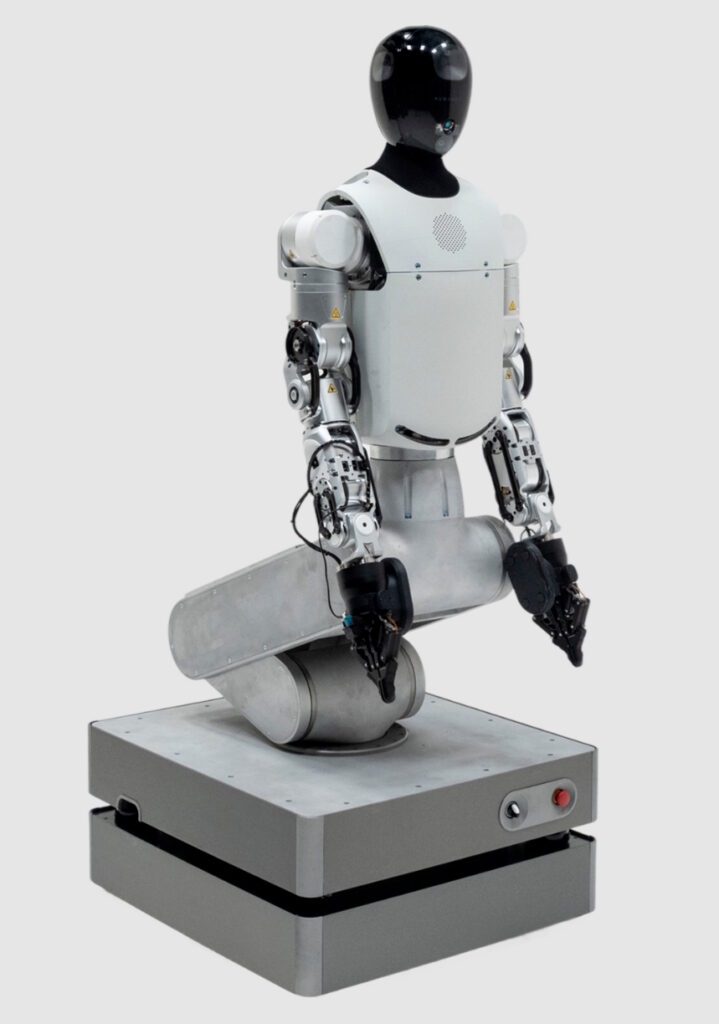
Some current humanoid robots, like the HMND 01 Alpha, that have been tested by Siemens don’t have legs or feet (Figure 1). The head has 360° view RGB cameras plus two depth sensors. The torso and body have 6-dimensional force and torque (F/T) sensors. The wrists have RGB cameras. The end effector has F/T plus haptic feedback sensors. The end effectors are a modular design with 12 degrees of freedom (DOF) motion, a 5-finger hand, or a 1-DOF parallel gripper with a pad. For motion, it uses an omnidirectional wheeled base with a maximum speed of 7.2 km/h. It also has interchangeable chest garments for protection and safety.
The target performance metrics were met during the limited test in a logistics facility, including a throughput of 60 tote moves per hour, uptime over 8 hours, and autonomous pick-and-place success rates above 90 percent. A good start, but it’s unclear if the HMND 01 Alpha robot, as used by Siemens, is ready for deployment in a live logistics operation.
The full value of a humanoid robot in Industry 5.0 is only realized when it becomes fully integrated as a collaborative asset. That requires real-time data exchange with other systems, including other robots and AGVs, and synchronizing activities with human operators; otherwise, it becomes just another island of automation.
Three pillars of Industry 5.0
In the longer term, humanoids and PAI are expected to support the three pillars of Industry 5.0: human-centricity, sustainability, and resilience.
- Human-centric design: Humanoid robots can handle monotonous, heavy, or hazardous tasks, working in tandem with humans, enabling humans to focus on creative, high-value tasks. PAI is the key technology enabling safe and intuitive human-humanoid interactions.
- Resilience: PAI combined with humanoids make the entire production process more flexible, able to accommodate unpredictable changes, and handle varying tasks. That will minimize production disruptions and absorb unanticipated shocks to the system.
- Sustainability: If the ‘AI’ component in PAI can be implemented with minimal energy consumption the net effect of PAI can be to minimize resource consumption and have a net positive impact on sustainability. The flexibility of humanoids can extend their useful lifetimes and require less frequent replacement compared with traditional automated systems.
Coexistence, cooperation, or collaboration?
Industry 5.0 includes human-centric, collaborative manufacturing. However, there are three recognized levels of workspace sharing for human-robot interaction. Coexistence indicates that humans and robots are working in the same space at the same time, but not on the same tasks. If they are working on the same task, but not in direct contact, it becomes cooperation. When humans and robots come into contact during work, it becomes a collaborative effort (Figure 2).
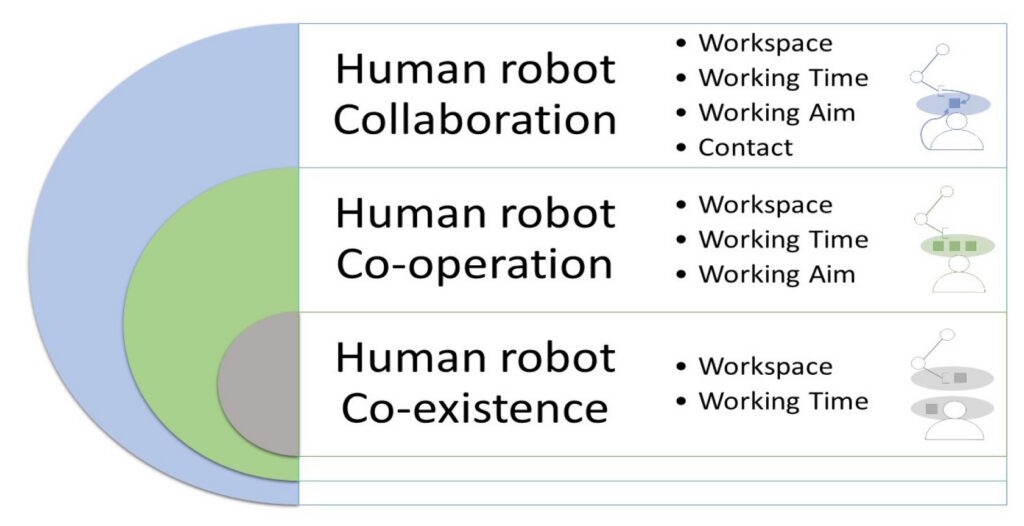
To be considered a true Industry 5.0 implementation, there must be actual collaboration between humans and robots. That collaboration can take two forms:
- Physical collaboration where there is direct contact between the human and robot, typically with the human hand contacting the robot’s end-effector. The force of the human hand directly assists or guides the motion of the end-effector.
- Contactless collaboration is implemented either through direct human control using speech or gestures, or indirectly using facial expressions, gaze directions, or intention recognition on the part of the robot. Intention recognition is the most complex and requires the robot to understand and identify a human’s immediate goals, actions, or intended next steps by analyzing their behavior, allowing the robot to adapt, assist, or react proactively.
Summary
Humanoid robots and PAI will be key technologies enabling Industry 5.0. Pilot installations are being used to test the limits and benefits of human-robot collaboration in industrial settings. In some instances, the technology is in the early stages of commercialization. The use of Industry 5.0 is expected to accelerate between now and 2030.
References
A sequential roadmap to Industry 6.0: Exploring future manufacturing trends, The Institution of Engineering and Technology
Are humanoid robots finally leaving the lab?, A reality check, Luxembourg Institute of Science & Technology
Control System Design and Methods for Collaborative Robots, MDPI applied sciences
Human and Humanoid-in-the-Loop (HHitL) Ecosystem: An Industry 5.0 Perspective, MDPI machines
Human-Centric Collaboration and Industry 5.0 Framework in Smart Cities and Communities, MDPI smart cities
Human–robot collaboration in Industry 5.0: a human-centric AI-based approach, Frontiers in Robotics and AI
In industry 5.0, great minds will literally think alike, Micron Technology
Industry 5.0 Explained: From Human-Machine Rivalry to Partnership, Simio
Industry 5.0 — A Human-Centric Solution, MDPI sustainability
Reviewing human-robot collaboration in manufacturing: Opportunities and challenges in the context of industry 5.0, Robotics and Computer-Integrated Manufacturing
Siemens and Humanoid bring Physical AI to the factory floor, Siemens
Special Issue: Human–Robot Collaboration in Industry 5.0. American Society of Mechanical Engineers
Towards seamless and safe human-robot collaboration in Industry 5.0: advances in human behaviour prediction, International Journal of Production Research
Related EEWorld Online content
What is multimodal sensing in physical AI?
The difference between physical AI and machine learning in power electronics
What are the applications of physical artificial intelligence?
How is power limiting the adoption of physical artificial intelligence in humanoid robotics?
How can robots improve the ice cream experience?