
Learn how to evaluate load capacity, efficiency, environmental conditions, protection features, and form factor when selecting power supplies for industrial automation systems.
By Ryan Winters, Product Manager, Jameco Electronics
Industrial automation systems are only as reliable as the power behind them. Whether you’re designing a new control panel, upgrading existing equipment, or expanding a manufacturing line, selecting the proper power supply is one of the most important design decisions you’ll make. A high-quality power supply doesn’t just deliver voltage, it helps maximize uptime, protects connected equipment, and contributes to the long-term reliability of the entire system.
Today’s industrial environments place greater demands on power systems than ever before. PLCs, HMIs, sensors, industrial Ethernet switches, servo drives, safety relays, and edge computing devices all rely on stable, dependable DC power. Choosing the wrong power supply can lead to nuisance shutdowns, excessive heat, reduced efficiency, or premature equipment failure.
Fortunately, selecting the right solution becomes much easier when you understand a few key considerations.
Determine Your Voltage and Power Requirements
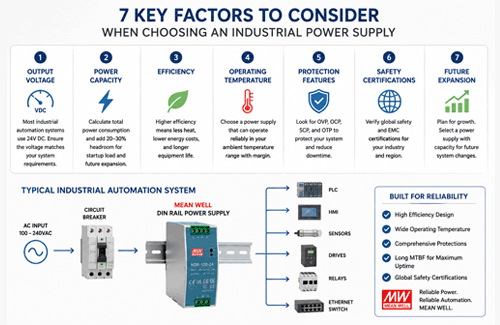
Remember that power (watts) is determined by both voltage and current (Watts = Volts × Amps), so selecting the correct output voltage is just as important as providing adequate power capacity. The first step is determining how much power your application actually requires. Add together the power consumption of every connected device, not only controllers and sensors, but communication modules, displays, relays, and accessories as well.
Rather than selecting a power supply that exactly matches your calculated load, experienced engineers typically include additional capacity to account for startup current, future expansion, and continuous operation. Providing reasonable operating headroom can reduce thermal stress and support longer service life, particularly in continuously operating systems.
Choose the Correct Output Voltage
Before selecting a power supply, verify that its output voltage matches the requirements of your connected equipment. Most industrial automation systems operate on 24VDC, making it the most common output voltage for PLCs, HMIs, sensors, relays, industrial Ethernet switches, and other control devices. However, many applications also require 5VDC, 12VDC, 15VDC, 48VDC, or multiple voltage rails.
Using the wrong output voltage can damage equipment, cause unreliable operation, or prevent devices from functioning altogether. Always review the voltage specifications of every connected component and ensure the power supply can provide the required voltage with sufficient current capacity for the entire system.
Consider the Operating Environment
Industrial applications are rarely installed in ideal conditions. High ambient temperatures, limited airflow, vibration, dust, moisture, and electrical noise all affect power supply performance.
When selecting a power supply, evaluate:
- Ambient operating temperature
- Ventilation inside the enclosure
- Mounting orientation
- Altitude
- Humidity
- Required ingress protection
- Shock and vibration requirements
Many industrial power supplies require output derating as temperatures increase. Choosing a model designed for higher operating temperatures helps maintain reliable performance even in demanding environments.
Efficiency Matters More Than You Think
Power supply efficiency has a direct impact on system reliability. Higher efficiency means less wasted energy, lower operating temperatures, and reduced cooling requirements inside the control cabinet.
Lower internal temperatures can significantly improve component lifespan while allowing engineers to design more compact control panels.
Modern high-efficiency power supplies also help organizations reduce energy consumption and operating costs throughout the life of the equipment.
Choose the Right Form Factor
Industrial automation applications commonly use two power supply styles:
DIN Rail Power Supplies are ideal for control cabinets, factory automation, process control, and building automation. They simplify installation, improve serviceability, and save valuable panel space.
Enclosed Power Supplies are commonly used inside machines, OEM equipment, test systems, kiosks, and other applications where DIN rail mounting isn’t required.
Selecting the proper form factor makes future maintenance easier while improving airflow and overall cabinet organization.
Don’t Overlook Reliability Features
Industrial power supplies should provide more than basic voltage regulation. Look for features that improve system reliability, including:
- Overvoltage protection
- Overcurrent protection
- Short-circuit protection
- Overtemperature protection
- High MTBF (Mean Time Between Failures)
- Wide operating temperature range
- Safety and EMC certifications
These features help protect both the power supply and the equipment connected to it, minimizing costly downtime.
Plan for Future Expansion
Automation systems rarely remain static. New sensors, communication modules, HMIs, cameras, and control devices are often added as operations expand. Choosing a power supply with 20–30% additional capacity helps accommodate future growth, reduces the likelihood of costly redesigns, and simplifies future maintenance and system upgrades.
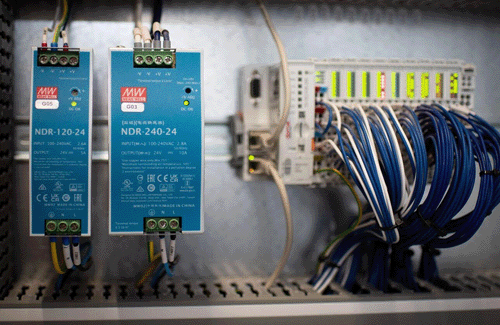
Once the system requirements are defined, engineers can compare power-supply families based on available space, performance, efficiency, and environmental demands. MEAN WELL offers power supplies designed for a wide range of industrial applications, including compact DIN rail models, enclosed AC/DC power supplies, programmable solutions, and redundant power systems. Their products are known for high efficiency, long operating life, comprehensive protection features, and global safety certifications.
Popular industrial series include:
- HDR Series for compact installations
- NDR Series for standard industrial applications
- SDR Series for higher performance and demanding environments
- XDR Series for premium efficiency, compact design, and advanced industrial automation applications
With models available in multiple output voltages and power ratings, engineers can select a solution that fits both current requirements and future system growth.
Selecting the right power supply is only part of a successful project. Working with a trusted distributor ensures you have access to quality products, technical resources, and knowledgeable support throughout the design process.
Jameco offers a broad selection of genuine MEAN WELL power supplies for industrial automation, manufacturing, test equipment, control panels, and OEM applications. Whether you’re replacing an existing unit or designing an entirely new system, our team can help you identify the best solution for your application.
Explore MEAN WELL Industrial Power Supplies at Jameco
https://www.jameco.com/MeanWell
Sponsored content by Jameco Electronics