
A unique thermal-management device keeps optical components at a known, stable temperature and is key to their consistent performance.
It’s interesting to see how a physics principle that was investigated a very long time ago – long before electronics and even electricity were understood – eventually becomes the key to a very modern technology. That’s the case with the Peltier effect and modern optical and electro-optical sources, data links, and interfaces.
This article will look at the Peltier effect, its embodiment in thermoelectric coolers, and their essential role in assuring wavelength stability in optical interfaces. These two very disparate technologies are linked by a single unavoidable factor: heat.
The dissipation and management of heat and temperature is an important topic in almost any design, whether it’s a small circuit board or a huge data center. In most cases, the problem is to get excessive heat away and keep the circuit or system below some threshold temperature, where “away” is defined as that magic place where the heat is no longer your problem but instead becomes someone’s else headache.
There are only three fundamental ways to pull that heat away from its source: via convection through a moving fluid, conduction through a solid, or radiation via infrared energy, shown in a common application of Figure 1.
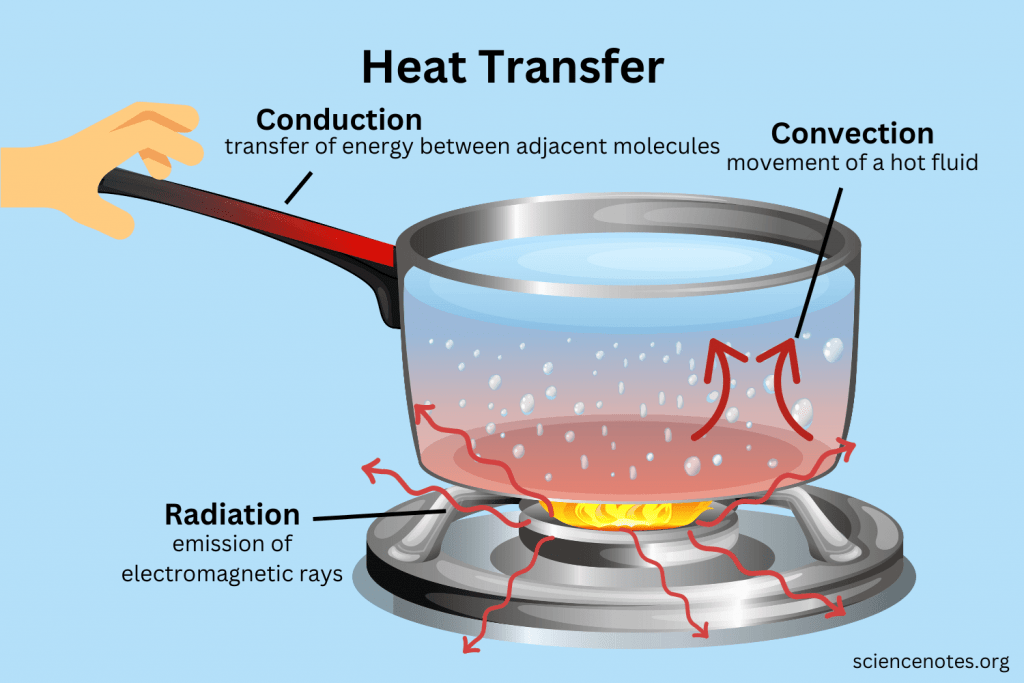
In most designs, highly localized conduction is used to get the heat away from its point source or sources, such as a semiconductor device or package; then convection (often with further conduction) is used to get that removed heat further away. In practice, radiation is ineffective at removing heat and is only used where there is no alternative, such as in the vacuum of space.
Despite all the attention given to keeping temperature below a threshold value, there’s another type of thermal management on which some engineers focus: keeping the temperature of a component at a preset setpoint value, often to within 1⁰C and in some applications 0.1⁰Cor even 0.01⁰C.
Two examples are the quartz crystal or MEMS-based oscillator used to establish timing or frequency, or a voltage reference for a precision test and measurement system. For highest performance and stability, the core element may be placed in an oven at a fixed temperature in these cases.
An increasingly important application centers of opto-electronics, where the stable performance of the sophisticated laser diode or other optical assembly across many of its key parameters is a function of its temperature. Consider that while a laser diode may be dissipating only a modest amount of – often just a few hundred milliwatts – this power is concentrated in a tiny area of less than a square millimeter, so the local heat density can be as high as 100 W/cm2.
What’s the problem if the diode gets hot? It’s not that a hotter temperature will lead to premature failure here (although it will). Instead, it’s that diode output power, modulation characteristics, noise, and most importantly, its operating wavelength are functions of temperature.
The solution is a micro-sized cooler/heater, capable of maintaining a local temperature at a precise value, almost always through needed cooling. On some infrequent occasions, heating will also be required if the ambient temperature is low and is already cooling the optical device below the setpoint.
For these optical applications, it also must be quiet, have no moving parts, and be inherently reliable. We’ll see how these difficult objectives can be met by employing the Peltier effect built into thermoelectric coolers (TECs) and how TECs are used to stabilize the temperature of optical components such as laser diodes and thus stabilize wavelength. (Note that “cooler” is a slight misnomer, since the same material and set-up can be used for heating as well, if needed, although that is rarely the need.)
The ability to provide active cooling on demand to below ambient temperature, as compared to just dissipation of excess heat, is one of the markers of the modern world. This is a point made clear in the Paul Theroux novel “The Mosquito Coast” (1981); the protagonist proclaims “ice is civilization!” as he attempts to bring a wood-fired refrigeration system to the Honduran jungle (the 1986 movie version starring Harrison Ford and Helen Mirren is also very good).
When you think about it, there’s a lot of truth and insight in that simple three-word exposition about the impact of refrigeration. Even Albert Einstein was fascinated by refrigeration and co-patented an innovative refrigerator design (see References).
The next section looks at the Peltier effect, the basis for thermoelectric coolers.
References
Einstein’s Little-Known Passion Project? A Refrigerator, WIRED
The Einstein-Szilard Refrigerators, Scientific American
Patent granted for Einstein-Szilard Refrigerator, November 11, 1930, American Physical Society
How Do TECs Work? The Peltier Effect, Sheetak
Water cooling with Peltier, worth it?, WordPress, Deavid Sedice’s Blog
Phononic Thermal Fabric™ Unlocks Performance, Efficiency, and Asset Life in AI Data Centers, Phononic
Co-Packaged Optics: Unmatched Bandwidth, Efficiency and Reliability, Phononic
Peltier Effect, Science Direct
Thermoelectric coolers prevent thermal drift within compact optical systems, Laser Focus World
Cooling is critical for copackaged optics, Laser Focus World
Thermoelectric effect, Wikipedia