
A unique thermal-management device keeps optical components at a known, stable temperature and is key to their consistent performance.
The Peltier effect
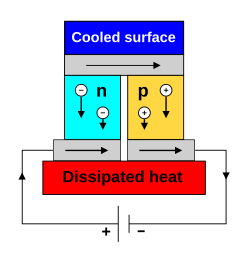
The eponymous effect was discovered in 1834 by the French physicist Jean-Charles-Athanase Peltier. It is a simple concept (although the underlying physics is not simple and was not understood for many years): when an electric current flows through a material consisting of two dissimilar conductors, there is cooling of one junction and the heating of the other; the effect is even stronger in circuits containing dissimilar semiconductors. Heat is absorbed by one of the junctions and released at the other, as seen in Figure 1.
Note that the Peltier effect does not “create” cooling; instead, it moves thermal energy (heat) from one side to the other, where it still needs to be “disposed of.” You can therefore move heat away and thus create a cooling effect, or you can move heat the other way to warm the area around the device by reversing the DC current flow. It’s an electrically reversible heater/cooler with no moving parts, which is an impressive feat.
That reversibility is the unique aspect of the Peltier effect. Change the direction of electrical flow, and you get heat moving in the opposite direction. Thus, the same junction can be used for localized heating or cooling, so long as you keep the cool side cool enough to “receive” the transferred heat.
If this sounds like a variation on the better-known Seebeck effect (named after the German physicist Thomas J. Seebeck, who discovered the phenomenon in the 1820’s) and thermocouples, it is the complement of that effect, seen in Figure 2.
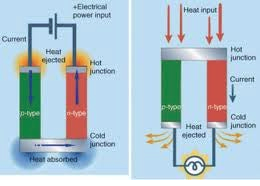
With the Seebeck effect, electricity is produced from heat. This thermoelectricity occurs in an electric circuit in which two dissimilar conductors or semiconductors are joined at their ends. When one of the junctions is at a different temperature than the other, a direct electric current will flow in the circuit.
The Seebeck effect and thermocouples are used to measure temperature, of course, as well as to provide power as a thermoelectric generator (TEG) using a heat source such as a flame or even radioactive decay (it is used in many space satellites and deep-space missions where solar panels are not viable).
In contrast, the Peltier effect is used in heat pumps, which remove heat (although they can also add heat) using a controlled, reversible solid-state device (meaning there are no mechanical parts).
TECs are solid-state Peltier devices that, once a DC current is applied, will transfer heat from one side to the other. This means that one side of the device will produce cold while the other side produces heat. The heated side is often attached to a heat sink so that the device can be used for cooling.
Consumer-product applications for TECs range from portable coolers to humidifiers, beverage coolers, and refrigerators. In the scientific realm, TECs are used in satellites, spacecraft, computer components (such as CPU coolers), to cool the lasers used in fiber optic communication networks, and more.
This ability to provide cooling without moving parts, vibration, or noise appears to be a great advantage compared to the more common compressor-based refrigeration. So why isn’t it used in applications such as consumer products?
In short: it is primarily due to their inefficiency. In simple terms, you have to pay a lot in power to get rid of that unwanted heat. It’s only worth it when there are no viable alternatives to getting heat away from a sensitive, specific area, even if you increase the overall thermal dissipation of the larger system.
There are many figures of merit used to characterize TECs, with these top-tier ones:
- Temperature Differential [ΔT (°C)]: The temperature difference between the cold side and hot side. This is the number that determines whether a TEC can reach the target operating temperature.
- Maximum Cooling Capacity [Qmax (W)]: The maximum heat the TEC can pump when ΔT is zero.
- Coefficient of Performance [COP]: Cooling power output divided by electrical power input. A COP of 0.5 means the TEC removes 0.5 W of heat for every 1 W consumed. COP drops as ΔT increases.
Going through the numbers in detailed thermal analysis will tell designers and users of specific TECs the performance and efficiency results with high accuracy. As a general rule, the reason that TECs are not used for large-scale, bulk area cooling comes down to efficiency.
The amount of input DC energy (and power) the TEC needs to operate is far greater than the amount of heat it can remove, typically by a factor of four to eight times. That means that the TEC itself consumes much more power than it pulls from the hot side to the cool side. Not only is that wasteful itself, but the power dissipated by the unit’s power source must also be removed to “away.”
For this reason, the dominant use for this Peltier-based cooling technology is for very localized, non-bulk cooling such as keeping an individual device at a specific setpoint temperature or below a threshold value, or where there is no viable alternative (such as a hot component in a spacecraft).
The next part looks at some TEC module specifics.
References
Einstein’s Little-Known Passion Project? A Refrigerator, WIRED
The Einstein-Szilard Refrigerators, Scientific American
Patent granted for Einstein-Szilard Refrigerator, November 11, 1930, American Physical Society
How Do TECs Work? The Peltier Effect, Sheetak
Water cooling with Peltier, worth it?, WordPress, Deavid Sedice’s Blog
Phononic Thermal Fabric™ Unlocks Performance, Efficiency, and Asset Life in AI Data Centers, Phononic
Co-Packaged Optics: Unmatched Bandwidth, Efficiency and Reliability, Phononic
Peltier Effect, Science Direct
Thermoelectric coolers prevent thermal drift within compact optical systems, Laser Focus World
Cooling is critical for copackaged optics, Laser Focus World
Thermoelectric effect, Wikipedia