
The synergy between quantum computing (QC) and artificial intelligence (AI) can be powerful. Quantum hardware supercharges AI capabilities, and AI helps solve the severe physical limitations of quantum systems. The synergy will be especially beneficial in applications like cybersecurity, computer vision, and design simulations.
The addition of room-temperature QC (RTQC) will amplify the benefits by more tightly coupling QC with classical computing and AI. Check out “System integration of quantum computing is the new and next challenge” for more info on practical RTQC.
How QC enhances AI
QC’s advantage versus conventional computing is derived from the use of qubits and the properties of superposition (being both 0 and 1 at the same time) and entanglement that links qubits so that the state of one instantly correlates with another, vastly multiplying computational capacity and enabling complex, coordinated operations that classical systems cannot perform.
Faster training and optimization of AI models is a key benefit of QC. As a result of its massive parallel processing capabilities, QC can perform algorithms like variational quantum circuits (VQCs) and quantum support vector machines (QSVMs) much faster than even supercomputers.
In addition, quantum neural networks (QNNs) and quantum transformers require a much smaller number of parameters to achieve high accuracy compared with classical large language models (LMMs) or convolutional neural networks (CNNs).
How AI improves QC
QC is fast, but qubits are fragile. That’s where AI can help mitigate problems like decoherence and high error rates, making QC processing more robust and reliable.
Error correction using deep learning models, reinforcement learning, and transformer networks can detect, decode, and suppress qubit errors and code faults. Examples include AlphaQubit from Google and PhysicsNeMo jointly developed by NVIDIA and QuEra.
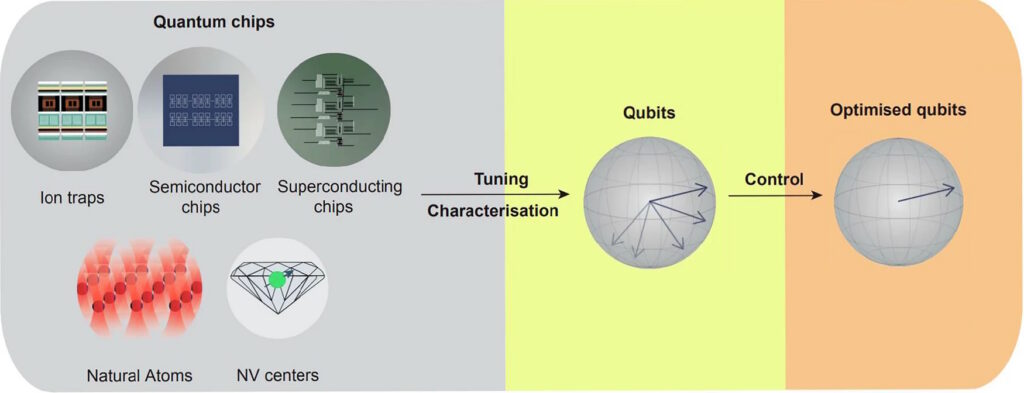
Bayesian optimization methods can reduce calibration times from hours to minutes, quickly tracking and accounting for qubit performance degradation, helping preserve high gate fidelity across long instruction chains.
Reinforcement learning algorithms can achieve faster gate speeds and shorter pulse durations. That leaves less time for the environment to interact with the system, effectively bypassing decoherence windows (Figure 1).
QML beyond simple synergy
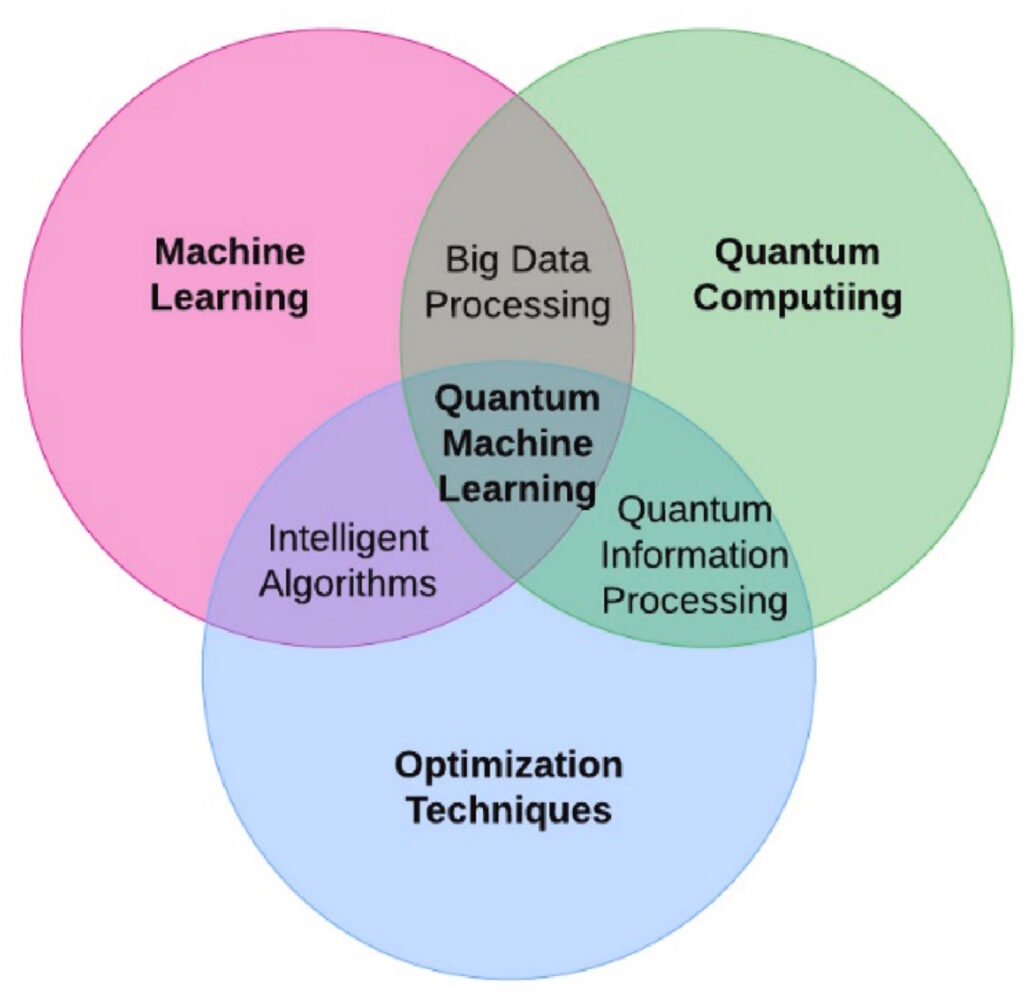
The relationship between QC and AI is deeper than simple synergy. QC and AI share a mathematical foundation rooted in linear algebra, vector spaces, and probability theory that powers quantum machine learning (QML).
QML exists at the intersection of ML and QC, and it supports advanced optimization algorithms (Figure 2). Instead of replacing classical computers with QC, QML uses quantum processors as specialized accelerators to speed up heavy mathematical calculations.
There are several possible approaches for leveraging the benefits of QML, including:
- QML can be used in cybersecurity, natural language processing (NLP), and other applications to efficiently measure the distance between data points in high-dimensional matrices to determine if points belong to the same class or cluster.
- Quantum neural networks (QNNs) combine classic artificial neuron-based ML with parameterized quantum circuits for advanced pattern recognition, drug discovery, and financial optimization applications.
- Variational quantum classifiers (VQC) are hybrid loops where a quantum circuit acts as the main classification function. VQC is used in engineering simulation, NLP, fraud detection, and other applications.
Synergy heats up
RTQC racks in data centers are an emerging form of QC accelerator. They combine easy co-location and simple integration. RTQCs consume far less power than existing high-performance computing racks and are compatible with the standard software development environments like Qiskit, Cirq and PennyLane (Figure 3).
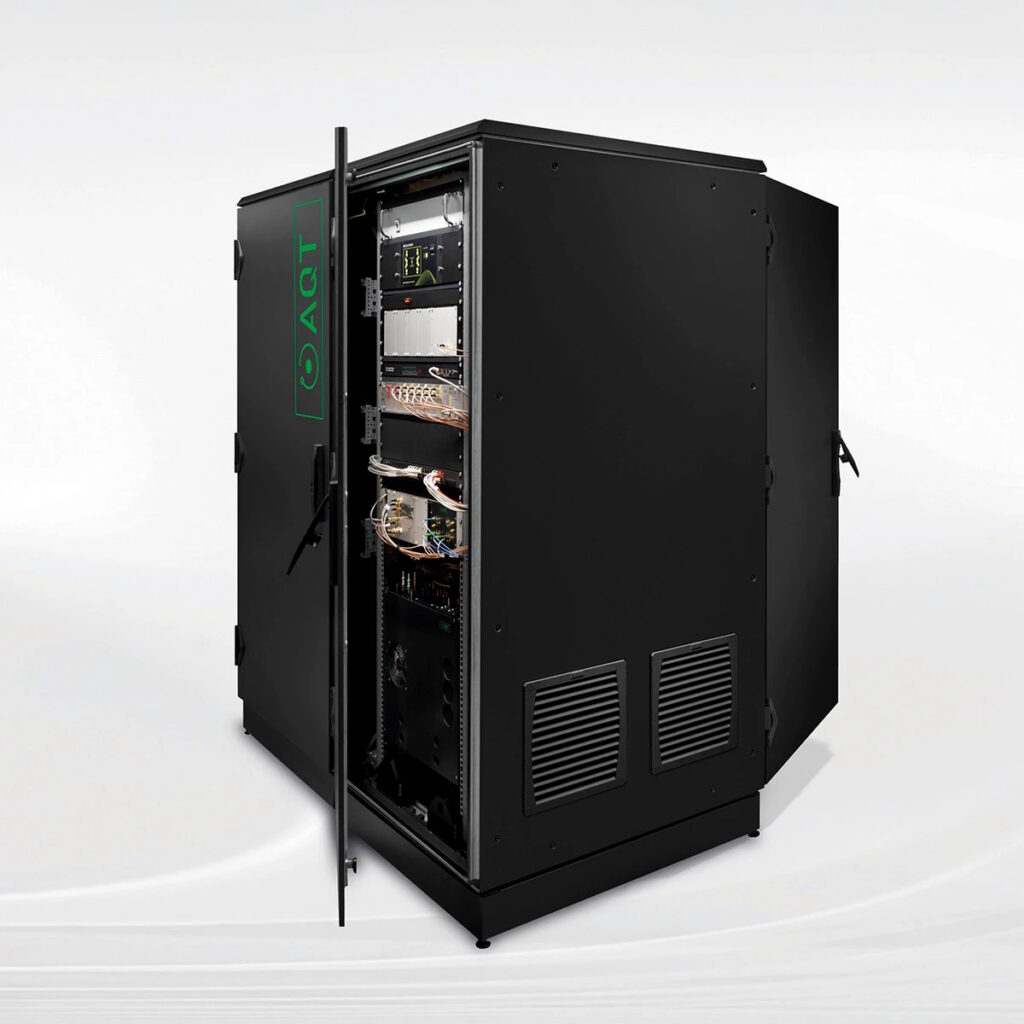
Physical proximity eliminates latencies inherent when using cloud-based cryogenic QC (CQC). Basic AI workloads like hyper-complex matrix multiplications or high-dimensional optimization can be offloaded to the RTQC processors. That also saves the expensive CQC processors for more demanding and high-value uses.
The room-temperature operation means that RTQCs can consume data continuously without the thermal penalties associated with SCQC. The relative stability of RTQCs supports running QNNs for processes like complex pattern recognition not possible to accomplish using classical computing.
Summary
Individually, QC and AI are game-changing technologies. Combined, they offer designers dramatic development and support processes and applications beyond the reach of either technology alone. Adding RTCQ along with high-performance CQC takes the combination to the next level in terms of both performance and accessibility for a wider array of applications. Maybe it’s 1 + 1 = 10, not 1 + 1 = 3.
References
Artificial intelligence for quantum computing, Nature Computing
Establishing Baselines for Photonic Quantum Machine Learning: Insights from an Open, Collaborative Initiative, arXiv
How Does Quantum Machine Learning Work?, IonQ
How quantum powers artificial intelligence, Pasqal
Introduction to Quantum Machine Learning, Geeks for Geeks
Machine learning and quantum computing for 5G/6G communication networks, International Journal of Intelligence Networks
Quantum Computers Will Make AI Better, Quantinuum
Quantum Computing & Artificial Intelligence, Cloud Security Alliance
Quantum Computing Meets AI: A Practical Guide for Data Scientists, Quandela
Quantum Machine Learning, QuEra
What is Quantum Machine Learning (QML)?, Quantum Insider
Related EEWorld Online content
What is the mathematical foundation of post quantum cryptography?
How are single photon sensors used in quantum computing?
What is physical artificial intelligence and why is it important?
How does artificial intelligence relate to immersive audio?
What’s the relationship between Ohm’s Law and quantum mechanics?