
Basic principles lead to a simple-looking yet esoteric cooling system.
If you’re immersed in electronics systems, circuits and individual components, it’s easy to pay less attention to the thermal design, advanced cooling, and production difficulties that designs of systems such as smartphones must work through. Yes, we know all about passive and active cooling using heat sinks, heat pipes, cold plates, thermal jumpers, fans, liquid cooling, and more. Further, we know about using convection, conduction, and even radiant cooling– the three basic principles of heat flow known since late 1700s and into the 1800s.
Still, there’s lots of cooling we really don’t see or appreciate, even as engineers. The general public, of course, has no idea what’s going on inside, nor do they care.
This reality hit me hard when a TV commercial from Apple recently caught my attention. The breathless, literally fast-moving one-minute ad briefly mentions and puts up text to tell the audience a quick factoid: their Models 17 and 17 Pro smartphones use “vapor cooling” to enable highest-speed operation while keeping cool (you can see the commercial video here). Apple is not the first to use this cooling technique in a smartphone, as Samsung and Google have used it for about two years, but they are apparently the first to brag to consumers about it.
Most smartphones rely on a solid conductive plate or tab made from materials such as copper to spread heat. The principle is basic: this plate heats up and then dissipates the heat through the chassis of the phone. However, this plate is no longer adequate to move the heat generated by a core IC in these new, extra-hot smartphones.
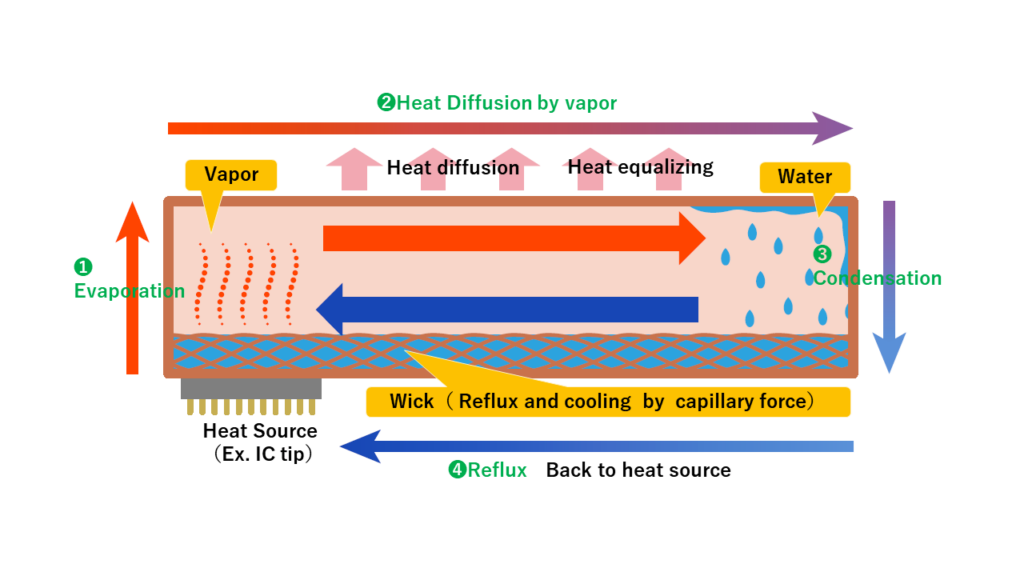
What is vapor chamber cooling? It is a technique used to remove heat from a local source via a flat, sealed chamber filled with a small amount of liquid (de-ionized water) that evaporates when exposed to heat, as seen in Figure 1.
Their physical appearance in the Apple phones, seen in Figure 2, is deceptively simple.
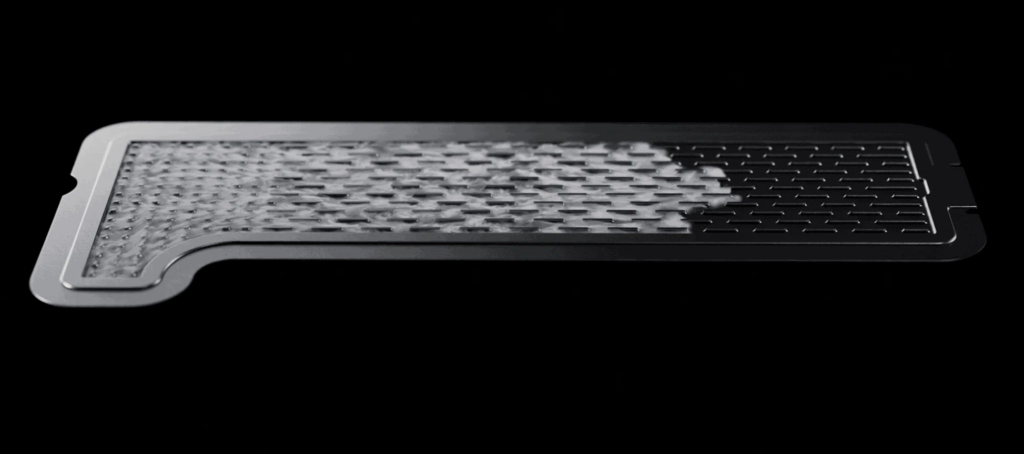
Vapor chamber cooling evenly distributes the heat across the entire chamber, allowing for more efficient cooling. While it has been on graphics and CPU cards as well as chassis, its use is spreading to truly mass-market consumer devices such as gaming consoles and smartphones.
Thin and wide vapor chambers have a high heat-removal capacity and offer an effective dissipation solution. The cycle between liquid and vapor is a powerful mechanism for absorbing and moving heat away from its source. Apple states, “Deionized water is sealed inside the vapor chamber, which is laser-welded into the aluminum chassis to move heat away from the powerful A19 processor, allowing it to operate at even higher performance levels. The heat is carried into the forged aluminum unibody, where it is distributed evenly through the system, managing power and surface temperatures to deliver incredible performance while remaining comfortable to hold.”
Not easy to make
While heat-spreading solid materials can be shaved down to be thinner, vapor chambers need to have enough space for coolant to travel through channels. The chamber has to be perfectly sealed to work properly; no one wants that drop of water to escape, which might damage the phone while allowing the heat-source IC to cook itself. Here’s a possible advertising caption: “It only takes a drop of water to keep this smartphone cool.”
As the thickness of the vapor chamber is scaled down, the physics of the fluid fights and scales back its performance relative to copper and other solid heat conductors. Therefore, obtaining the benefits of vapor-chamber cooling is quite a challenge. The amount of liquid it contains is so small that it is easy to not even notice the drop of water in the chamber when it is opened.
The cooling system uses a mesh between two plates to distribute water throughout the chamber. Apple uses an unique aerospace-grade aluminum alloy for the chamber, and claims it has 20 times the performance of the previous titanium-based design.
At first glance it may seem that a vapor chamber is just a flattened heat pipe, but that is not the full story. Heat pipes have a sealed metal tube that is typically filled with water. When heat is applied to one end of the heat pipe, the liquid evaporates and travels to the cooler end, where it condenses back into liquid and releases heat, usually to a heat absorber such as a heat sink or cold plate of Figure 3.
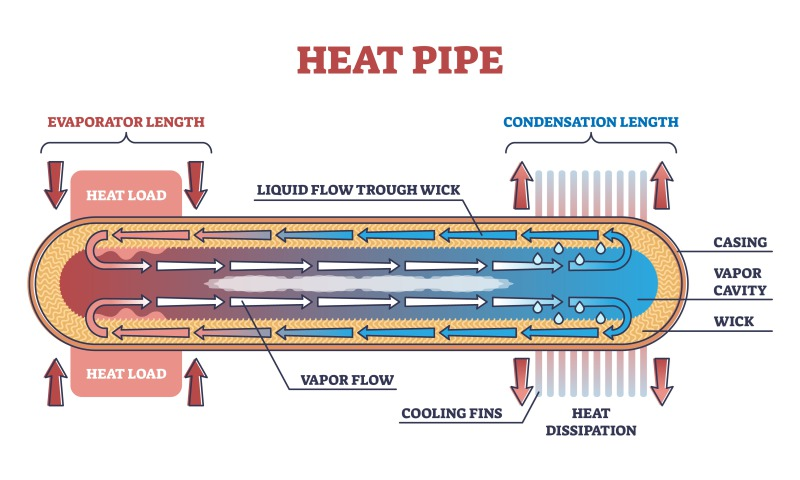
As with the vapor chamber, this passive process continues in a closed loop, effectively transferring heat away from the source.
In contrast, vapor chambers are made up of multiple layers of metal with a wick structure inside and support for two-dimensional spreading of the heat. The wick is typically made of a porous material such as copper or sintered powder that helps to evenly distribute the water across the surface of the chamber.
When heat is applied to the vapor chamber, the liquid evaporates and vapor spreads out across its surface, absorbing the heat in the process. Heat pipes help in moving heat away from the source in a single direction to another cooling, heat-absorbing surface, but the vapor chamber spreads the heat.
What are the larger lessons here?

- The physics of thermal flow and heat transfer — well known since the 1800’s — are still very valid but have taken on new physical implementations.
- Advanced materials and manufacturing techniques such as laser welding enable these principles to be applied in innovative ways and at incredible tiny scales.
- The physical realizations of these principles are shrinking in order to accommodate smaller, high-density, highly localized heat sources, but doing requires sophisticated modeling and simulation. Many of the thermal processes are non-linear and get better, or worse, as size decreases.
- Modern, high-volume consumer products can adapt techniques and components that were previously reserved for high-end non-mass-market systems and meet the cost, performance, and reliability expectations of these devices.
- Getting excess local heat from its source to that magical place called “away” where it is no longer a catastrophic issue is only part of the problem; designers need to have a way to deal with that heat when it gets to “away”. Apple uses a brushed aluminum unibody design made of a lightweight aerospace-grade 7000-series aluminum alloy to deliver what they maintain is the best-ever thermal performance in an iPhone, seen in Figure 4.
One thing is clear: modern modeling, materials, and production have redefined the position of vapor-chamber cooling, allowing it to join the long list of technologies and techniques that have transitioned from somewhat esoteric to mainstream and mass-market.
References
What is Vapor Chamber Cooling?, Radian Thermal Products
Heat Pipes vs. Vapor Chambers, Dai Nippon Printing Co (DNP)
How and where is vapor chamber cooling used?, EE World Online,
Here’s what we know about the iPhone’s vapor chamber cooling system, Computerworld
Water Vapor Could Cool Your Next iPhone, IEEE Spectrum,
Here’s how the iPhone 17 Pro vapor chamber actually works, 9to5Mac
Apple unveils iPhone 17 Pro and iPhone 17 Pro Max, the most powerful and advanced Pro models ever, Apple, Inc.
Related EEWorld Online content
Zoned cooling targets AI thermal hotspots
How and where is vapor chamber cooling used?
How do thermal interface materials help in power electronics cooling?
Convection cooling components
My odd affinity for heat sinks
Passive cooling options and considerations (Part 1)
Passive cooling options and considerations (part 2)