
ICE vehicles have transitioned from electromechanical power-train subsystems to all-electronic ones.
The word “revolutionary” gets invoked quite a lot these days, with even modest advances touted as gamechangers, upsetting the established scheme. Sometimes that’s the case; often it is not. Some of these transformations are visible (make your own list), while many are less visible but nonetheless truly significant.
One good example of the latter is the switchover from electromechanical creation and control of the spark that ignites the gasoline-air mixture in internal combustion engines and the associated induction of the mixture within the engine cylinder. Reality is that despite all the attention given to EVs, the internal combustion engine (ICE) still dominates the automotive world.
The effort to “go electronic” and replace the electromechanical system that enabled the automobile engine from its earliest days began in the 1970s. It was not a one-step sudden changeover, but a more gradual process as technology improved, new components became available (largely driven by the opportunity and market size), and better understanding of design issues and even failure modes. By the turn of the calendar to the 2000s, the revolution was complete.
This four-part article will begin with an overview of the classical subsystem that creates and delivers the spark to the engine cylinder, and its replacement by the all-electronic version. This will be followed by a look at the carburetor and its replacement by fuel injection.
The classic ignition system
The objective of any ICE ignition system is clear: create a spark at the right instant in the cylinder into which a gas/air mixture has been injected, to ignite the volatile mixture. The resultant explosion pushes the piston down, and a crankshaft converts the up-/down motion of the piston to rotary motion.
The earliest cars did not have a battery or complicated ignition system. A magneto – a magnet/coil self-generating subsystem – created the needed spark. It was simple but inefficient, and hard to control. Despite its shortcomings, the magneto is still used in battery-free products such as lawnmowers, chain saws, and more, as it is “good enough” and very cost-effective in those applications.
The first mass-produced, battery-driven ignition system as we know it was invented by Charles F. Kettering; it first used commercially on the 1912 Cadillac and was manufactured by Delco. It is an inductive system which makes and breaks the primary coil circuit(called the low-tension side in the early days) thus converting the DC into an interrupted waveform, where it is stepped up to around 25,000 volts, as seen in Figure 1.
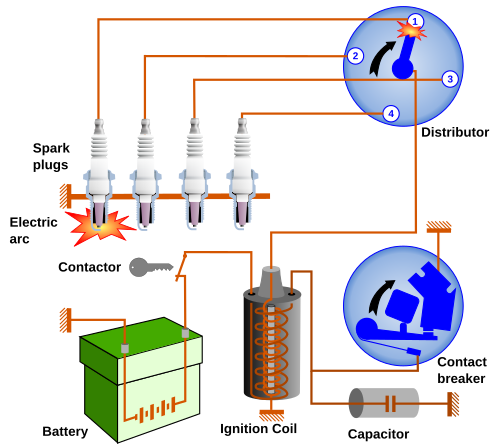
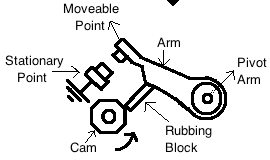
In this arrangement, the breaker points form an electrical switch that is opened and closed by a cam on the distributor shaft, seen in Figure 2. Timing is critical: points are closed for most of the engine cycle, allowing current to flow through the ignition coil and build up voltage, then are opened momentarily to create the step-up action via an inductive kick when a spark is needed. The spark must occur at just the right time in the piston up/down travel, when the piston is near top dead center.
There is also a capacitor (called a condenser in the early decades of electricity) connected across the points. This capacitor absorbs the voltage spike developed in the primary coil when the points open. Without this capacitor, an electric arc would form at the newly opened contacts on the points and induce rapid erosion of these contacts. Although it is a passive device, this capacitor was one of the weak links in the system, as it would dry out from continuous “pounding” in the harsh under-the-hood setting, causing pitting of the points and poor electrical contact.
The distributor rotor is linked to the camshaft. When it is time for a spark plug to fire, the rotor under the distributor cap connects the center electrode of that distributor cap to the appropriate electrode that is connected to a spark plug wire. This occurs simultaneously with the points opening and the coil delivering a high voltage to the center electrode. Distributors are available for four-, six-, and eight-cylinder engines.
The high voltage induced in the transformer coil is thus directed to the appropriate cylinder and its spark plug, where it jumps the gap and creates the spark needed for ignition. The wires from the distributor to the spark plugs are specially designed to handle the very high voltage, not have internal flashover or breakdown, survive under hood heat and fluids, and more.
The optimal timing of the spark with respect to piston position is a function of the engine operating point. For this reason, advanced distributors include a vacuum or centrifugal advance to very slightly adjust the timing dependent on engine load or speed.
What can degrade or fail
When you look at the electromechanical complexity pf the system and harsh, non-stop environment in which it must function, it’s actually amazing that it works as well and reliably as it has, as demonstrated by the billions of vehicles in which it has been used. Nonetheless, this system has some well-known weaknesses:
- There will be some arcing at the points even with the capacitor, and it will increase as the capacitor degrades. Arcing causes the points to “burn” which causes resistance at the point contacts and, in turn, reduces primary current and resulting spark intensity.
- The mechanical cam-follower block that rides on the distributor cam and opens the points wears over time, reducing how much the points open (the “point gap”). This causes a corresponding change in both the ignition timing and the fraction of time during which the points are closed. These changes require a maintenance “tune-up” every 10 to 30 thousand miles to replace the points and condenser and set the gap to factory specification. This gap must be set precisely using a set of feeler gauges, as improperly gapped points wouldn’t work efficiently.
- The distributor angle must be mechanically aligned so it delivers the spark at the optimum moment. This requires manually rotating the unit while using a strobe aimed at one of the pulleys on the front of the engine while the distributor is rotated until a notch on the pulley lines up with a mark on the pulley guard.
- The distributor cap and rotor can develop conductive “sneak paths” on their surfaces due to dirt buildup or microcracks. Due to these paths, some of the current flow developed by the coil’s high secondary voltage is not delivered to the plugs but “gets away,” thereby reducing spark intensity and even its timing. When these sneak paths develop, the only remedy is replacement of the cap and/or rotor.
Keep in mind that the entire ignition process is fast-moving and occurs at a high rate, taking place within a few milliseconds. For a six-cylinder engine, it occurs at approximately 18,000 times per minute when driving at 90 miles per hour.
The next part of this article looks at the migration to an all-electronic replacement for the electromechanical design.
References
Distributors: Points vs. Electronic Ignition, JBugs
Electronic Ignition vs. Points, YouTube
Three Types of Vehicle Ignition Systems and How They Work, Advance Auto Parts
What Is the Difference Between Conventional, Electronic and Distributor-less Ignition Systems?, Your Mechanic
Understanding Breaker Point Ignition Systems, Gas Engine Magazine
Electronic Ignition System: Definition, Parts, Working, Advantages, Application, The Mechanical Engineering
Ignition Systems, Clemson University
How Ignition Systems Work, Champion Auto Parts
Delco ignition system, Wikipedia
A Beginner’s Guide to Fuel-Injected vs. Carbureted Engines, CarParts.com
Carburetor vs Fuel Injector, Goldfarb & Associates
The Pros And Cons Of Carbureted vs. Fuel Injected Engines, Boldmethod LLC
Carburetor vs. Fuel Injection: What’s the Difference and Which Is Better?, I Evil Energy
How a fuel injection system works, How A Car Works
Forget the Spark Plug: Use a Laser to Ignite ICE Gasoline, Electronic Design
Related EEWorld Online content
FAQ on magnetos for power and ignition: part 1
FAQ on magnetos for power and ignition: part 2
Automotive platform consolidates functions on one ECU
Reference design covers ECUs for electronic fuel injection
The Wright brothers: engineers, scientists, and yes, even bicycle mechanics, Pt 1
The Wright brothers: engineers, scientists, and yes, bicycle mechanics, Part 2