
Quantum computing (QC) is on the horizon, and it’s rapidly approaching for some applications like materials science, drug discovery, medicine, quantitative finance, and more. Surveying the available design tools can be a good way to get a quick overview of the capabilities and ease of use of new technologies like QC.
There are several software layers to consider between the classical application layer and the qubits in the dilution fridge (Figure 1).
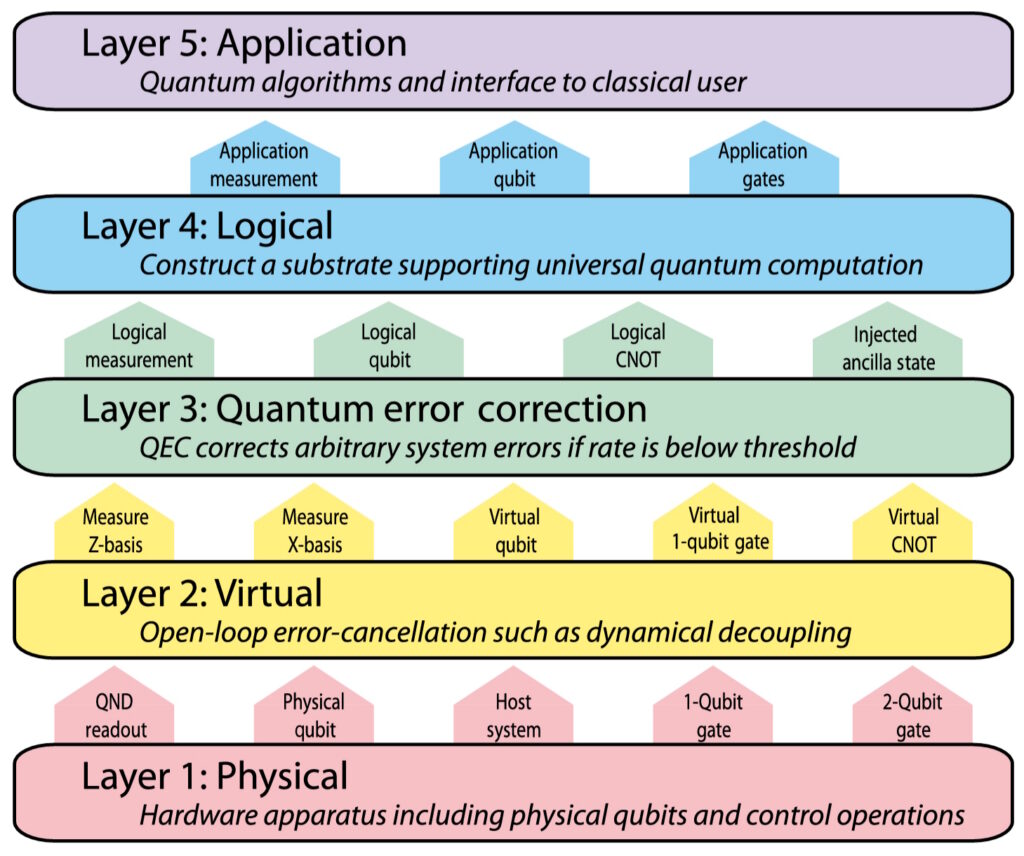
Tools available for integrating QC into systems include software development kits (SDKs), hybrid programming platforms, and cloud orchestration layers. Each will play an important part in the speed of adoption of QC from the Cloud to data centers, and ultimately to the edge.
Gaining familiarity with QC now will pay dividends soon, especially when room-temperature QC becomes available as shown at the end of this piece. It can begin with current SDKs like Qiskit, PennyLane, and Braket.
Qiskit by IBM is designed for general-purpose QC, quantum information science, and deep integration with IBM’s hardware ecosystem. It’s suited for beginners and general design projects and includes extensive educational tutorials and deep control features.
Xanadu’s PennyLane is suited for designers interested in quantum machine learning and hybrid quantum-classical computing. It’s compatible with ML frameworks like PyTorch, TensorFlow, and JAX. It also acts as a “write-once, run-anywhere” tool that can send code to various hardware backends (including IBM, IonQ, and Braket).
Amazon Braket, from AWS, is a Cloud-native, multi-hardware experimentation platform. It’s designed for building workflows inside the AWS cloud and test code across multiple different quantum hardware providers, like IonQ, QuEra, and Rigetti. It supports access to superconducting and trapped-ion hardware. It also supports plugins that support frameworks like PennyLane or Qiskit on top of AWS.
Hybrid programming platforms
Hybrid programming platforms coordinate iterative execution between classical processors and quantum QPUs by managing variational algorithms that require real-time parameter updates based on quantum measurement results. They also handle tasks like data pre-processing, tight-loop feedback, and error correction.
NVIDIA CUDA-Q was the first unified, open-source platform specifically designed for hybrid quantum-classical programming, allowing developers to write a single program that distributes work across traditional CPUs, GPUs, and quantum processing units (QPUs). It’s built on a C++ platform that includes Python bindings.
Other non-Python platforms include: Microsoft Azure Quantum / QDK that uses Q#, a standalone, domain-specific programming language that integrates natively with .NET languages like C#; Quantum Machines OPX Platform that uses the company’s proprietary QUA, a real-time procedural programming language, and others.
Most quantum hybrid computing platforms rely heavily on Python for high-level algorithm design, including those from IBM, Google, Xanadu, Amazon, Quantinuum, and others.
Cloud orchestration layers
Cloud orchestration layers for QC are middleware that manage, schedule, and translate quantum jobs coming from the cloud so they can be run on QPUs and hybrid classical-quantum systems. They are the connection between users and delicate QC hardware in the ultra-cold fridge. Common orchestration functions include:
- Translation of high-level logical gates into physical pulse schedules or native gate sets.
- Compression and shortening quantum circuits to optimize operation by controlling the impact of noise and qubit decoherence.
- Application of noise suppression, such as dynamic decoupling sequences, during qubit idle time for error mitigation.
- Dynamic coordination of operation between classical CPU/GPU nodes and QPUs, including pre- and post-processing of data.
- Monitoring QPU operational status and scheduling calibration routines.
25 degrees of simplification
Room-temperature photonic quantum computing eliminates the need for bulky cryogenic refrigerators, complex microwave control gear, and specialized vacuum apparatuses. Room-temperature technology is moving into early deployment of commercial prototypes and datacenter integration (Figure 2).
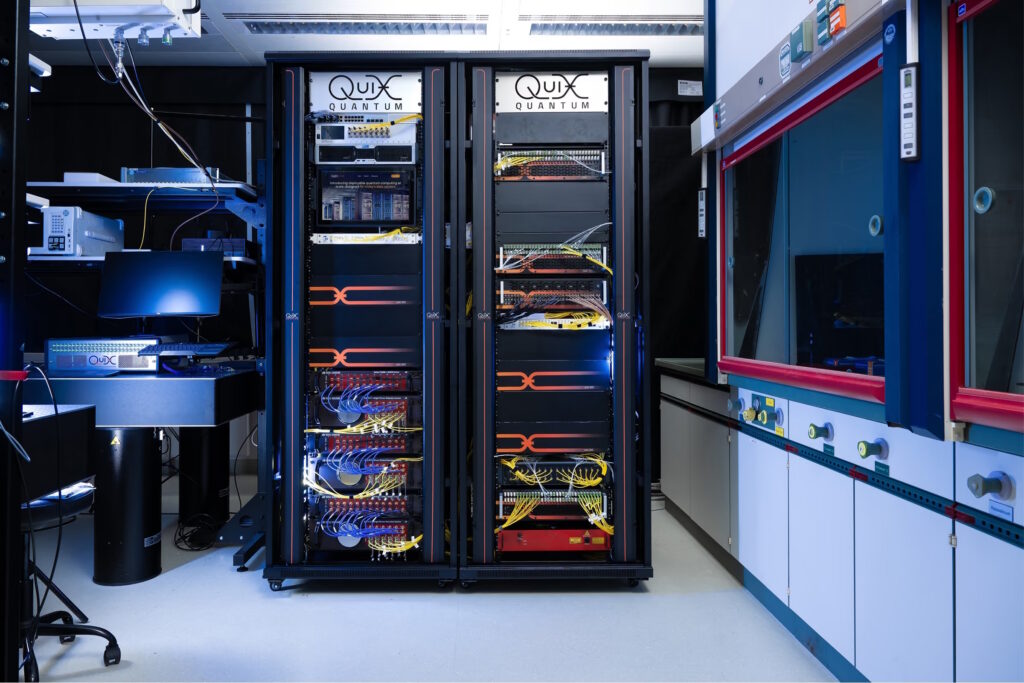
Faster than room-temperature QC is emerging, photonic QC development software tools are expanding.
Since photonic QC operates at room temperature, its operation is simplified compared with operation in a dilution fridge, and the range of necessary integration tools in much narrower. A few of the numerous SDKs include specialized tools for optical circuits and photonic QC simulation:
- Strawberry Fields is a cross-platform Python library for designing, simulating, and optimizing continuous-variable (CV) photonic quantum circuits.
- Perceval is focused on defining, analyzing, and simulating linear optical circuits and single-photon sampling algorithms.
- PennyLane integrates QC with machine learning, supporting photonic hardware devices and differentiable quantum programming.
- Aegiq LightWorks provides developers with APIs to coordinate and optimize classical computing tasks alongside photonic-native applications.
Summary
There’s growing interest in integrating QC into commercial systems. But the use of dilution fridges often presents a practical roadblock. Recent developments in room-temperature QC may change that. In addition to eliminating the need for complex cryogenic environments, room-temperature photonic QC simplifies the required software development and integration tools. The proliferation of those tools is expected to accelerate the adoption of QC in data centers.
References
A Benchmarking Framework for Hybrid Quantum–Classical Edge-Cloud Computing Systems, MDPI applied sciences
Built for All: Introducing Our New Software Stack, Qualcomm
Integrating Quantum Computing into Your HPC Infrastructure, QuEra
Google Quantum AI Software, Google
NVIDIA Launches Ising, the World’s First Open AI Models to Accelerate the Path to Useful Quantum Computers, NVIDIA
Photonic Design Software, Keysight
Powerful new developer tools increase the versatility of the Microsoft Quantum platform, Microsoft
The Architecture Blueprint for Hybrid Quantum-Classical Supercomputers, Quantum Machines
Top 35 Open Source Quantum Computing Tools, Quantum Insider
Top Quantum Computing Software Tools & 2025 Trends, SpinQ
Related EEWorld Online content
What’s a quantum sensor?
Post-quantum crypto standardization — background
How does a quantum radar sensor work?
What’s the relationship between Ohm’s Law and quantum mechanics?
What is the mathematical foundation of post quantum cryptography?