
Synopsys has released its first Multiphysics Fusion solutions, integrating Ansys golden signoff analysis directly into chip design workflows for timing signoff, design closure, multi-die design, and analog and photonic design.
The tools address a growing problem at advanced nodes: physics-related effects, including IR drop, thermal variation, electromagnetic interference, and mechanical stress, have become significant constraints that traditional siloed workflows struggle to catch early enough. The Multiphysics Fusion portfolio embeds these analyses into existing digital and analog flows rather than treating them as separate verification steps.
Key capabilities and reported performance metrics:
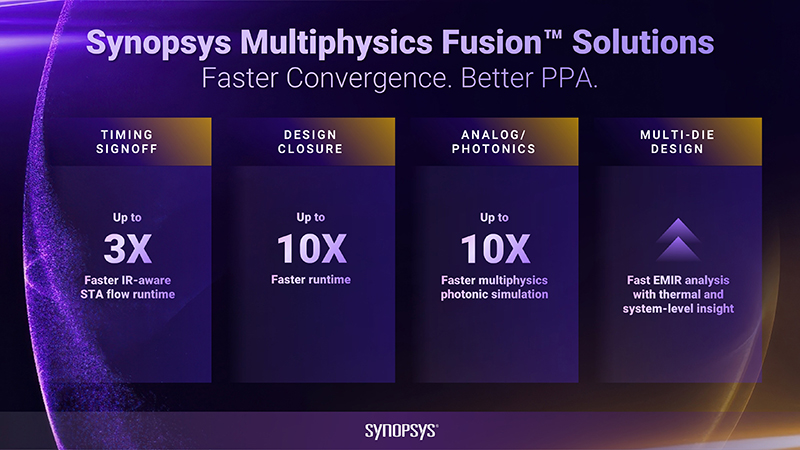
Timing Signoff integrates PrimeTime with RedHawk-SC, RedHawk-SC Electrothermal, StarRC, and HFSS-IC to incorporate IR, thermal, and stress effects directly into timing analysis. Reported runtime improvement: up to 3x, with SPICE-accurate correlation.
Design Closure combines PrimeClosure with RedHawk-SC to embed power integrity into signoff optimization. Reported improvement: up to 10x faster convergence, with higher ECO success rates and better PPA outcomes.
Multi-die Design uses the 3DIC Compiler platform with RedHawk-SC and HFSS-IC for concurrent power integrity, thermal, and electromagnetic analysis across dies and packaging from early exploration through signoff.
Analog and Photonic Design adds on-chip EM analysis to analog flows via Custom Compiler and HFSS-IC, plus end-to-end photonic IC support through OptoCompiler with Lumerical.
The flows use GPU acceleration via NVIDIA CUDA-X libraries, including cuDSS, targeting SPICE simulation, EM, and power integrity workloads. Validation results from early adopters include up to 20x faster runtime for signoff design closure (Cisco Silicon One), 86% IR fix rates in pilot designs (NVIDIA), and 10x faster multi-die analysis (MediaTek).