
At Embedded World 2026 in Nuremberg, Ambarella had a clear message: the next major compute migration is already underway, and it runs toward the edge, not away from it.
The Ambarella team drew the parallel to what happened with cloud adoption a decade ago. Data centers didn’t disappear when hyperscalers took off, but rather, the two coexisted. The same pattern is playing out now with edge AI.
“We believe the next evolution will be data center and cloud workloads moving towards the edge,” they said. Two distinct motions are driving it: cloud-to-edge, where training stays in the cloud but inference moves to the edge; and edge-to-cloud, where autonomous edge devices run closed-loop AI locally and share selective intelligence back upstream. “It’s an autonomous entity that controls itself, and then can share some of its learnings to the cloud. That’s very different from cloud running everything.”
That closed-loop capability is where agentics enters the picture. Traditional IoT sensors collect data and wait for a human to act on it. Agentic systems don’t wait. As they put it: “Agentics allows you to put an interface which will look at all the inputs from the sensors and come up with the reasoning and the thinking and then execute that on your behalf. That is closed-loop automation, and that will happen at the edge.”
The booth demos put real numbers behind those claims. An N1 chip processed 64 simultaneous 720/30 fps video streams, with each frame converted to image embeddings via a Vision Transformer model, and the entire workload all running locally within a sub-50 Watt SoC power envelope.
The CV7 handled four cameras at 4K/60fps with ISP, encoding, depth estimation, and people detection running concurrently.
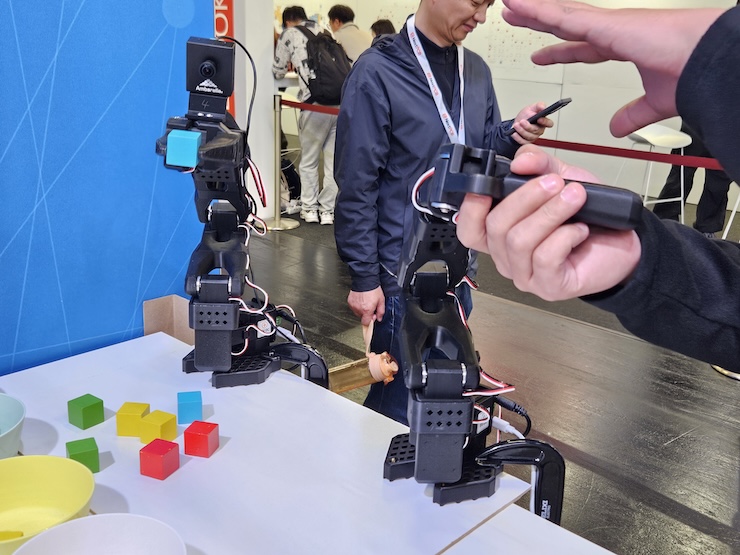
A robotics demo powered by the N1-655 SoC showed a vision language-action model, learning manipulation tasks from human demonstrations, running fully locally at a sub-15-watt SoC power envelope, with applications ranging from industrial automation to robotic surgery.
Partner demos covered a useful cross-section of where this is actually landing.
A retail analytics solution powered by N1-655 from meldCX tracks customer journeys from entry to exit across seven to ten cameras per edge box, replacing configurations that previously required a full GPU server.
Rhonda, another Ambarella ecosystem partner, showcased 2 impressive demos.
A machine vision camera running on-device anomaly detection catches PCB assembly defects, including incorrect component polarity, in 15 milliseconds.
Cogniac, a rail monitoring system covering U.S. train lines, inspects wheel wear and tear in real time at operating speed.