
IEEE 1588 PTP and SyncE protocols keep radio units, switches, and distribution units in sync.
by Jeff Gao, SiTime
The 5G infrastructure landscape is a dynamic environment in which timing requirements and deployment scales are continually evolving beyond early-phase projections. To inspire competition and innovation, the open radio access network, or Open RAN, is an industrywide initiative to enable interoperability among hardware suppliers. While Open RAN standardization aims to increase competition and interoperability, the practical realization of these benefits depends on overcoming significant multi-vendor integration and performance challenges. Network providers, and by extension consumers, will welcome decreased costs from interoperability. The growing number of components that need synchronization, brought on by network densification, makes careful consideration of network timing functions critical.
The OPEN RAN architecture consists of three major components: the remote radio unit (RU), the fronthaul switch, and the distribution unit (DU), shown in Figure 1. The RU serves as the consumer’s access point to the network. The DU acts as the connection to the centralized unit (CU) and the mobile core. Finally, the fronthaul switch routes traffic between the RU and DU. The standardized interface that transmits information between components of the radio access network is known as enhanced Common Public Radio Interface (eCPRI). These components need precise synchronization to avoid data packet loss and network interruptions.
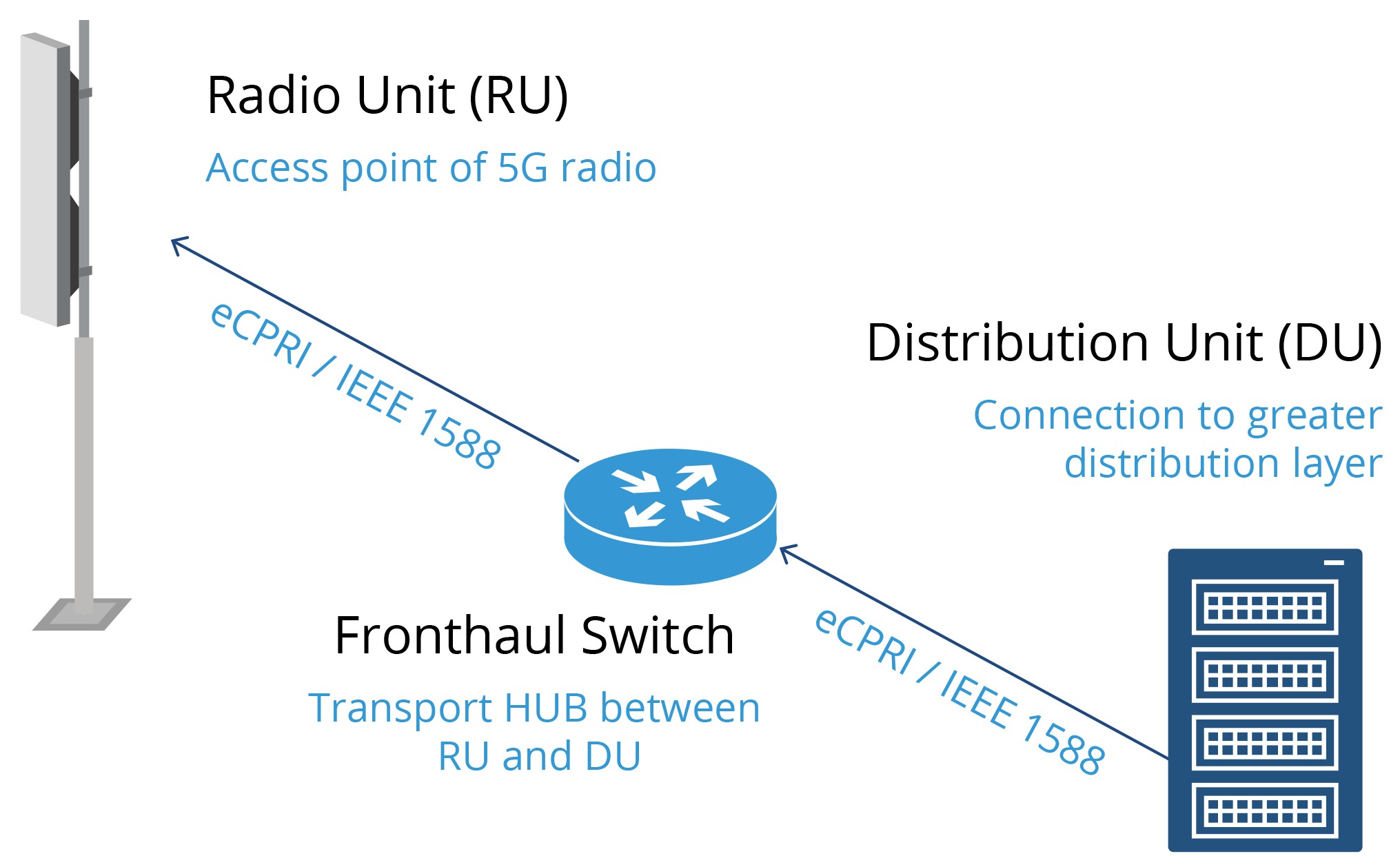
Before we cover methods of synchronization, you should understand time division duplexing (TDD) and why it’s becoming the dominant form of duplexing for 5G OPEN RAN. Unlike frequency division duplexing (FDD), TDD separates outbound and inbound signals by transmission time slots, not separate frequencies. TDD offers greater flexibility, as the outbound-to-inbound transmission ratio can be adjusted based on demand at any given time, resulting in more efficient use of the channel. This flexibility is necessary in 5G Open RAN because upload and download demands constantly change. Because TDD depends on precise timing, the network uses the IEEE 1588 Precision Timing Protocol (PTP) to synchronize transmitted and received signals. While time-based synchronization is becoming more common in the network, frequency-based synchronous Ethernet (SyncE) remains an underlying technology critical to system synchronization. Additionally, both PTP and SyncE are robust alternatives to GPS synchronization. While accurate, GPS reference timing can be affected by poor weather and is vulnerable to jamming or spoofing. Depending on the network architecture, Open RAN networks can use PTP, SyncE, or both for synchronization.
Not only is PTP critical because it’s the gateway to nanosecond time error, but it’s also an intelligent system that can adapt to the loss of a grandmaster and can selectively reassign the “highest ranking” timing packet. The increasing volume of data passing through the network at higher speeds makes PTP synchronization crucial for a reliable Open RAN. Therefore, oscillators and jitter cleaners that enable the highest performance with the IEEE 1588 protocol are equally crucial.
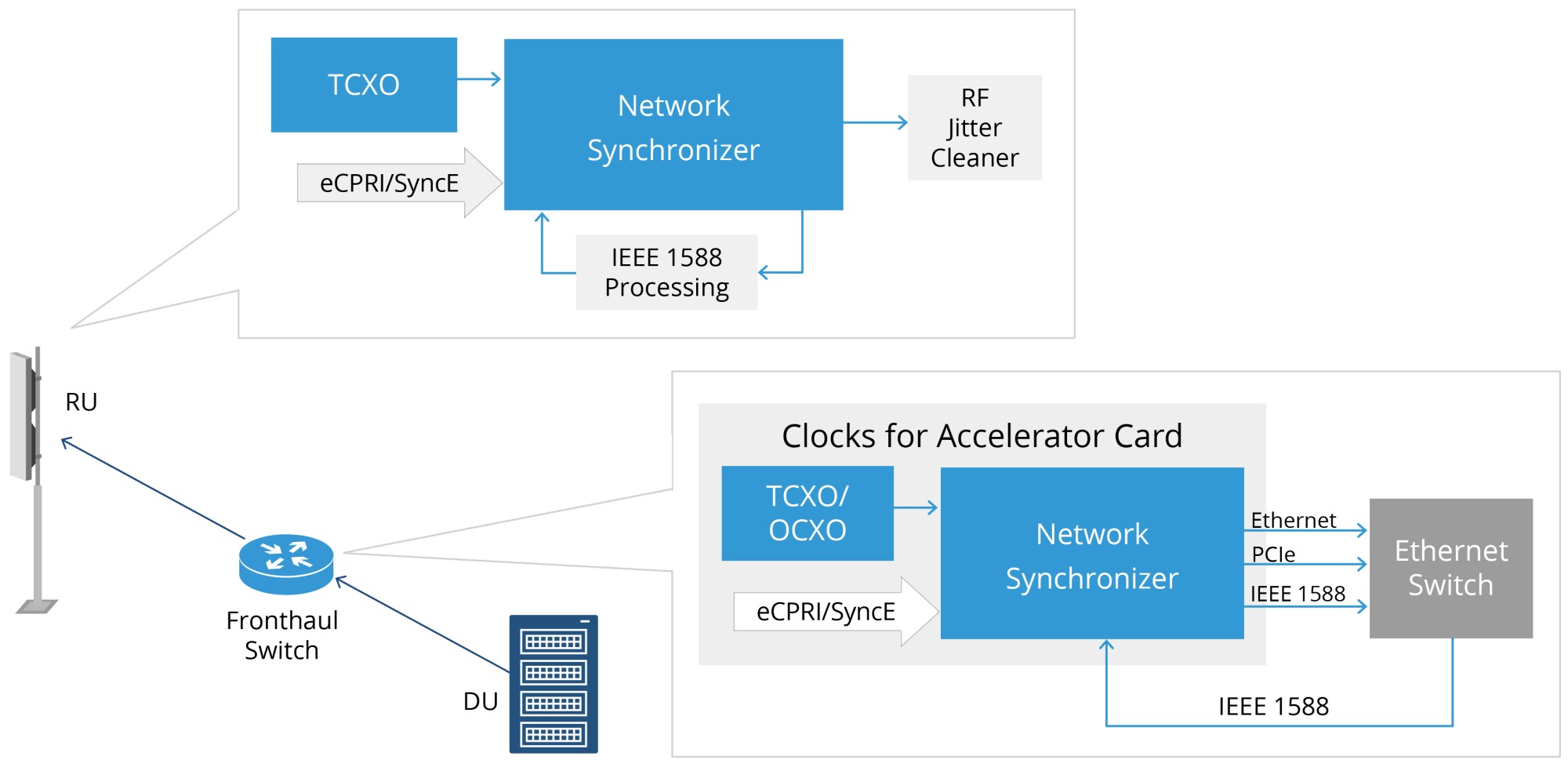
Of the three main components in the Open RAN architecture (Figure 2), the RU has the least stringent timing requirements, but it must be the most environmentally robust. RUs are often installed in dense, uncontrolled environments and must remain precisely synchronized to the rest of the network while subjected to heat, airflow, and vibration. The densification of radios in 5G Open RAN requires them to be placed in environmentally unforgiving locations: on rooftops, poles, and near roads and highways. RUs generally require the timing of high-performance temperature-compensated oscillators (TCXO) or MEMS oscillators. Similar in architecture to the RU, the fronthaul switch uses a reference oscillator and jitter cleaner to clock an FPGA accelerator that also performs IEEE 1588 processing.
Which timing source?
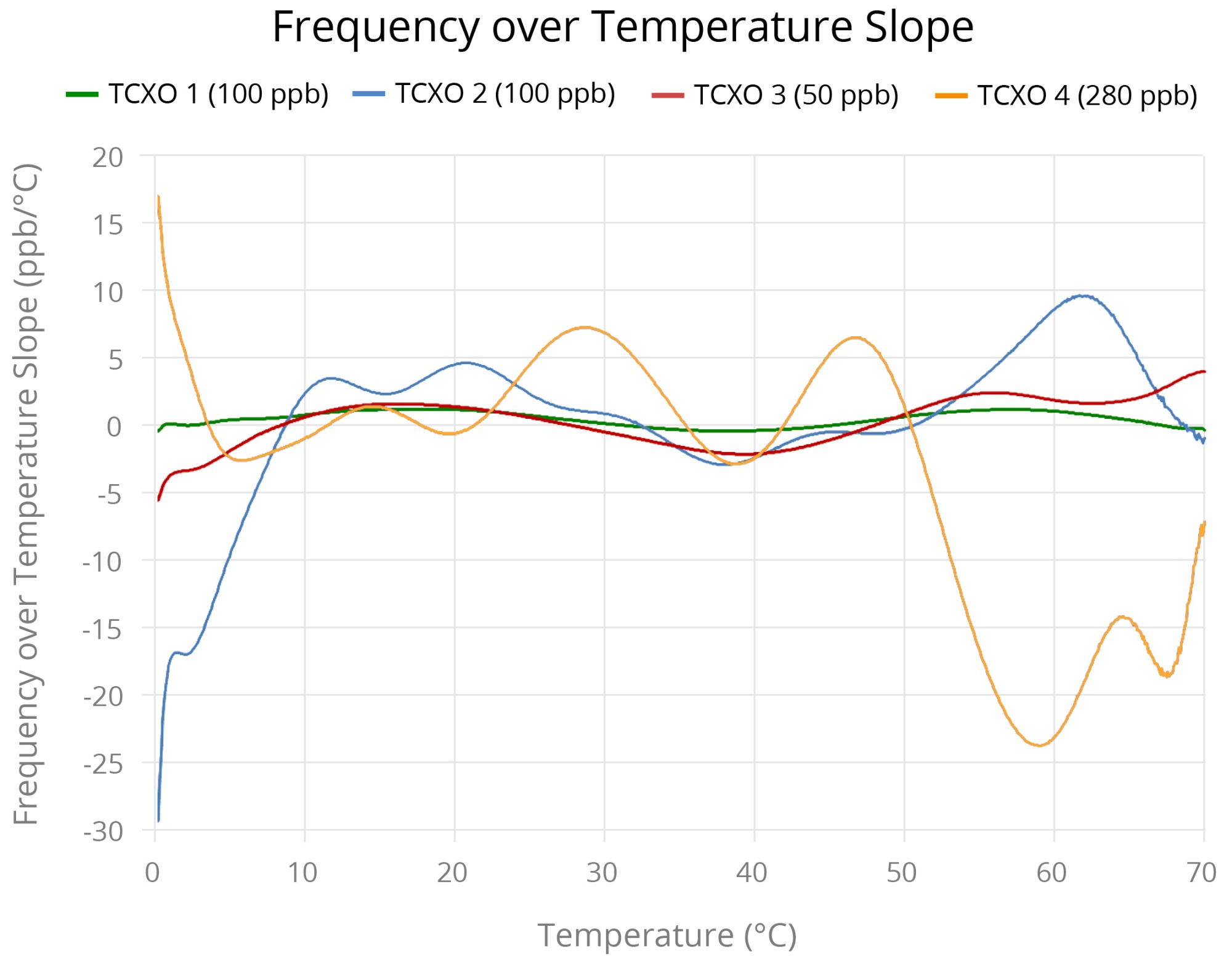
Only the most precise TCXOs available today can maintain the performance required by the RU and fronthaul switch under environmental stresses. Frequency slope is one of the most critical oscillator parameters for Open RAN. This specification describes how the frequency will vary with ambient temperature. Any sudden changes in frequency can correlate with a high-frequency slope. In applications dependent on PTP, a low frequency-over-temperature slope, typically ±1 ppb/°C or less (Figure 3), allows the TCXO to maintain an accurate reference between timing packets, even during fast temperature ramps. This enables a longer loop bandwidth, giving the IEEE 1588 algorithm more time to select the packet from the highest-ranking available clock.
Selecting timing components for Distributed Units (DUs) requires balancing specific architectural constraints against the need for thermal stability and high-performance holdover (Figure 4). As the gateway to the network core, it must maintain a precisely synchronized time reference, which it passes down to the fronthaul switch and RU. In some networks, the fronthaul switch will also require an OCXO.
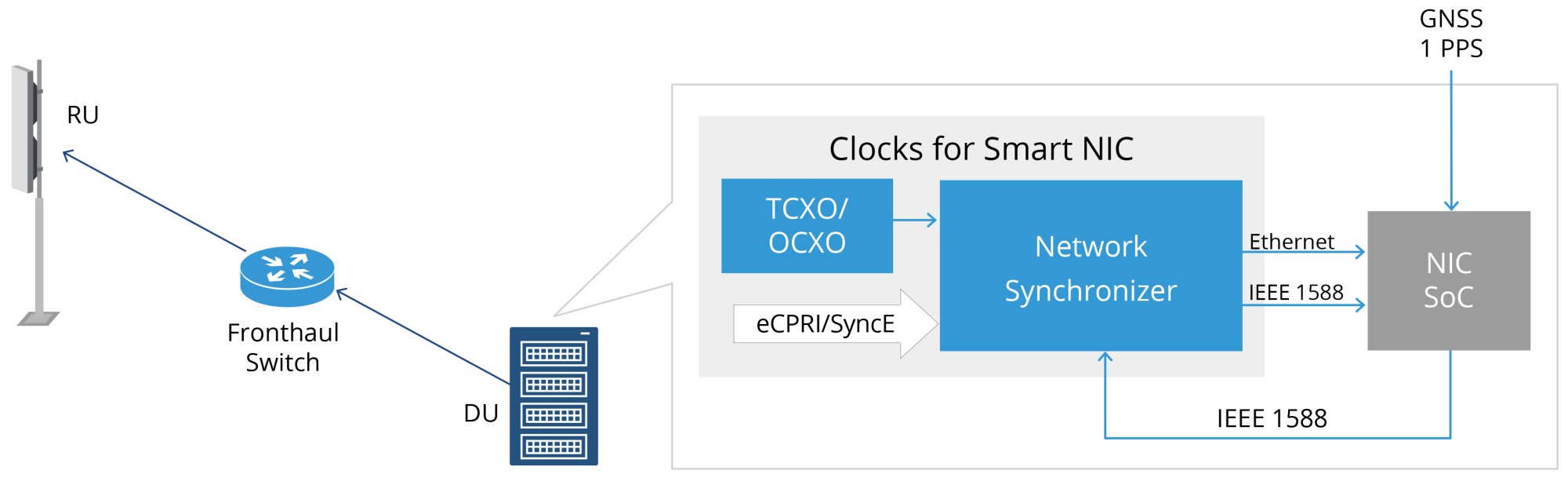
In Open RAN systems, the need for an OCXO over a TCXO is generally driven by a time holdover requirement, which defines how long it can “free run” without a reference before accumulating a certain time error. If all timing references are lost, the DU must maintain an accurate output clock until connection to the reference is restored. tated holdover targets of four to 12 hours serve as useful mid-range design benchmarks, though mission-critical or high-availability deployments often necessitate scaling these targets based on local redundancy needs. Increasing time holdover in the DU improves reliability across the system by passing accurate time to the fronthaul switch and RU, even when the connection to the reference time is interrupted. While these numbers are still used as common design targets, modern “High-Availability” Open RAN specs and Private 5G networks often require greater flexibility. Some mission-critical industrial 5G deployments now look at 24-hour holdover or more to survive localized outages, while “lite” urban small cells might accept much less. Treat “12 hours” as a common mid-range target, not the definitive “high-end” anymore.
Stability counts
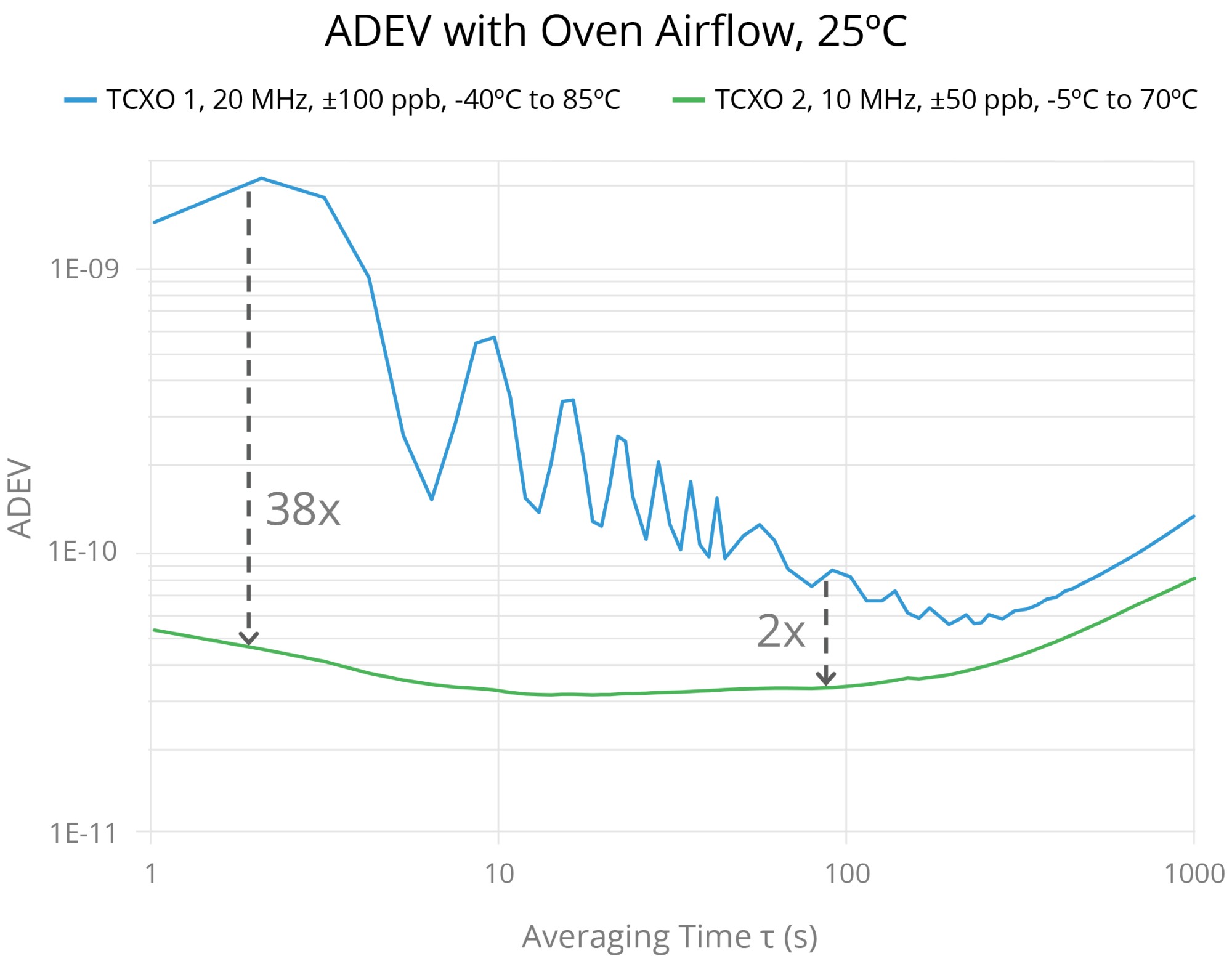
In addition to providing sufficient time holdover, the OCXO must remain stable under environmental stressors such as airflow and rapid temperature change. An OCXO must retain its accuracy even when placed near a fan or when the SoC emits heat under heavy load. Placing processing units closer to the network edge to reduce latency requires timing components designed to withstand the environmental stressors of unregulated or outdoor environments. Allan deviation (ADEV), a measure of oscillator stability in the time domain, is an important parameter for OXCOs used within Open RAN.
Figure 5 demonstrates the difference in ADEV performance under airflow between high-quality and low-quality TCXOs. When the devices are subjected to airflow, the TCXO 1 has 38 times lower ADEV at a 3-sec averaging time. A similar difference can be seen when comparing high- and low-quality OCXOs. When operating in a pole-mounted RU or a DU next to a fan, timing errors caused by poor ADEV can delay PTP packets, ultimately leading to data errors and loss of synchronization.
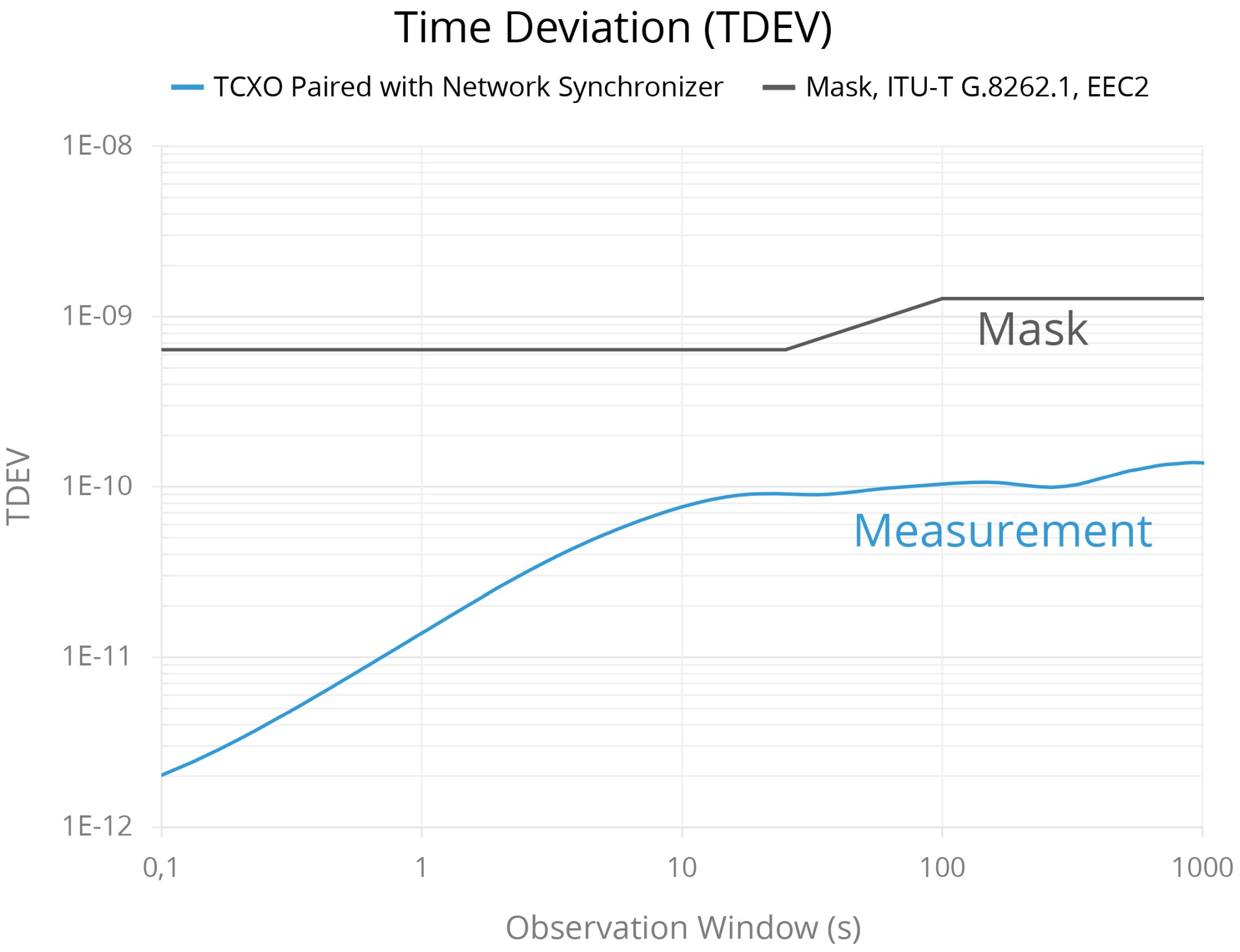
While environmental resilience is needed to get the most out of a PTP synchronized system, PTP can be combined with SyncE for the best overall performance. To regulate these incoming timing references and operate the IEEE 1588 loop, an advanced type of PLL, called a network synchronizer, is required. The ITU Telecommunication Standardization Sector (ITU-T) has defined the maximum time deviation (TDEV) allowable for SyncE, and for best system performance, it is crucial to ensure the total TDEV is below this mask with a considerable margin (Figure 6).
Both IEEE 1588 PTP and SyncE are cornerstones of 5G OPEN RAN, and using them together is essential to achieve the best system performance. As RUs are subjected to harsh outdoor conditions, better dynamic performance of the TCXO and OCXO under fluctuating temperature and airflow leads to fewer disruptions and service outages. The oscillator’s frequency-over-temperature slope must also be considered, as a lower slope directly translates to more accurate PTP timestamps. Finally, network synchronizers are instrumental in managing the reference inputs, generating an array of clock outputs for various systems, and functions facilitating the IEEE 1588 loop.

Jeff Gao, Senior Director of Product Marketing at SiTime, has over 20 years of experience in the semiconductor and networking/communications industries in wireless systems, VoIP, biometrics, semiconductor timing, and embedded software. Prior to SiTime, Jeff held various product marketing and engineering positions of increasing responsibility with Atmel, Cisco, Vovida Networks and ArrayComm. His current technical interests include high-precision timing and synchronization in 5G, data center, optical transports, and next-gen industrial applications. Jeff earned his MBA from the University of California, Berkeley and MSEE from the University of Wisconsin–Madison.