
Optical wireless communications in the form of “Li-Fi” is a technical alternative to RF-based Wi-Fi with distinct strengths and weaknesses.
Part 1 established a context for Li-Fi. This part looks at basic Li-Fi characters as well as hardware and software structure.
Q: What are some of the favorable attributes of Li-Fi?
A: There are several, and keep in mind that what one user might consider favorable might be considered a drawback by others. But the key attributes are:
- capable of very high connection speeds in the tens and even hundreds of Mbits/sec. That’s about 20-100× faster than Wi-Fi, although actual numbers vary and are a function of many factors. This speed is largely due to the huge bandwidth of optical spectrum.
- It is a line-of-sight link and so impervious to outside snooping or eavesdropping, as hackers use a sophisticated radio to “pick up” or even interject RF Wi-Fi signals. It is nearly impossible to intercept the optical signal as you must be in the line of sight. Yes, there are cases of optical signals being picked up by indirect reflection, but Li-Fi is targeted primarily at indoor, enclosed settings.
- due to the enormous bandwidth, many users can easily be accommodated, far more than with Wi-Fi.
- Li-Fi is immune to electrical interference (EMI/RFI), nor does it create any, and it is not subject to any FCC restriction in the US or similar ones elsewhere.
- for those concerned with RF signal energy and possible health implications, Li-Fi is not RF; it is light-based.
Q: Sounds great, so what are the perceived negatives?
A: There are some:
- it is a line-of-sight system. While some might consider this a good thing for security, it also means the users have to be in clear sight of a node. This is not always practical, and if you move or someone tosses a jacket or napkin in the wrong place, the link could be obstructed. Simple “repeaters” (mirrors or reflectors) can help to some extent. In some cases, the light signals can bounce off ordinary walls well enough to get around the direct light-of-sight restriction.
- Li-Fi does not lend itself the kind of effortless, no-thinking-needed placement or mobility and moving around that people are used to with Wi-Fi.
- even if the potential bandwidth and data rate between the user and the Li-Fi node is so high, it does not necessarily mean that the backhaul connection between the node and the Internet can actually support that rate.
- Li-Fi has a maximum range of 10 meters versus 30 meters for Wi-Fi. In many settings, 10 meters is not enough (of course, this may actually be preferred for security and privacy reasons).
Q: Is there more to using an LED as a light source than just turning it on and off?
A: Yes, the basic physical-level action involves on/off, as Li-Fi uses direct detection and intensity modulation. These constraints cause losses with respect to power efficiency, but there are various modulation and encoding schemes which can improve the situation such as Orthogonal Frequency Division Multiplexing (OFDM), Carrier-less Amplitude Modulation, and Pulse-Amplitude Modulation.
Q: What does Li-Fi hardware and software look like?
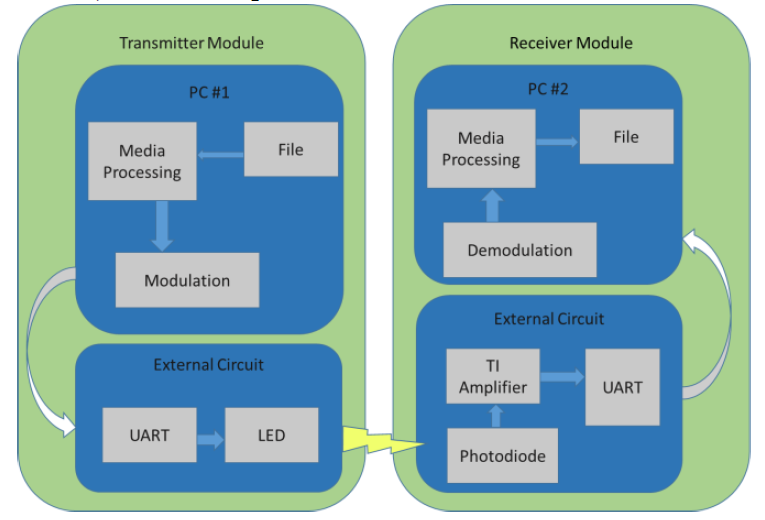
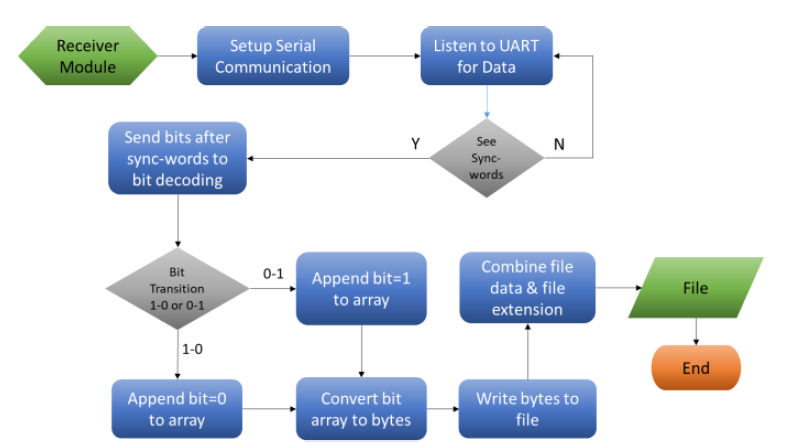
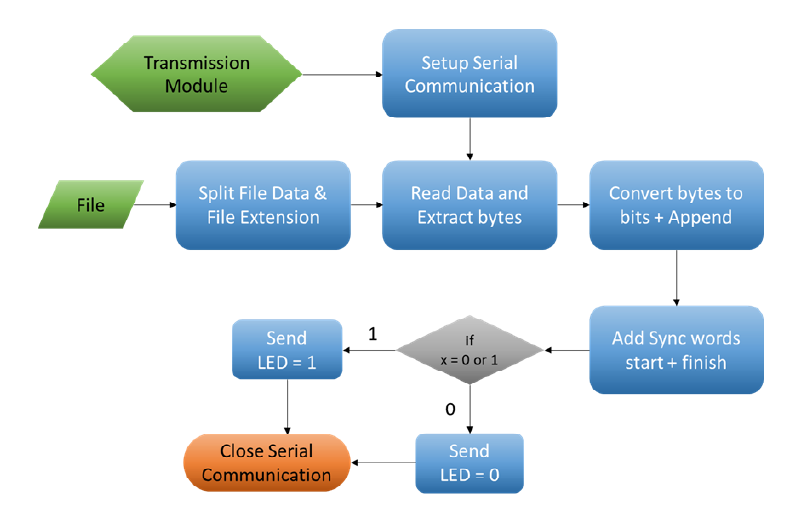
A: The block diagrams are fairly standard and unsurprising (Figures 1, 2, and 3). Of course, simple diagrams do not necessarily correlate with trivial implementations. A smooth-running, high SNR data link is easy to manage. Still, the reality is the link must also work and recover itself during startup, line surges, optical and electrical transients, hard breaks (someone blocked the light path), and other occurrences which greatly complicate operation.
The next part of this article looks at system-level Li-Fi issues and installations and assesses the status of Li-Fi.
EE World Related Content
Report: Global Light Fidelity (Li-Fi) Technology Market to Reach $35.82 Billion By 2028
Textured LED Gives Green Light To Li-Fi
Light-Based Transmission Test Comes to the Workplace
This Wireless Technology Is 100 Times Faster Than Wi-Fi
Company turns LED lights into a Wi-Fi network
External References
Wi-Fi and IrDA
- CableFree, “WiFi Standards and Development History”
- Brittanica, “Wi-Fi networking technology”
- McCannTech, “Wi-Fi 101 — Wi-Fi Origins and History”
- ThoughtCo, “Who Created Wi-Fi, the Wireless Internet Connection?”
- Wikipedia, “Infrared Data Association”
Technical and Vendor Material
- Wikipedia, “Li-Fi”
- Signify, “What is LiFi?”
- Pure LiFi, “LiFi Technology”
- co, “LiFi: Wireless data from every light bulb”
- Science Direct, “LiFi is a paradigm-shifting 5G technology”
- Avnet, “Li-Fi: IoT at the Speed of Light”
- Iberdrola, “LiFi, the internet at the speed of light”
- Versa Technology, “Li-Fi: Internet at the Speed of Light”
- Li Fi Tech News, “Top 15 Li-Fi Applications”
- IEEE Internet Initiative, “Li-Fi: An Overview, Part 1 – Purpose and Function”
- Mordor Intelligence, “Li-Fi (Light Fidelity) Market – Growth, Trends, COVID-19 Impact, and Forecasts (2021 – 2026)”
- VLNcomm, “Limitless Connectivity”\IEEE, “Optical data transmission using portable USB Li-Fi module (dongle)”
- International Journal of Engineering and Advanced Technology (IJEAT), “Data Transmission using Visible Light Communication”
- International Research Journal of Engineering and Technology (IRJET), “Data Transmission Through Li-Fi”
- International Journal of Advance Research in Computer Science and Management Studies, “Li-Fi Technology: Data Transmission through Visible Light“
- Arvix, “Conceptual Design of LiFi Audio Transmission Using Pre-Programmed Modules”
- Oledcomm, “What is LiFi?”
- Circuit Digest, “Li-Fi based Text Communication between Two Arduino”
Li-Fi News and Updates
- IEEE Spectrum, “Li-Fi Scrubs Into the Operating Room”
- IEEE Spectrum, “Infrared Light Promises Ultrafast Wireless Communications”
- LEDs Magazine, “Li-Fi picks up speed. But oh, that dongle…”
- Digital Trends, “Whatever happened to Li-Fi?”
- Photonics.com, “US Army to incorporate Li-Fi technology”