
Engineering is sometimes referred to as the management of technical trade-offs. That can be especially true in complex systems like solid-state transformers (SSTs). A successful SST design balances competing constraints, like extreme heat generation versus a compact solution. That may not always require a wide bandgap (WBG) power device.
The use of silicon carbide (SiC) and gallium nitride (GaN) WBG power semis in SSTs drives lots of headlines. So, the low-risk conclusion can be that non-WBG power semis are unsuited for use in SSTs.
It’s true that WBGs can perform all the power conversion functions in SSTs. But that doesn’t necessarily make WBGs the only, or even the best choice in every case.
WBGs hit the ‘highs’
SSTs need power semis that can operate at high voltage, high frequency, and high temperature. Common designs operate in the distribution portion of the utility grid with inputs of 13.8 kVac. It’s a three-phase system, and the phase-to-phase (or line-to-line) voltage is 13.8 kVac, so the power semis need to handle (13.8 kVac) / (√3) ≈ 7.97 kV, the phase-to-neutral voltage.
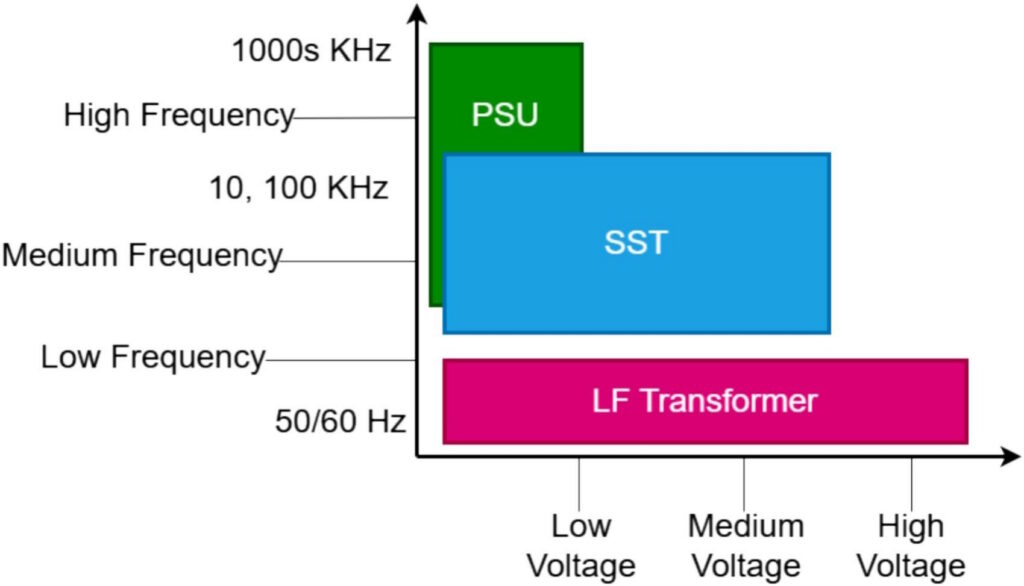
The optimal switching frequency for SSTs ranges from 10 to 50 kHz. Compared with line frequency transformers (LFTs) that operate at 50/60 Hz, that’s a high frequency. But compared with other power supplies (PSUs) that switch at about 1 MHz, it’s relatively low (Figure 1). This sweet spot balances the desire for a small transformer core with the need to keep heat at safe levels.
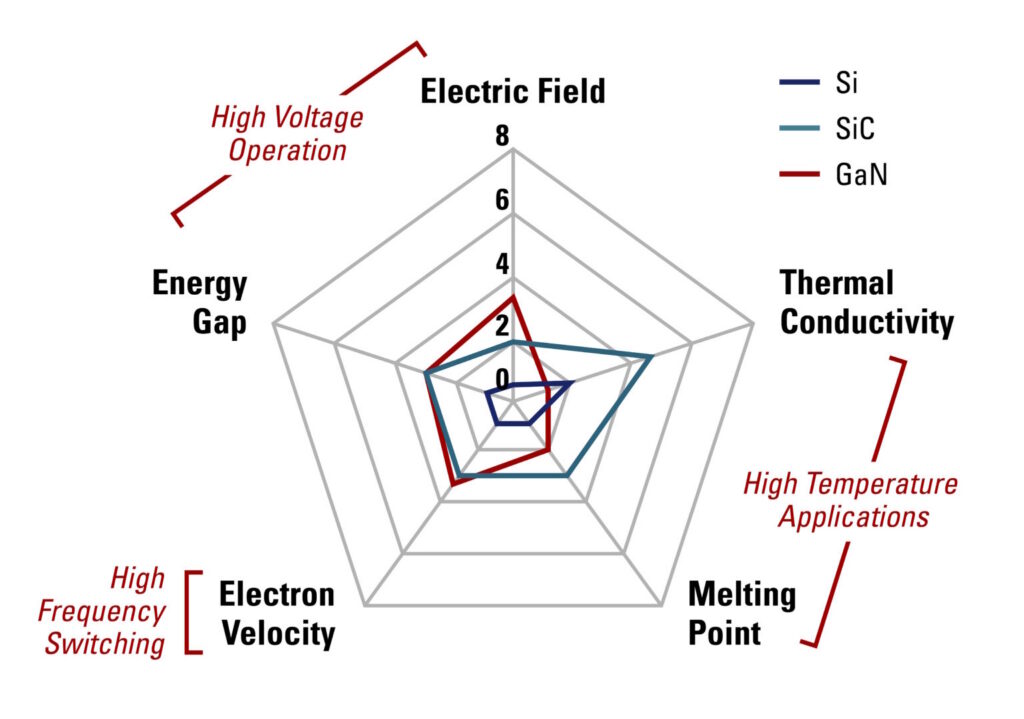
Keeping the temperature safe ensures long-term reliability. In a silicon-based PSU design, junction temperatures are usually kept below 125 °C. In an SST, power conversion at tens of kHz supports compact designs, but concentrates heat and can result in junction temperatures up to 175 °C (Figure 2).
What does an SST really look like?
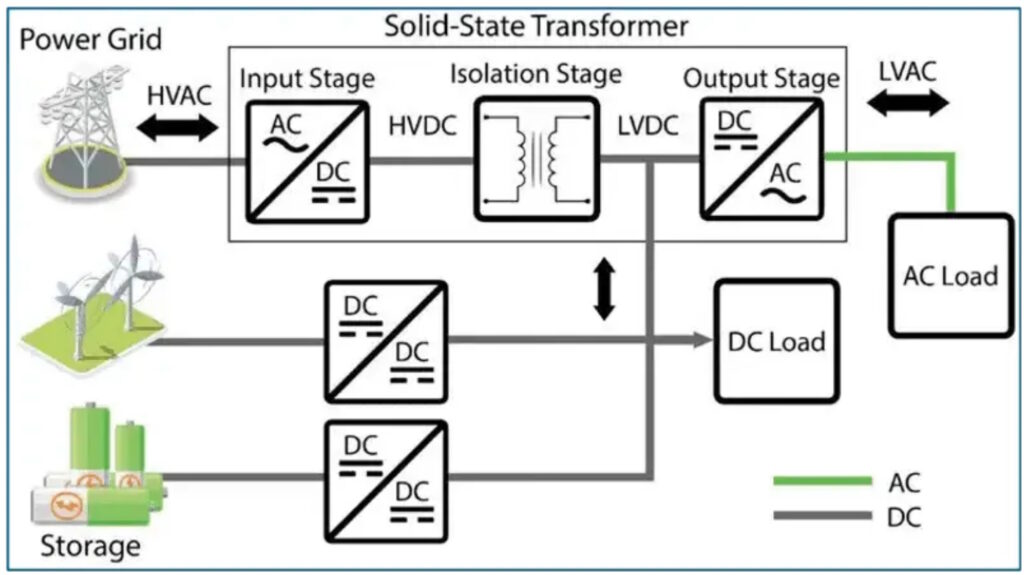
SST can be as simple as the top box in Figure 3, where the input connects to the distribution grid and the output sends lower voltage AC to local loads. The input stage is where WBGs really shine. They can feed high-voltage DC to the isolation stage that uses a compact medium frequency transformer for conversion to the lower voltage needed by the output stage.
Is Si irredeemable?
The material property advantages of SiC aren’t going to disappear. That doesn’t necessarily mean that SiC is irreplaceable and Si is irredeemable. Technologies, especially semiconductor technologies, including Si power, are in a constant state of development and advancement.
SiC has largely replaced Si in high-frequency and high-performance SSTs. But there are new Si-based alternatives to consider. Creativity is the key.
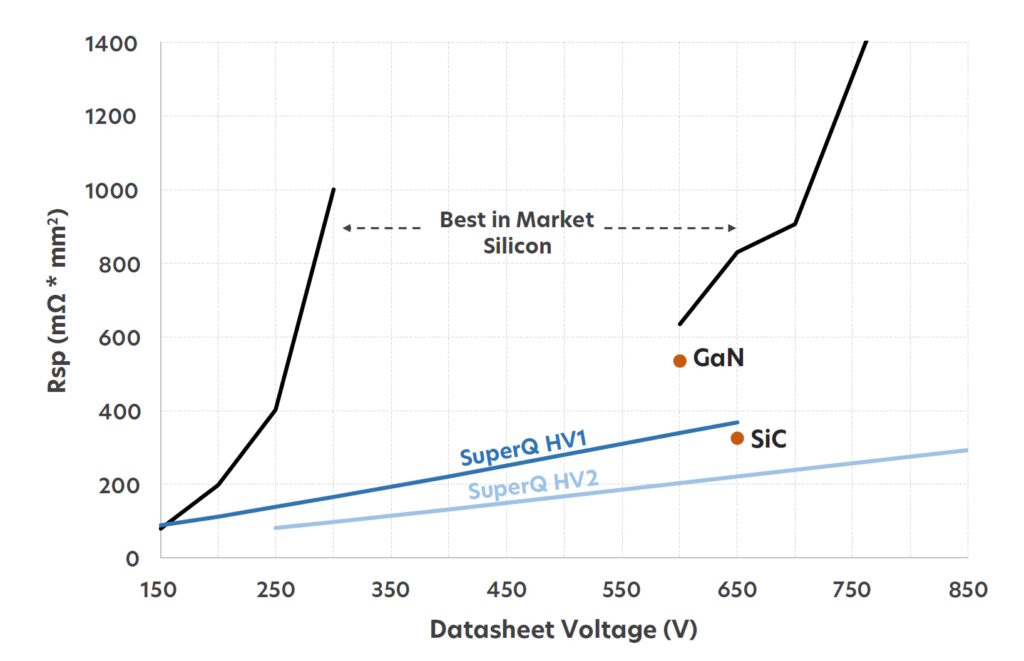
Specific on-resistance (Rsp) is an important consideration. It’s the normalized resistance-area product in the conducting state and key to defining the fundamental efficiency limits in a power converter. Reengineering the structure of Si power devices can result in Rsp that’s comparable to WBGs (Figure 4).
In another case, device designers have combined a SiC MOSFET and a Si IGBT in a single power module. It maximizes efficiency by using the SiC MOSFET to handle current during light loads and automatically shifts to the cost-effective Si IGBT to carry heavier loads. That reduces cost and losses.
If IGBT losses are too high, designers can turn to reimaged bidirectional bipolar junction transistors that reduce losses by 50% or more compared with Si IGBTs. In addition, the new device is symmetrical and equally efficient in both directions, bringing new options to designers of SSTs, electric vehicles, and green energy systems.
Summary
SiC has become the incumbent technology in SST designs and the target for several new approaches. But the relatively high cost of SiC devices makes them vulnerable and attractive to competitive technologies. Emerging Si options are not direct replacements for SiC, but they give designers new sets of design tradeoffs to manage.
References
Advanced Power Semiconductor Devices, Electric Power Research Institute
Advancements in power device technologies to meet the demands of power electronics applications, Applied Physics Express
Benefits of Si/SiC Fusion Switch for EREV Architectures, Infineon
Power Electronics Revolutionized: A Comprehensive Analysis of Emerging Wide and Ultrawide Bandgap Devices, MDPI micromachines
Exploring SiC MOSFET Figure of Merit (FoM), Toshiba Semiconductor
Introducing SuperQ Technology, iDEAL Semiconductor
Revolutionizing Power Electronics with Silicon Carbide to Pioneer Sustainable Solutions, Wolfspeed
SiC vs GaN: Choosing the Right Semiconductor for Optimizing Power Delivery, Tenxer Labs
Silicon Carbide and Gallium Nitride Bring New Challenges for Semiconductor Test, Teradyne
Solid state transformer in energy conversion and distribution: a structured design framework, four-dimensional taxonomy, control strategies, and deployment roadmap, Energy Conversion and Management
Solid-state transformers: An overview of the concept, topology, and its applications in the smart grid, International Transactions on Electrical Energy Systems
Wide-bandgap semiconductors: Performance and benefits of GaN versus SiC, Texas Instruments
Related EEWorld Online content
Isn’t a solid-state transformer just another AC/AC converter?
How TLVRs support extreme power demands in AI datacenters
“Solve the hardest problem first,” Alex Lidow on winning the GaN race
What’s the symbiosis between AI and solid-state transformers?
What’s the difference between an IGBT and an IGCT?