
Yes, and no. From one perspective, solid-state transformers (SSTs) and AC/AC converters are cousins, so they are similar. But they are also quite different. AC/AC converters are the simple cousin, while SSTs are the genius cousin. An AC/AC converter is often used as a building block in an SST.
Intent is a key driver of the differences.
AC/AC converters are a legacy technology intended to support existing applications in motor speed control, lighting, heat regulation, and so on. SSTs are new and are being developed with the intent to leverage the performance capabilities of advanced technologies like wide bandgap (WBG) power semiconductors and high-performance MCUs to support emerging and demanding applications in AI data centers, EV charging infrastructure, green energy microgrids, smart grids, and more.
An AC-AC converter is a basic circuit that alters and regulates the frequency, voltage, and/or phase of the AC, without the complex active grid management or the ability to handle both AC and DC grids that are hallmarks of SSTs.
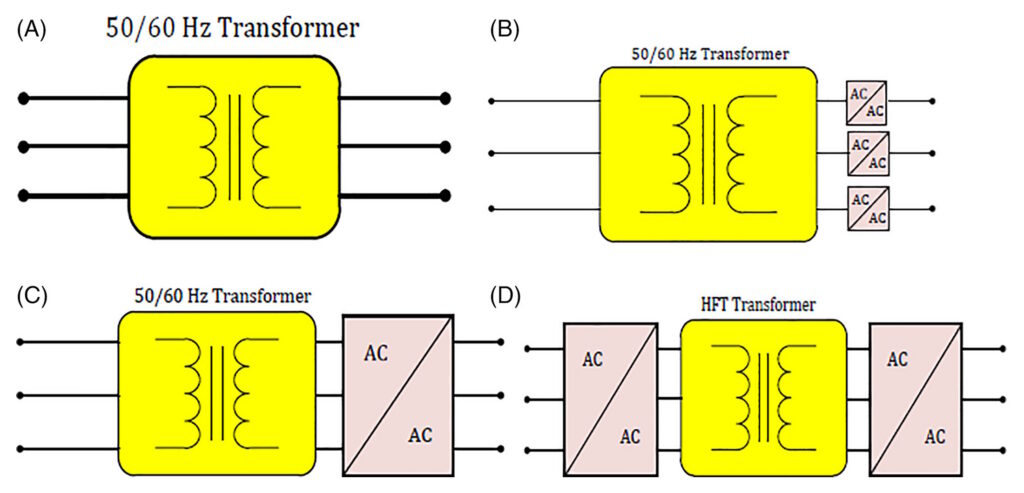
In addition to numerous circuit topologies like cycloconverters, matrix converters, and resonant converters, AC/AC converters are available in several configurations. Common examples are illustrated in Figure 1.
- Simple low-frequency transformers
- Transformers with series voltage regulators
- AC series chopper transformers
- Advanced AC/AC converter or SST
Sometimes, as in the case of matrix converters that are bidirectional and utilize high-frequency switching (using WBGs), the distinction can seem more nuanced. While a matrix converter is a specific type of switching topology, an SST is an entire system architecture that occasionally uses a matrix converter as one of its internal stages.
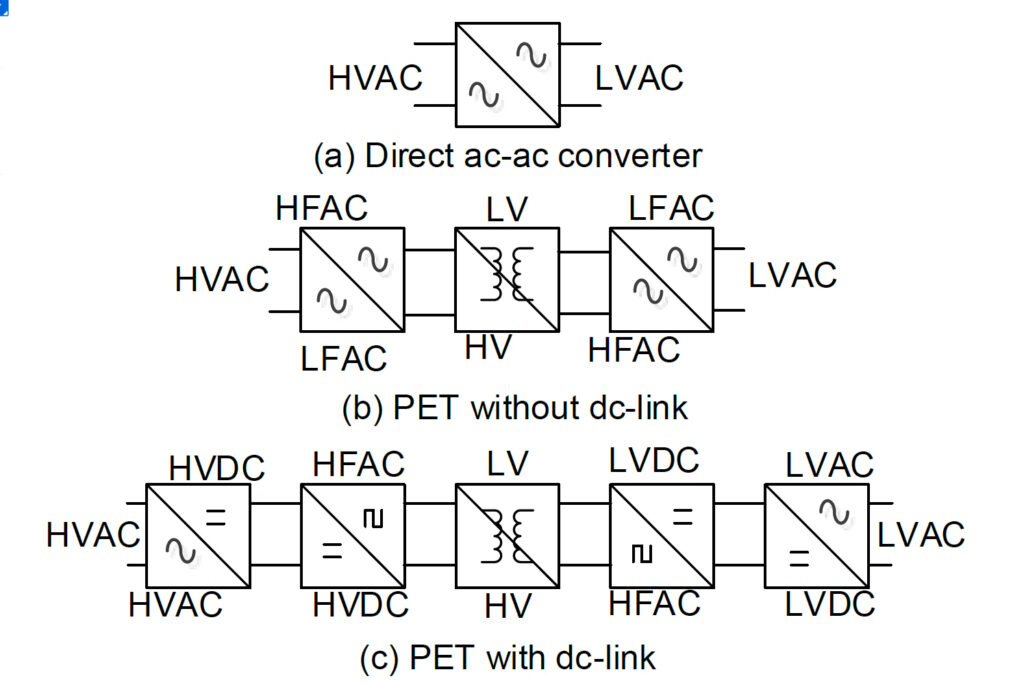
Some practitioners refer to SSTs as power electronic transformers (PETs). Figure 2 compares a basic AC/AC converter (Figure 2a) with two common PET configurations. A PET without a DC-link is shown in Figure 2b. The first stage converts the low-frequency AC (LFAC) input into high-frequency AC (HFAC), and the third stage converts the HFAC back to LFAC. In between is a compact, high-frequency transformer. That supports magnetic isolation and size reduction. However, features like power factor control can be challenging to implement.
Figure 2c is a more common and capable PET approach. The first stage in this architecture converts the high-voltage AC (HVAC) input into high-voltage DC (HVDC). The HVDC is then converted to HFAC, sent through an HV to LV magnetic transformer, and then reconverted from HVDC to LVAC through subsequent stages.
SST advantages
Advanced AC/AC converters and SSTs both use high-frequency switching. That results in smaller passive components, reduced footprints, and lighter weight. So, there’s no advantage to SSTs. It’s the genius part of an SST that drives the advantages.
SSTs can support more complex reactive power management. The inherent galvanic isolation and multi-stage power conversion of SSTs, combined with high-performance MCUs, enables them to independently control reactive and active power flow, while shielding the grid from disturbances.
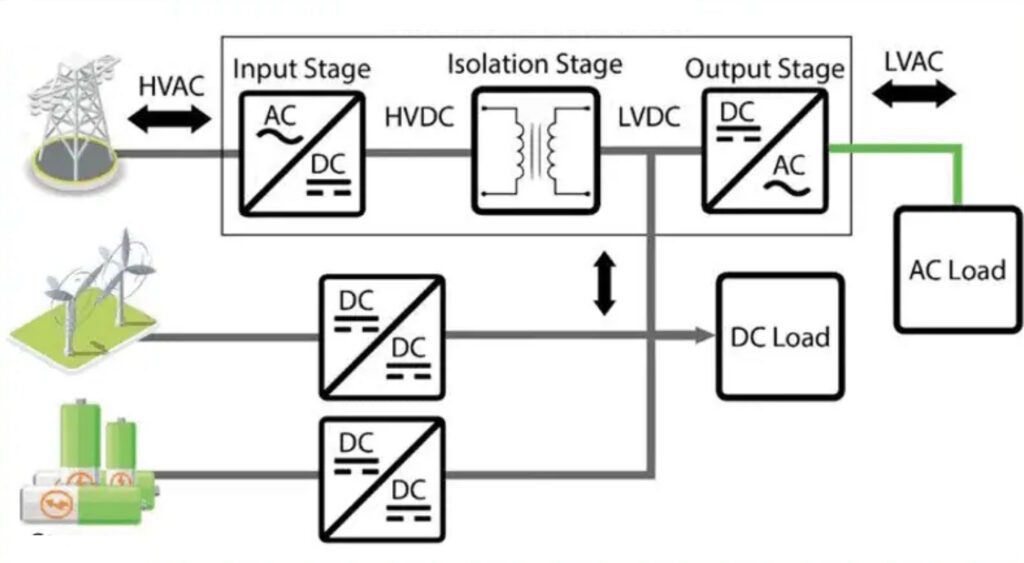
That’s good, but there’s more. The architecture of an SST enables it to easily incorporate distributed energy resources (DER) like photovoltaics and batteries, taking the benefits of SST use to the next level. That’s not really possible with an AC/AC converter, not even with an advanced design.
Not ready for prime time
The ability of SSTs to efficiently and reliably integrate distributed energy resources (DER) into the utility grid will enable increased sustainability and energy efficiency. Unfortunately, SSTs are not ready for widespread use, especially in utility settings. SSTs are more complex and, therefore, more expensive than even the most complex AC/AC converters (Figure 3).
It’s not just about the cost. SSTs are currently hamstrung by technological barriers related to reliability and thermal management. Utility procurement often compares SST cost and reliability with that of simple AC transformers. It’s no contest. SSTs can’t compete on those terms.
That’s a large part of the reason that initial adoption of SSTs is in emerging applications like AI data centers and green energy systems that operate outside the traditional utility industry.
Summary
AC/AC converters and SSTs are not the same. They are related and are part of the continuum of increasingly capable and complex converters for controlling AC power and delivering a range of performance capabilities. They can be optimized for simple applications like motor drives and lighting or for complex dynamic environments found in green energy microgrids and infrastructure applications like EV charging and smart grids.
References
A state-of-the-art review on topologies and control techniques of solid-state transformers for electric vehicle extreme fast charging, IET Power Electronics
Advanced Topics in AC/AC Converters, Monolithic Power Systems
Analysis of Matrix Converter as Solid State Transformer (SST) in Battery Charging Using Fuzzy Logic Control, Electrician Journal
Isolated AC/AC Converter With LLC Resonant Converter High-Frequency Link and Four-Quadrant Switches in the Output Stage, IEEE
Solid-State AC-AC Transformers, AstrodyneTDI
Solid State Transformers, Idaho National Laboratory
Solid State Transformers, the Truth Behind the Hype, The Fusion Report
Solid State Transformers: A Review—Part I: Stages of Conversion and Topologies, MDPI technologies
Solid-state transformers: An overview of the concept, topology, and its applications in the smart grid, International Transactions on Electrical Energy Systems
Solid State Transformers: Concepts, Classification, and Control, MDPI energies
Solid state transformer in energy conversion and distribution: a structured design framework, four-dimensional taxonomy, control strategies, and deployment roadmap, Energy Conversion and Management
Related EEWorld Online content
How do liquid metal batteries fit in EV and BESS designs?
Detroit microgrid tests SST and real-time energy management under live grid conditions
Nano grids, microgrids, and zero net energy consumption
How advanced control strategies and system architectures contribute to sustainability
DC voltages, AC voltages and Stiff voltages