
Silicon Labs used its Works With Summit in Austin to announce three developer initiatives: a public beta of its Simplicity AI SDK, an open-source developer community, and a connection between its edge ML tools and the Databricks platform.
AI SDK in public beta
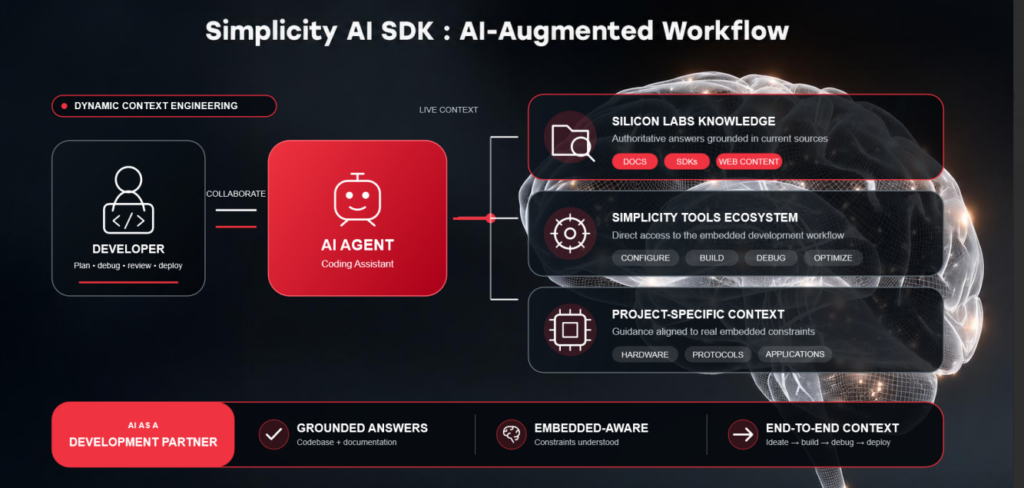
The Simplicity AI SDK gives general-purpose AI coding assistants structured access to Silicon Labs SDKs, tools, documentation, and connected hardware. The beta supports GitHub Copilot and Codex. Official support covers Bluetooth LE only for now. Supported workflows include project creation and configuration, building, flashing, debugging, network and power analysis, documentation search, and hardware interaction.
The problem it targets is context. A general-purpose assistant doesn’t know a vendor’s SDK structure or device constraints. The SDK supplies that grounding.
Hardware Intent
The company also introduced Simplicity Design Intelligence, a set of capabilities meant to check an implementation against the original design intent. The first, Hardware Intent, takes product requirements and a board schematic, guides pin, peripheral, and software configuration, then compares the result to the requirements. The goal is to flag pin conflicts, peripheral mismatches, and missing constraints before fabrication. RISCO Group is an alpha customer. The alpha release is planned for January 2027, so for now this is a roadmap item.
Open-source community
The open-source community beta also starts with Bluetooth LE. Sample applications and tooling are on GitHub, where developers can file issues, propose fixes, and submit pull requests. Accepted contributions pass through Silicon Labs’ standard engineering and test process before landing in a future SDK release. Proposed fixes remain visible to other developers before acceptance. The applications team will handle issues raised on GitHub. Other wireless technologies will follow, with no dates given.
Databricks integration
An initial MLOps SDK connects devices to Databricks to capture fleet data. Training then runs in Databricks using its existing pipelines and GPU resources. The Silicon Labs ML Profiler estimates whether a trained model fits the target device’s memory and CPU budget. The company calls that feedback “directionally accurate,” so expect to verify on hardware. The MLOps tools are available in Databricks now.