
Power-distribution architectures are evolving to meet the energy needs of artificial-intelligence workloads.
Data-center power consumption regularly makes headlines, with consumers fearing that data-center operators are driving up electricity prices. The IEA expects that power demands will continue to rise as data centers increasingly run demanding artificial-intelligence (AI) workloads. The agency estimates that data-center energy consumption reached 415 TWh in 2024, representing 1.5% of global energy consumption, and will increase to 945 TWh annually by 2030.[1]
Q: What accounts for this increase in power—more data centers or more power-consumption per data center?
A: Both. Each data center that comes online is likely to require more power than an older facility. Estimates suggest that a single server rack within a data center will consume 1.5 MW in power by 2028, up from an estimated 400 kW in 2026.[2]
Q: What steps can be taken to limit data-center power consumption?
A: One key factor is maximizing power efficiency. That is, ensuring that the power consumed goes to the compute engines and is not wasted in the power-conversion components and power-distribution conductors.
Q: How can we maximize efficiency?
A: To answer that question, it helps to understand how data-center power-distribution architectures have evolved over the years. Figure 1 at the top shows a traditional power-distribution architecture.
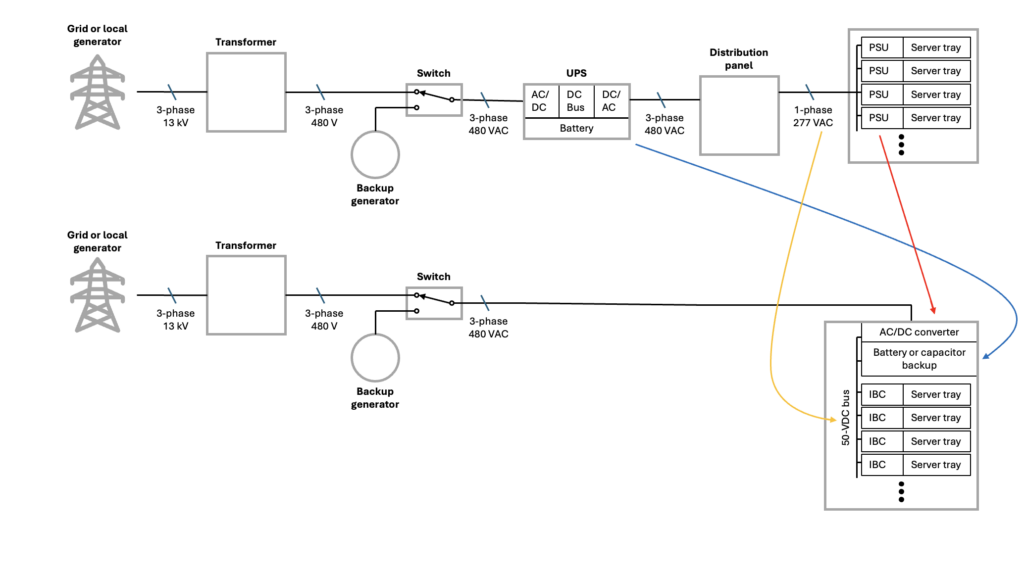
In this example, the utility grid or an on-premises generator provides three-phase 13 kVAC, which a stepdown transformer converts to 480 VAC. In the event of a grid failure, an uninterruptible power supply (UPS) can provide 480-VAC power until a backup generator can be brought online. Finally, a distribution panel routes single-phase 277-VAC (the line-to-neutral value of three-phase 480 VAC) to a power-supply unit (PSU) in each server tray, which derives 12 VDC for powering various point-of-load (POL) regulators throughout the tray’s electronics.
Q: What’s the drawback to this approach?
A: You can choose from a variety of UPS configurations.[3] The one shown in Figure 1 is an online double-conversion topology. This approach provides the highest quality sine-wave output and zero transfer time, but the continuous AC/DC conversion followed by DC/AC inversion exacts an efficiency penalty.
Q: What’s the solution?
A: One approach is to move the backup storage downstream, thereby minimizing the conversion and inversion losses. In Figure 1 at the bottom, a single AC/DC converter per rack replaces the PSU per tray (red arrow) and establishes a 50-VDC bus (orange arrow) with battery or capacitor backup (blue arrow). The bus powers an intermediate bus converter (IBC)[4] in each tray, which develops a 12-VDC level for the POL regulators within the tray electronics.
Q: You mentioned that rack power will reach 1.5 MW soon. That would be a lot of current at 50 VDC.
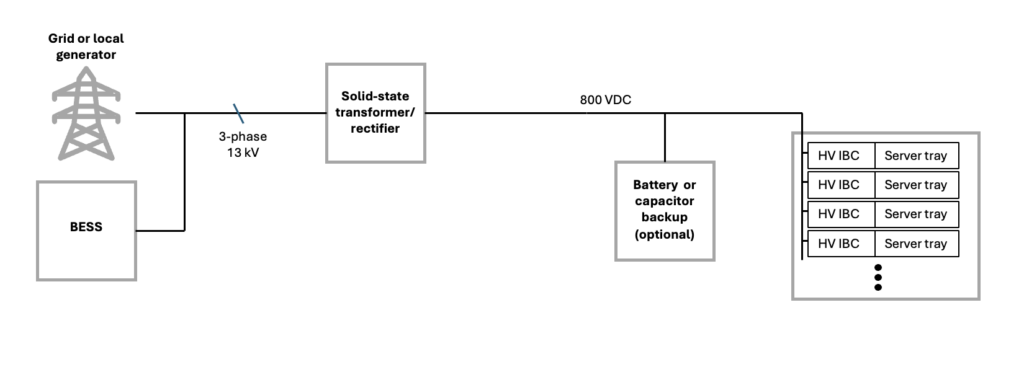
A: Right, 30,000 A, a totally impractical amount to handle in a standard server rack. Consequently, the industry is exploring 800-VDC architectures (Figure 2). Such a system would have a grid-side AC-output battery energy storage system (BESS) for grid backup. A solid-state transformer/rectifier would develop an 800-VDC bus, which would power high-voltage IBCs (HV IBCs) in each server tray, with DC bus battery or capacitor backup optional.
Q: What’s the status of this architecture?
A: Nvidia is promulgating this architecture in partnership with semiconductor and equipment manufacturers in the data-center electrical ecosystem. NVIDIA suggests such systems could be deployed in 2027 and that the architecture could support compute racks rated up to 8 MW.[5]
Q: What are the test and measurement implications for these systems?
A: Impedance is the key parameter to measure. We’ll look at the equipment we can use to make the relevant measurements in part 2 of this series.
References
[1] Energy and AI, IEA
[2] Data centers evolve to meet AI’s massive power needs, Texas Instruments
[3] Comparison of UPS Topologies: Offline vs Line-interactive vs Online, FS
[4] Enabling Future Innovations: Intermediate Bus Converter—Part 1: Benefits, Analog Devices
[5] 800 VDC Architecture for Next-Generation AI Infrastructure, Nvidia
Related EEWorld Online content
How is physical artificial intelligence used to optimize data center efficiency?
APEC 2024: Power to the data center
New developments in 212+G per-lane data-center connectors and cables
Data Center Solutions – The Heat is On
What is the mathematics behind artificial intelligence?
Artificial intelligence and machine learning for power electronics