
A new automotive RF connectivity architecture promises many benefits, but at what maintenance cost to the user?
Every decade or so, the automotive industry introduces a new internal architecture and promotes its many likely benefits. These changes are often a good thing, as they add useful functions and features, increase efficiency, and enhance capabilities
For example, in the past few years have been hearing that “zonal architecture” is the next big shift. What is zonal architecture? In short, it divides the car’s power distribution network (PDN) along geographic zones, each with a regional power controller, and all supplied by a central power controller and the car batteries. Each of these regional controllers provides power to the local regulators of individual modules in the car – cars now typically have over a hundred of these, permeating and managing every nook and cranny.
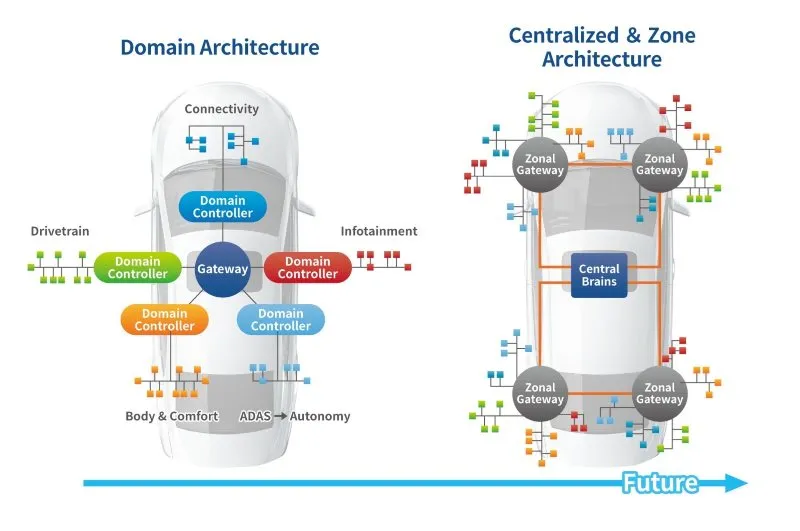
On the face of it, zonal makes a lot of sense with respect to weight, cabling complexity, power-systems management, and many other critical factors. It is a radical departure from its predecessor, usually called a domain or centralized architecture seen in Figure 1. In that classic arrangement, which has been used for decades, power distribution is not determined by the physical or spatial location of loads in the car, but rather the function of the module(s) being supported. For example, the four power windows might have a single power unit for all four windows (and maybe the trunk release) with DC rail cabling running to all these locations.
Predecessors to zonal architecture have merits, too
Domain architecture was the second stage in power evolution. It was the successor to tried-and-true distributed power, which is conceptually the simplest and made a lot of sense in cars when there were relatively few electrical loads.
Distributed power is clear: each load, such as the radio, lights, starter motor, or dashboard, has a direct connection to the battery (regulators were largely non-existent) with a simple on/off switch for that loop (there might be an intermediate relay for higher-current loads). Each loop and load was physically and electrically separate and independent of all the others.
One virtue of first-generation distributed power is that it simplifies diagnosing electrical problems, as each load is on its own independent loop. Yet while I see the potential benefits of zonal architecture in design and production of vehicles, there’s an aspect that I haven’t seen discussed: how does it affect inevitable troubleshooting once the car is on the road.?Will it make it easier or more difficult? Will it add to cost and time in the repair shop (see Vampire power, by design or fault, is killing my batteries)?
I am skeptical when I see any advance touted as having significant benefits but with very little mention of downsides. I’m not saying that doesn’t happen, but in the real world there are almost always tradeoffs and compromises. The designers must weigh these, then decide if the gain is worth any negatives that come with them (see the “platform and modular” Related Content).
What about centralized automotive computing?
The next major automotive topology change about which I am reading is formally called the integrated Connectivity Hub Module (CHM) as the realization of Centralized Automotive Computing. General Motors is its leading advocate and is expected to unveil it in a high-end Cadillac by 2028, so it is not just futuristic speculation.
In this unified connectivity node, the CHM places all major RF links of the vehicle – among them cellular networks, Wi-Fi, Bluetooth, Bluetooth Low Energy (BLE), Ultra-Wideband (UWB), and Global Navigation Satellite System (GNSS) connectivity – at an optimal location for RF functions, as seen in Figure 2 (the only figure I could find, and not very informative!). Doing so presents a clean, high-bandwidth digital interface into the electrical architecture’s core compute and broader vehicle network.
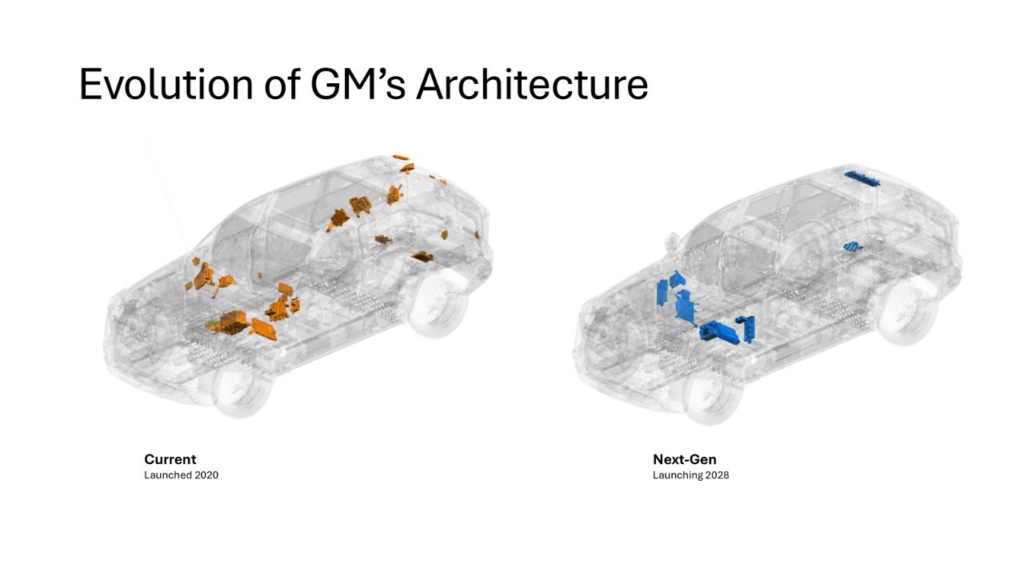
While the existing modular approach places antennas in individually best locations, it brings difficult physical and logistical bottlenecks. High-frequency signals, especially the gigahertz bands used in 5G Cellular and Wi-Fi, experience significant insertion loss as they travel through long cables and impedance mismatches at connectors.
This results in degraded performance and a significant effort to manage at the system level. Additionally, the thick bundles of coaxial cables consume valuable packaging volume, add mass, complicate electromagnetic compatibility (EMC), and require expensive connectors that complicate assembly operations.
What does CHM offer?
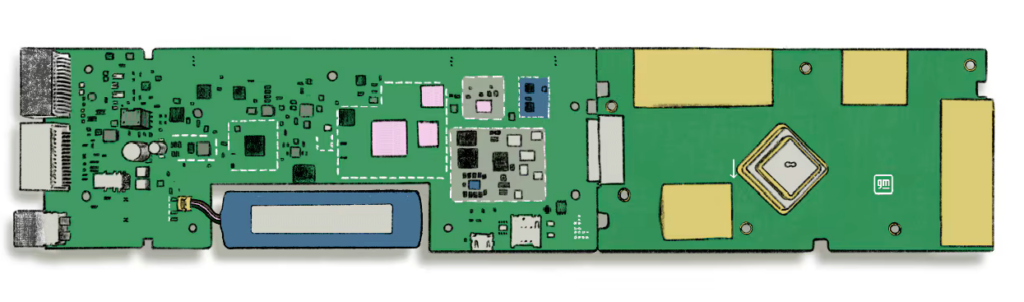
The integrated CHM collapses this distributed architecture into a single, highly optimized edge node, shown in Figure 3. By combining the network processors, memory, RF transceivers, antenna arrays, and a dedicated backup battery for GM’s OnStar functionality into a unified module, the CHM acts as a complete, self-contained connectivity hub.
The CHM must be sealed against water and dust ingress, so engineers cannot rely on active fan cooling – nor would they want to in this setting. Instead, its thermal management uses the module’s cast aluminum housing as a structural heat sink and advanced thermal interface materials (TIMs) to move heat away from critical components. It also relies on intelligent software to dynamically throttle compute or transmission power during peak thermal events, while also preserving safety-critical communications.
On the production side, consolidating the antennas and electronics cuts the bill of materials (BOM). Additionally, installing a single CHM on the assembly line via a standard digital connection is much more efficient than routing long RF cables and mating multiple fragile connectors, thus driving down labor costs and reducing potential manufacturing defects.
This is all getting very complicated, that’s for sure. Presumably, this architectural choice dramatically improves cost, mass, volume, and RF performance parameters. GM acknowledges that it also introduces complex multi-physics engineering challenges, most notably with issues such as receiver desensitization, RF coexistence, and thermal load, but says these can be overcome.
Perhaps ironically, the previous distribution of the many RF front ends and related functions was considered a smart decision, as it eased technical delegation of RF functions. Well, things change, I suppose, as does the rationale for these design decisions.
Possible CHM downside?
My concern with CHM is the same as it is for zonal power. Even if it simplifies overall design — IMO, a big “if” — will it do so by making in-the-field troubleshooting more confusing and costly? Will the resultant configuration yield a system that is so intertwined that almost nothing works until nearly everything works? (I’ve worked on designs like that, and they are misery.) Will it be like thermal management and heat sinking, where the goal often seems to be to deal with the excess heat by making it into someone else’s problem?
Perhaps CHM will catch on, perhaps it won’t; I certainly can’t say. I do wonder if the pendulum of automotive system architecture will then swing back to a non-centralized approach in another decade or two, with presumed benefits of more localization, enhanced flexibility, simplified upgrades, and less undesired interaction among subsystems?
Time will tell, as the cliché goes. Still, the jaded cynic in me says it is like corporations that periodically reorganize to cover their problems (“we’re centralizing to minimize waste, duplication, and overlap”) and then some years later do the opposite (“we’re decentralizing to put employees closer to the customer and in closer touch with the action on the ground”) and then repeat that cycle.
It looks like it will be an interesting ride — literally and figuratively — that’s for sure!
References
Related EEWorld Online content
Vampire power, by design or fault, is killing my batteries
Be wary of “platform” and “modular” architectures: part 1
Be wary of “platform” and “modular” architectures: part 2
Why are EV cooling loops becoming multi-domain systems?
Tech Toolbox: Automotive Electronics
Connector series simplifies automotive cabling