
The sense of touch is vital for humanoids. Tactile feedback allows humanoids to handle delicate objects, navigate occluded or blind locations, and safely collaborate with humans. Vision and other senses can’t measure physical properties like slip, texture, surface deformation, or exact grip force. That takes a delicate touch, and it can be complicated.
Unlike other humanoid senses that use standard sensors like inertial measurement units (IMUs) and cameras, specialized hardware and software are needed to convert physical forces like pressure, slip, and vibration into useful signals.
Touch can be implemented using arrays of touch-sensitive pixels, known as taxels (tactile pixels), arranged closely together that convert physical pressure or small movements into electrical signals.
In some designs, each taxel independently measures localized physical changes like static pressure (normal force) and sliding friction (shear force) across multiple axes. Touch requires a dense array of sensors to enable the humanoid to identify detailed textures, shapes, and complex distributions of force like those associated with a slipping grip (Figure 1).
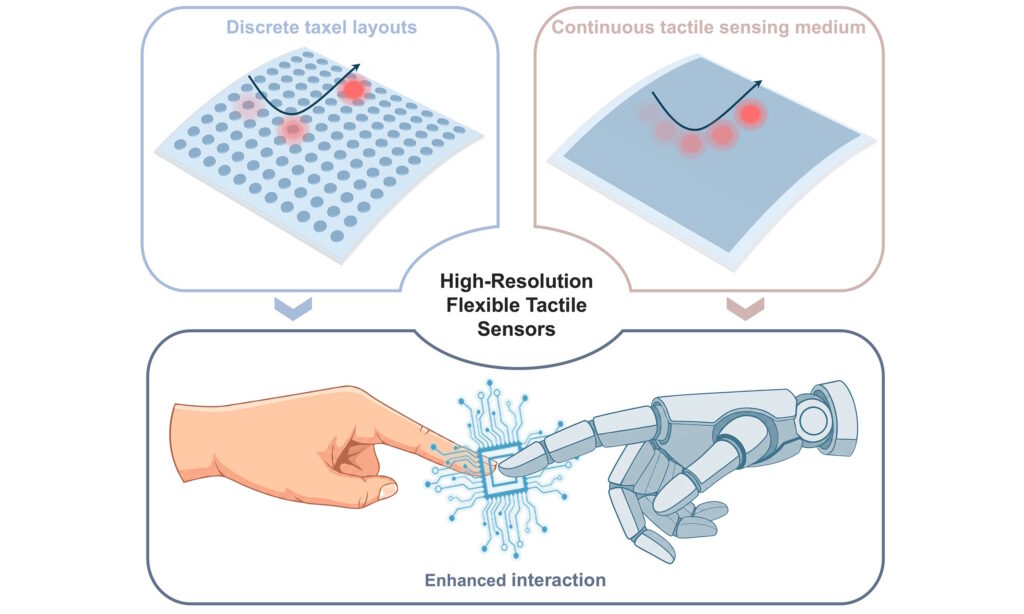
Sensor functions and modalities
Touch sensing can be subdivided by function and by sensor technology. Basic functions include tactile sensors and force sensors. Humanoid systems typically include both types. Tactile sensors measure pressure across a surface and can be used to identify features like the degree of smoothness, identify contact with objects, and slip detection.
Force-torque sensors are typically 6-axis devices that measure the total force applied and identify unexpected resistance, enabling the robot to adjust its actions in real time. There are several sensor modalities used in humanoids.
- 6-axis force/torque sensors use piezoelectric elements to measure three-axis of orthogonal forces and three axes of rotational torque for controlling wrist and hand movements. They can also be used in fingertips for vector-based load balancing and to infer joint-level forces.
- Capacitive and piezoresistive taxel skins can be fabricated using flexible membranes and embedded across palms and fingers for mapping localized profiles of contact and pressure.
- Optical taxel pads use embedded imaging systems to track surface movements.
- Multimodal arrays that combine pressure tracking with acoustic vibration sensing are under development for measuring the texture of a gripped surface.
Not that simple
Converting measurements into meaningful data is challenging. For example, sensor calibration in these applications can drift because of mechanical wear and require adaptive software that automatically recalibrates the system to maintain accuracy.
Power management of complex sensor arrays can be daunting. Load switches are used to dynamically power-gate taxel subarrays, reducing idle power and moderating inrush currents during simultaneous activation of many individual taxels. Fault monitoring is needed to protect delicate taxels from localized short circuits caused by physical wear.
The behavior of the electromechanical elements used for gripping and movement is not perfect and can vary over time and based on operating conditions. That requires constant real-time feedback to ensure proper performance.
Motor skills
Feedback from tactile and force sensors is key input for adaptive motion control in humanoids. Simple industrial robots are often based on deterministic control commands like “move to position X at rate Y.” That’s not good enough for humanoid interactions.
Humanoids require continuously adaptive control based on position, velocity, and force feedback to account for changes in mechanical resistance and adjust motion force, speed, and grip strength to operate effectively in unstructured environments and work safely alongside humans.
The physical AI (PAI) used by humanoids relies on complex and fluid commands like, “Move toward location X, but slow down if vibration exceeds a threshold value and stop if force exceeds the defined safe level.”
Humanoids must be able to do things that humans do instinctively, like instantly adjusting grip when picking up a slippery object. Adjustments must be made in milliseconds to compensate for dynamic conditions.
It begins with the motion planner that provides the desired trajectory. The sensor array monitors how successfully the plan is being implemented. The adaptive controller calculates deviations from anticipated results, modifying motion commands millisecond-by-millisecond to adapt to changing outcomes. It takes a highly complex hardware and software PAI system to mimic instinctive human behavior (Figure 2).
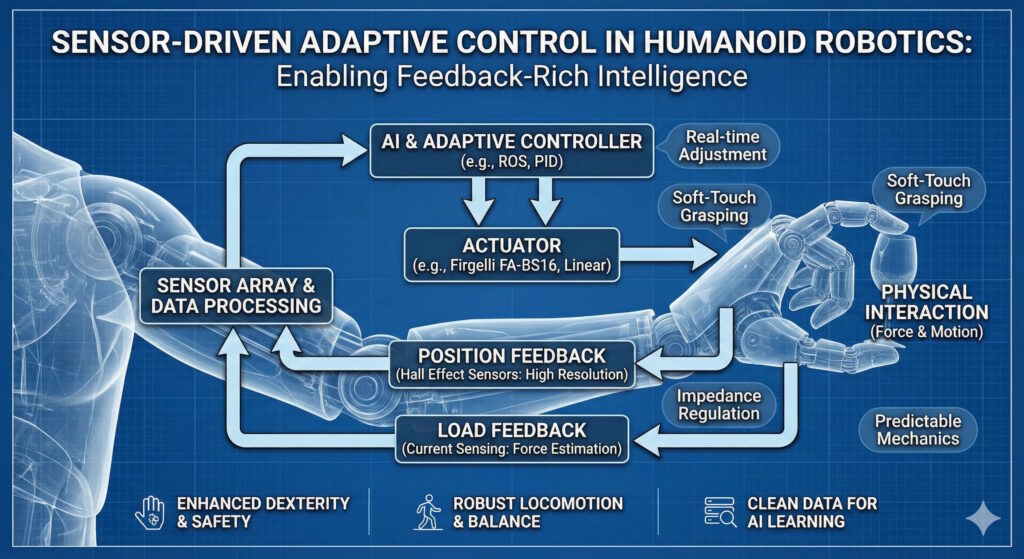
Summary
Touch is vital for humanoids and can be the “missing link” to safe, high-performance interactions with humans. It’s more nuanced and complex than other humanoid ‘senses’ and requires sophisticated sensors, software, and supervision, including real-time feedback and control. The mathematics of touch in humanoid robots combines mechanics, continuous-time dynamics, signal processing, and machine learning to translate physical contact into computable data. That will be the focus of a future article.
References
3D-ViTac: Learning Fine-Grained Manipulation with Visuo-Tactile Sensing, arXiv
Bringing Human Touch to Robots: The Future of Tactile Sensing, Analog Devices
Bringing Tactile Feedback to Robotic Hands, NMB Technologies
Film-type tactile sensor, Nissha
High-resolution flexible tactile sensors, OAE Publishing
Humanoid Robots Are Getting in Touch, Techstrong
Robotic Tactile Sensing with Capacitive Sensors, PPS
Sensor-Driven Adaptive Control in Humanoid Robotics, Firgelli Automations
Super Intelligence, NIST
Tactile Robotics: Why a Sense of Touch Is the Missing Piece in Humanoid Robots, The Institution of Engineering and Technology
Tactile Sensing: Definition, Examples & Sensors, Tacterion
The science of human touch – and why it’s so hard to replicate in robots, The Conversation
Why Humanoid Robots Need a Sense of Touch: A Simple Guide to Force Sensing in Robotics, Galoce
Related EEWorld Online content
What is multimodal sensing in physical AI?
Computational and control architectures for humanoid robots
What kinds of PAI dev kits are available for humanoid robotics?
What are the mathematics that enable sensor fusion?
How do humanoid robots and physical artificial intelligence fit into industry 5.0?