
Efficiency, impedance, and power quality are key parameters to measure in data-center power-distribution networks.
In part 1 of this series, we looked at the evolution of data-center power architectures in the age of artificial intelligence (AI). Here, we’ll look at some key power parameters and the test instruments needed to measure them.
Q: What are some of the key parameters?
A: The overriding concern is efficiency. The operator of a grid-connected data center will ask, “Of the energy that I buy from the utility, what percentage can I deliver to the processors, communications chips, and other components that perform AI training and inference?” In percent, efficiency is simply 100 times output power divided by input power.
Q: How do we measure efficiency?
A: The typical approach to measuring and optimizing efficiency is to take individual components of your power system and test the efficiency of each, making improvements as necessary. Figure 1a, for example, shows a portion of the traditional data-center power system we examined in part 1. As part of our efficiency study, we can take an individual power-supply unit (PSU) as our device under test (DUT) and measure its efficiency. To do that, we use a programmable AC source[1] to represent the PSU’s input and connect a programmable DC load to its output (Figure 1b). This approach enables us to calculate the PSU’s efficiency under various load conditions. It also allows us to determine how the PSU responds to AC input disturbances.
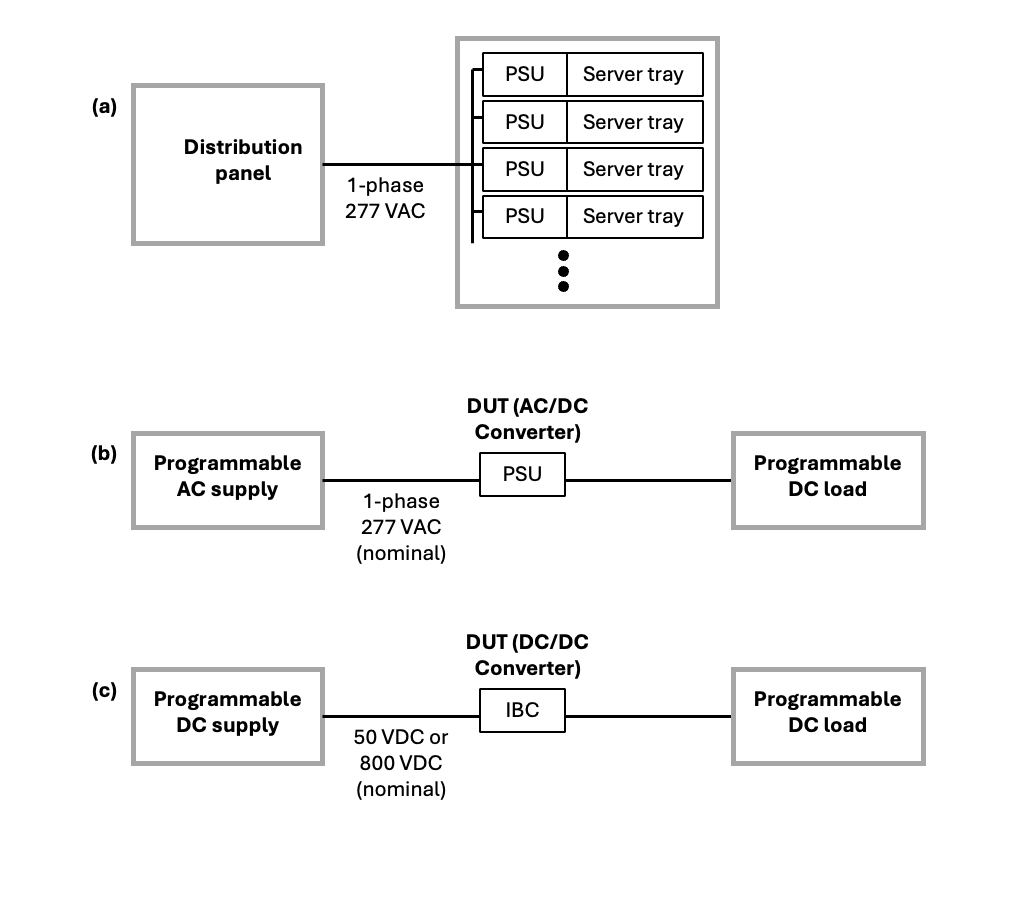
Q: What’s going on in Figure 1c?
A: In part 1, we noted that advanced data centers are moving to DC buses running at 50 V or as high as 800 V. In these cases, the rectification has moved upstream, and the PSU in Figure 1a is replaced by an intermediate bus converter (IBC). In Figure 1c, we are using a programmable DC supply as the input to an IBC, and we continue to use our programmable DC load as the IBC output. Once again, we can calculate the IBC’s efficiency over a range of power levels, and we can study its response to DC bus perturbations.
Q: How do we boost efficiency?
A: To boost overall efficiency, keep the impedances of all your conductors low. For a conductor with resistance R carrying a current I, the losses are I2R, so keep R to a minimum. In addition, keep the power factor high: as close to 1 as possible. A low power factor increases reactive currents, which don’t do any useful work but do contribute to conductor I2R losses. Designers of an AC/DC PSU will include a power-factor correction stage on the input.[2] As far as the efficiency of the PSU itself is concerned, designers can do something as simple as using power switches with lower on-resistances (RDS_ON) or experimenting with a different switching frequency, or they can try a completely different circuit topology.[3] And to help you get a handle on PSU efficiency, you can look for an 80 PLUS ratings, which extend from standard and Bronze at the low end to Titanium and Ruby at the high end.[4]
Q: What about power quality?
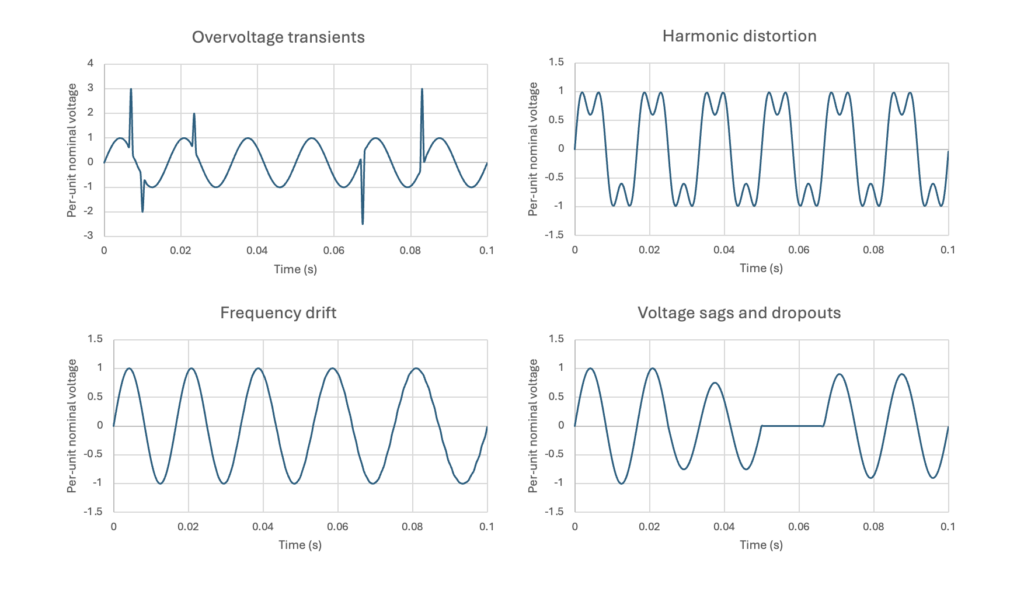
A: Power quality is of serious concern to data-center operators. Figure 2 illustrates some power-quality issues that can occur. Maintaining good power quality generally requires continuous monitoring of multiple channels of power distribution system voltages and currents, with real-time decision making to head off outages.[5] Power quality is more difficult to quantify than efficiency or resistance, but a goal is often “five nines availability”—that is, 99.999% uptime, limiting downtime to five and a quarter minutes per year.[6]
Q: Is power integrity the same as power quality?
A: Generally, power quality refers to the AC input, while power integrity refers to the low-voltage DC rails at the circuit board and chip level. So far, we have looked at power distribution from the AC grid to the AC/DC converter or the high-voltage DC input to the IBC. Next time, we’ll conclude this series with a look at the downstream point-of-load voltage levels that deliver on the order of 1-VDC to the processors and other electronic components.
References
[1] Advanced AC Source Solution for Data Centers and IT Servers, Keysight
[2] Power Factor Correction (PFC) Handbook, onsemi
[3] Comparison of AC/DC Power Conversion Topologies for Three Phase Industrial Systems, Texas Instruments
[4] 80 PLUS Power Supply Certification Program, CLEAResult
[5] Data Center Power Monitoring, Emerson/NI
[6] Power quality for data centers, Siemens
Related EEWorld Online content
Selecting and applying programmable power supplies
How AC Power Sources Get Synchronized
How to use remote sensing for DC programmable power supplies
The many measurements of power quality
What are some design considerations for titanium ac/dc power supplies?
What are the hardware strategies for building energy-efficient AI accelerators?